
Pulp Fiction, 1921 · page 168 of 204
Adventure Magazine Cover, June 18, 1921 — page 168: what you’re looking at
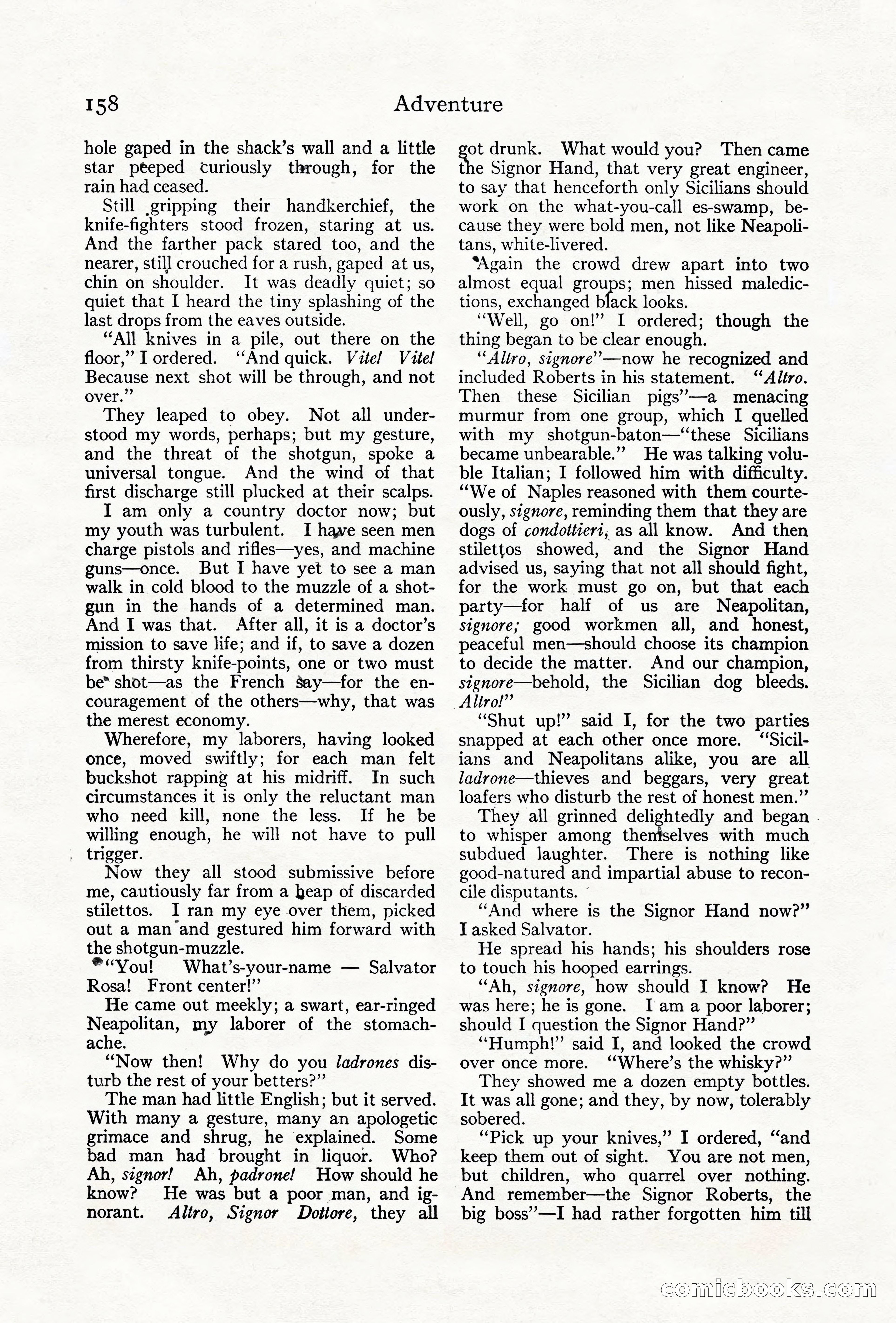
A restored page from Pulp Fiction, 1921. Page through the whole issue in the reader above.
📄 Transcribed text from this page (OCR, searchable)
Machine-transcribed from the original scan — historical spelling and the odd misread are preserved.
158 hole gaped in the shack’s wall and a little star peteped curiously through, for the rain had ceased. Still gripping their handkerchief, the knife-fighters stood frozen, staring at us. And the farther pack stared too, and the nearer, still crouched for a rush, gaped at us, chin on shoulder. It was deadly quiet; so quiet that I heard the tiny splashing of the last drops from the eaves outside. ‘All knives in a pile, out there on the floor,” I ordered. ‘‘And quick. Vitel Vitel Because next shot will be through, and not over.” They leaped to obey. Not all under- stood my words, perhaps; but my gesture, and the threat of the shotgun, spoke a universal tongue. And the wind of that first discharge still plucked at their scalps. I am only a country doctor now; but my youth was turbulent. I have seen men charge pistols and rifles—yes, and machine guns—once. But I have yet to see a man walk in cold blood to the muzzle of a shot- gun in the hands of a determined man. And I was that. After all, it is a doctor’s mission to save life; and if, to save a dozen from thirsty knife-points, one or two must be shot—as the French say—for the en- couragement of the others—why, that was the merest economy. Wherefore, my laborers, having looked once, moved swiftly; for each man felt buckshot rapping at his midriff. In such circumstances it is only the reluctant man who need kill, none the less. If he be willing enough, he will not have to pull . trigger. Now they all stood submissive before me, cautiously far from a heap of discarded stilettos. I ran my eye over them, picked out a man and gestured him forward with the shotgun-muzzle. ®“VYou! | What’s-your-name — Salvator Rosa! Front center!” He came out meekly; a swart, ear-ringed Neapolitan, my laborer of the stomach- ache. ‘Now then! Why do you ladrones dis- turb the rest of your betters?” The man had little English; but it served. With many a gesture, many an apologetic grimace and shrug, he explained. Some bad man had brought in liquor. Who? Ah, signor! Ah, padrone! How should he know? He was but a poor man, and ig- norant. Altro, Signor Dotiore, they all Adventure got drunk. What would you? Then came the Signor Hand, that very great engineer, to say that henceforth only Sicilians should work on the what-you-call es-swamp, be- cause they were bold men, not like Neapoli- tans, white-livered. “Again the crowd drew apart into two almost equal groups; men hissed maledic- tions, exchanged black looks. ‘Well, go on!’ I ordered; though the thing began to be clear enough. ‘‘Aliro, signore’’—now he recognized and included Roberts in his statement. ‘‘Altro. Then these Sicilian pigs’”—a menacing murmur from one group, which I quelled with my shotgun-baton—‘these Sicilians became unbearable.” He was talking volu- ble Italian; I followed him with difficulty. “‘We of Naples reasoned with them courte- ously, signore, reminding them that they are dogs of condottiert1; as all know. And then stilettos showed, and the Signor Hand advised us, saying that not all should fight, for the work must go on, but that each party—for half of us are Neapolitan, signore; good workmen all, and honest, peaceful men—should choose its champion to decide the matter. And our champion, signore—behold, the Sicilian dog bleeds. _Altro!”’ “Shut up!” said I, for the two parties snapped at each other once more. ‘‘Sicil- ians and Neapolitans alike, you are all ladrone—thieves and beggars, very great loafers who disturb the rest of honest men.” They all grinned cehehtedly and began - to whisper among thentselves with much subdued laughter. There is nothing like good-natured and impartial abuse to recon- cile disputants. © ‘And where is the Signor Hand now?” I asked Salvator. He spread his hands; his shoulders rose to touch his hooped earrings. “Ah, szgnore, how should I know? He was here; he is gone. I am a poor laborer; should I question the Signor Hand?” “‘Humph!”’ said I, and looked the crowd over once more. ‘‘Where’s the whisky?” They showed me a dozen empty bottles. It was all gone; and they, by now, tolerably sobered. “Pick up your knives,” I ordered, ‘and keep them out of sight. You are not men, but children, who quarrel over nothing. And remember—the Signor Roberts, the big boss”—I had rather forgotten him till COmicloo CN Vp) CO