
Pulp Fiction, 1921 · page 167 of 204
Adventure Magazine Cover, June 18, 1921 — page 167: what you’re looking at
A restored page from Pulp Fiction, 1921. Page through the whole issue in the reader above.
📄 Transcribed text from this page (OCR, searchable)
Machine-transcribed from the original scan — historical spelling and the odd misread are preserved.
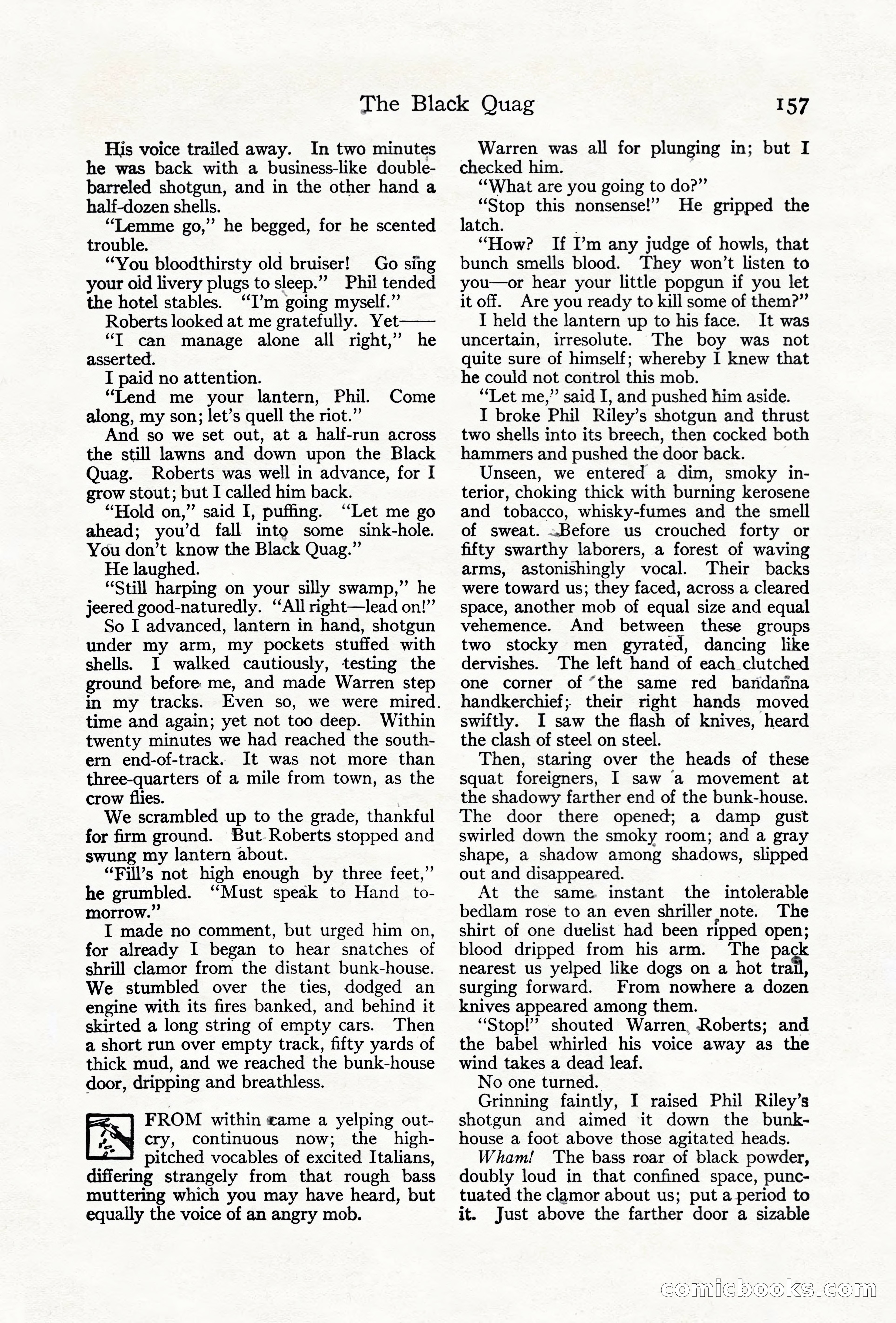
The Black Quag His voice trailed away. In two minutes he was back with a business-like double- barreled shotgun, and in the other hand a half-dozen shells. “Lemme go,” he begged, for he scented trouble. “You bloodthirsty old bruiser! Go sing your old livery plugs to sleep.” Phil tended the hotel stables. ‘I’m going myself.” Roberts looked at me gratefully. Yet—— “T can manage alone all right,” he asserted. I paid no attention. “Lend me your lantern, Phil. along, my son; let’s quell the riot.” And so we set out, at a half-run across the still lawns and down upon the Black Quag. Roberts was well in advance, for I grow stout; but I called him back. “Hold on,” said 1, pufing. ‘Let me go ahead; you’d fall into some sink-hole. You don’t know the Black Quag.” He laughed. “Still harping on your silly swamp,” he jeered good-naturedly. ‘All right—lead on!” So I advanced, lantern in hand, shotgun under my arm, my pockets stuffed with shells. I walked cautiously, testing the ground before me, and made Warren step in my tracks. time and again; yet not too deep. Within twenty minutes we had reached the south- ern end-of-track. It was not more than three-quarters of a mile from town, as the crow flies. , We scrambled up to the grade, thankful for firm ground. But.Roberts stopped and swung my lantern about. “Fill’s not high enough by three feet,” he grumbled. “Must speak to Hand to- morrow.” I made no comment, but urged him on, for already I began to hear snatches of shrill clamor from the distant bunk-house. We stumbled over the ties, dodged an engine with its fires banked, and behind it skirted a long string of empty cars. Then a short run over empty track, fifty yards of thick mud, and we reached the bunk-house door, dripping and breathless. =s— FROM within came a yelping out- 4 cry, continuous now; the pitched vocables of excited Italians, differing strangely from that rough bass muttering which you may have heard, but equally the voice of an angry mob. Come Even so, we were mired. 157 Warren was all for plunging in; but I checked him. ‘“‘What are you going to do?” “Stop this nonsense!’’ He gripped the latch. “How? If I’m any judge of howls, that bunch smells blood. They won’t listen to you—or hear your little popgun if you let it off. Are you ready to kill some of them?” I held the lantern up to his face. It was uncertain, irresolute. The boy was not quite sure of himself; whereby I knew that he could not control this mob. “Let me,” said I, and pushed him aside. I broke Phil Riley’s shotgun and thrust two shells into its breech, then cocked both hammers and pushed the door back. Unseen, we entered a dim, smoky in- terior, choking thick with burning kerosene and tobacco, whisky-fumes and the smell of sweat. =Before us crouched forty or fifty swarthy laborers, a forest of waving arms, astonishingly vocal. Their backs were toward us; they faced, across a cleared space, another mob of equal size and equal vehemence. And between these groups two stocky men gyrated, dancing like dervishes. The left hand of each clutched one corner of “the same red bandarna handkerchief; their right hands moved swiftly. I saw the flash of knives, heard the clash of steel on steel. Then, staring over the heads of these squat foreigners, I saw a movement at the shadowy farther end of the bunk-house. The door there opened; a damp gust swirled down the smoky room; and a gray shape, a shadow among shadows, slipped out and disappeared. At the same instant the intolerable bedlam rose to an even shriller note. The shirt of one duelist had been ripped open; blood dripped from his arm. The pack nearest us yelped like dogs on a hot trail, surging forward. From nowhere a dozen knives appeared among them. “Stop! shouted Warren. Roberts; and the babel whirled his voice away as the wind takes a dead leaf. No one turned. Grinning faintly, I raised Phil Riley’s shotgun and aimed it down the bunk- house a foot above those agitated heads. Wham! The bass roar of black powder, doubly loud in that confined space, punc- tuated the clamor about us; put a period to it. Just above the farther door a sizable COmicloo \ ) C©