
Pulp Fiction, 1921 · page 155 of 204
Adventure Magazine Cover, June 18, 1921 — page 155: what you’re looking at
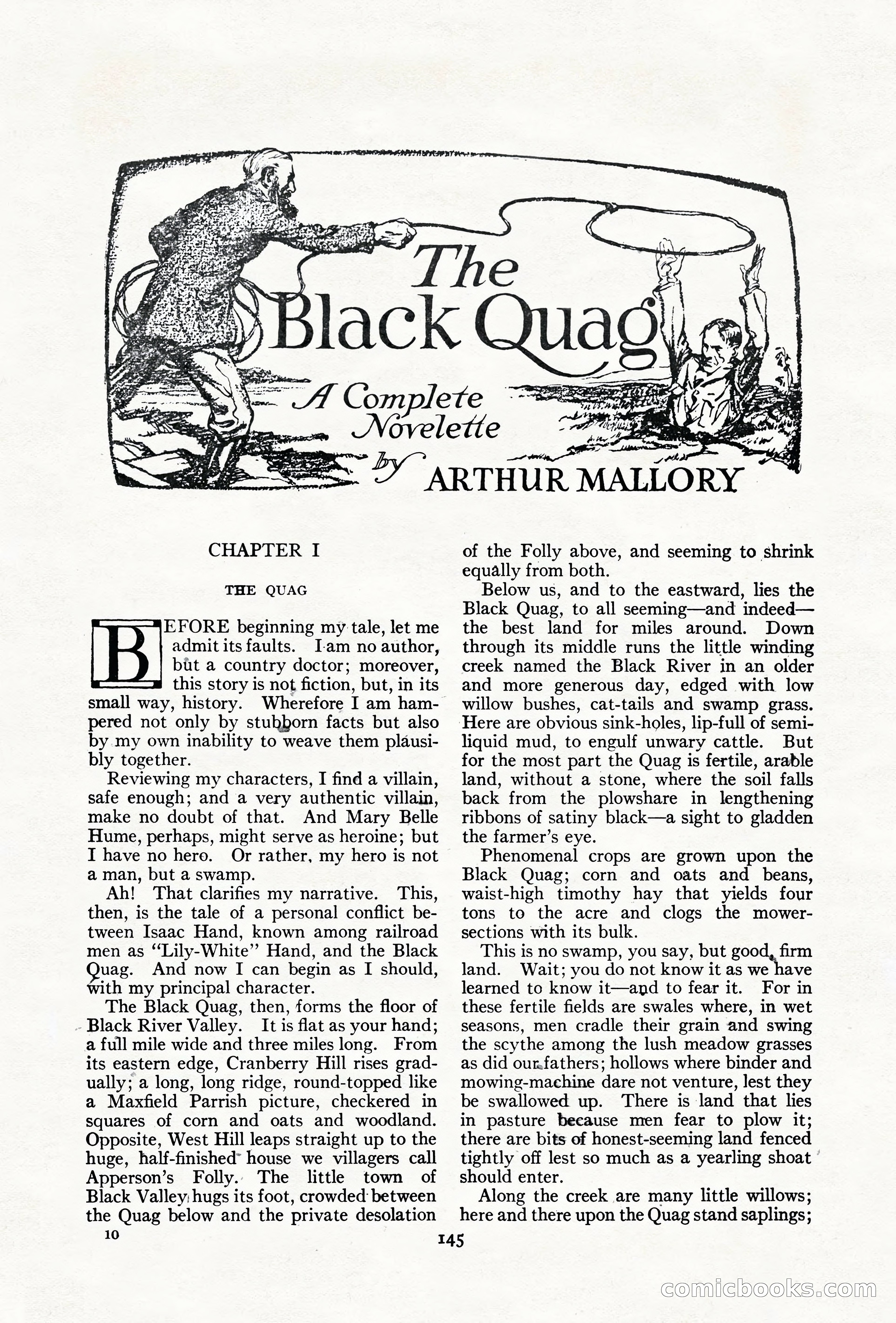
A restored page from Pulp Fiction, 1921. Page through the whole issue in the reader above.
📄 Transcribed text from this page (OCR, searchable)
Machine-transcribed from the original scan — historical spelling and the odd misread are preserved.
CHAPTER I THE QUAG EFORE beginning my tale, let me admit its faults. JI-am no author, but a country doctor; moreover, this story is not fiction, but, in its small way, history. pered not only by stubborn facts but also by my own inability to weave them plausi- bly together. Reviewing my characters, I find a villain, safe enough; and a very authentic villain, make no doubt of that. And Mary Belle Hume, perhaps, might serve as heroine; but I have no hero. Or rather, my hero is not aman, but a swamp. Ah! That clarifies my narrative. This, then, is the tale of a personal conflict be- tween Isaac Hand, known among railroad men as “‘Lily-White”’ Hand, and the Black uag. And now I can begin as I should, with my principal character. The Black Quag, then, forms the floor of - Black River Valley. It is flat as your hand; a full mile wide and three miles long. From its eastern edge, Cranberry Hill rises grad- ually; a long, long ridge, round-topped like a Maxfield Parrish picture, checkered in squares of corn and oats and woodland. Opposite, West Hill leaps straight up to the huge, half-finished” house we villagers call Apperson’s Folly. The little town of Black Valley: hugs its foot, crowded: between the Quag below and the private desolation 10 Wherefore I am ham- a ape Lr4\ ¥- . ryan saat a ee ni et = age of the Folly above, and seeming to shrink equally from both. Below us, and to the eastward, lies the Black Quag, to all seeming—and indeed— the best land for miles around. Down through its middle runs the little winding creek named the Black River in an older and more generous day, edged with low willow bushes, cat-tails and swamp grass. ‘Here are obvious sink-holes, lip-full of semi- liquid mud, to engulf unwary cattle. But for the most part the Quag is fertile, arable land, without a stone, where the soil falls back from the plowshare in lengthening ribbons of satiny black—a sight to gladden the farmer’s eye. Phenomenal crops are grown upon the Black Quag; corn and oats and beans, waist-high timothy hay that yields four tons to the acre and clogs the mower- sections with its bulk. This is no swamp, you say, but good, firm land. Wait; you do not know it as we have learned to know it—and to fear it. For in these fertile fields are swales where, in wet seasons, men cradle their grain and swing the scythe among the lush meadow grasses as did our.fathers; hollows where binder and mowing-machine dare not venture, lest they be swallowed up. There is land that lies in pasture beeause men fear to plow it; there are bits of honest-seeming land fenced tightly off lest so much as a yearling shoat should enter. Along the creek are many little willows; here and there upon the Quag stand saplings; 145 Clo@@ C© 5}