
Pulp Fiction, 1919 · page 19 of 208
Adventure Magazine Cover — page 19: what you’re looking at
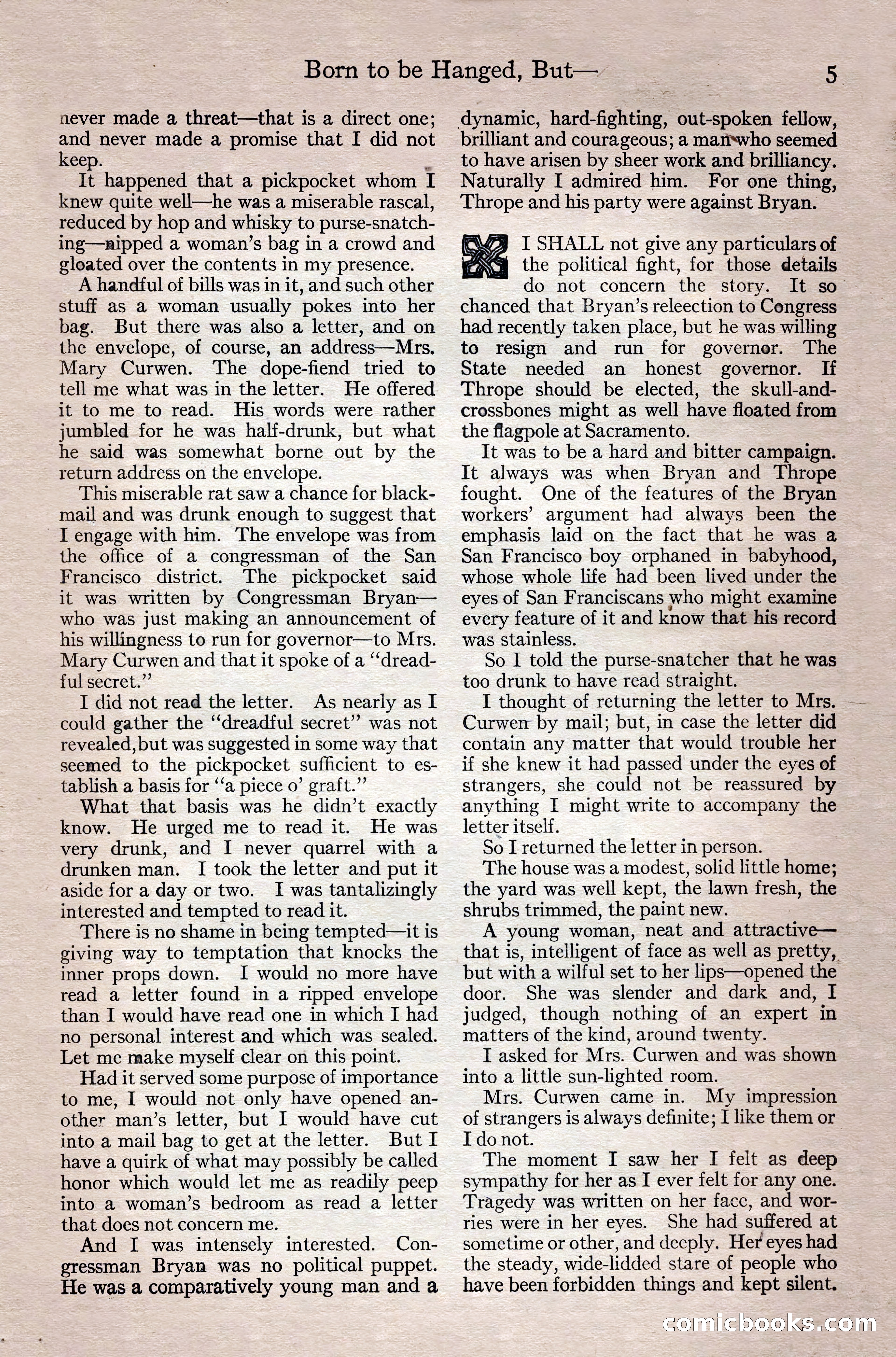
A restored page from Pulp Fiction, 1919. Page through the whole issue in the reader above.
📄 Transcribed text from this page (OCR, searchable)
Machine-transcribed from the original scan — historical spelling and the odd misread are preserved.
Born to be Hanged, But— 5 never made a threat—that is a direct one; and never made a promise that I did not keep. = It happened that a pickpocket whom I knew quite well—he was a miserable rascal, reduced by hop and whisky to purse-snatch- ing—nipped a woman’s bag in a crowd and gloated over the contents in my presence. A handful of bills was in it, and such other stuff as a woman usually pokes into her bag. But there was also a letter, and on the envelope, of course, an address—Mrs. Mary Curwen. The dope-fiend tried to tell me what was in the letter. He offered it to me to read. His words were rather jumbled for he was half-drunk, but what he said was somewhat borne out by the return address on the envelope. This miserable rat saw a chance for black- mail and was drunk enough to suggest that LT engage with him. The envelope was from the office of a congressman of the San Francisco district. The pickpocket said it was written by Congressman Bryan— who was just making an announcement of his willingness to run for governor—to Mrs. Mary Curwen and that it spoke of a ‘“‘dread- ful secret.” I did not read the letter. As nearly as I could gather the “dreadful secret”? was not revealed, but was suggested in some way that seemed to the pickpocket sufficient to es- tablish a basis for “‘a piece o’ graft.” What that basis was he didn’t exactly know. He urged me to read it. He was very drunk, and I never quarrel with a drunken man. I took the letter and put it aside for a day or two. I was tantalizingly interested and tempted to read it. There is no shame in being tempted—it is giving way to temptation that knocks the inner props down. I would no more have read a letter found in a ripped envelope than I would have read one in which I had no personal interest and which was sealed. Let me make myself clear on this point. Had it served some purpose of importance to me, I would not only have opened an- other man’s letter, but I would have cut into a mail bag to get at the letter. But I have a quirk of what may possibly be called honor which would let me as readily peep into a woman’s bedroom as read a letter that does not concern me. And I was intensely interested. Con- gressman Bryan was no political puppet. He was a comparatively young man and a vo dynamic, hard-fighting, out-spoken fellow, brilliant and courageous; a marnwho seemed to have arisen by sheer work and brilliancy. Naturally I admired him. For one thing, Thrope and his party were against Bryan. do not concern the story. It SO- chanced that Bryan’s releection to Congress had recently taken place, but he was willing to resign and run for governer. The State needed an honest governor. If Thrope should be elected, the skull-and- crossbones might as well have floated from the flagpole at Sacramento. It was to be a hard and bitter campaign. It always was when Bryan and Thrope fought. One of the features of the Bryan workers’ argument had always been the emphasis laid on the fact that he was a San Francisco boy orphaned in babyhood, whose whole life had been lived under the eyes of San Franciscans who might examine every feature of it and know that his record was stainless. So I told the purse-snatcher that he was too drunk to have read straight. I thought of returning the letter to Mrs. Curwen by mail; but, in case the letter did contain any matter that would trouble her if she knew it had passed under the eyes of strangers, she could not be reassured by anything I might write to accompany the letter itself. So I returned the letter in person. The house was a modest, solid little home; the yard was well kept, the lawn fresh, the shrubs trimmed, the paint new. A young woman, neat and attractive— that is, intelligent of face as well as pretty, but with a wilful set to her lips—opened the door. She was slender and dark and, I judged, though nothing of an expert in matters of the kind, around twenty. I asked for Mrs. Curwen and was shown into a little sun-lighted room. Mrs. Curwen came in. My impression of strangers is always definite; I like them or I do not. The moment I saw her I felt as deep sympathy for her as I ever felt for any one. Tragedy was written on her face, and wor- ries were in her eyes. She had suffered at sometime or other, and deeply. Her eyes had the steady, wide-lidded stare of people who have been forbidden things and kept silent. Gomicbooks (E(0)