
Pulp Fiction, 1919 · page 18 of 208
Adventure Magazine Cover — page 18: what you’re looking at
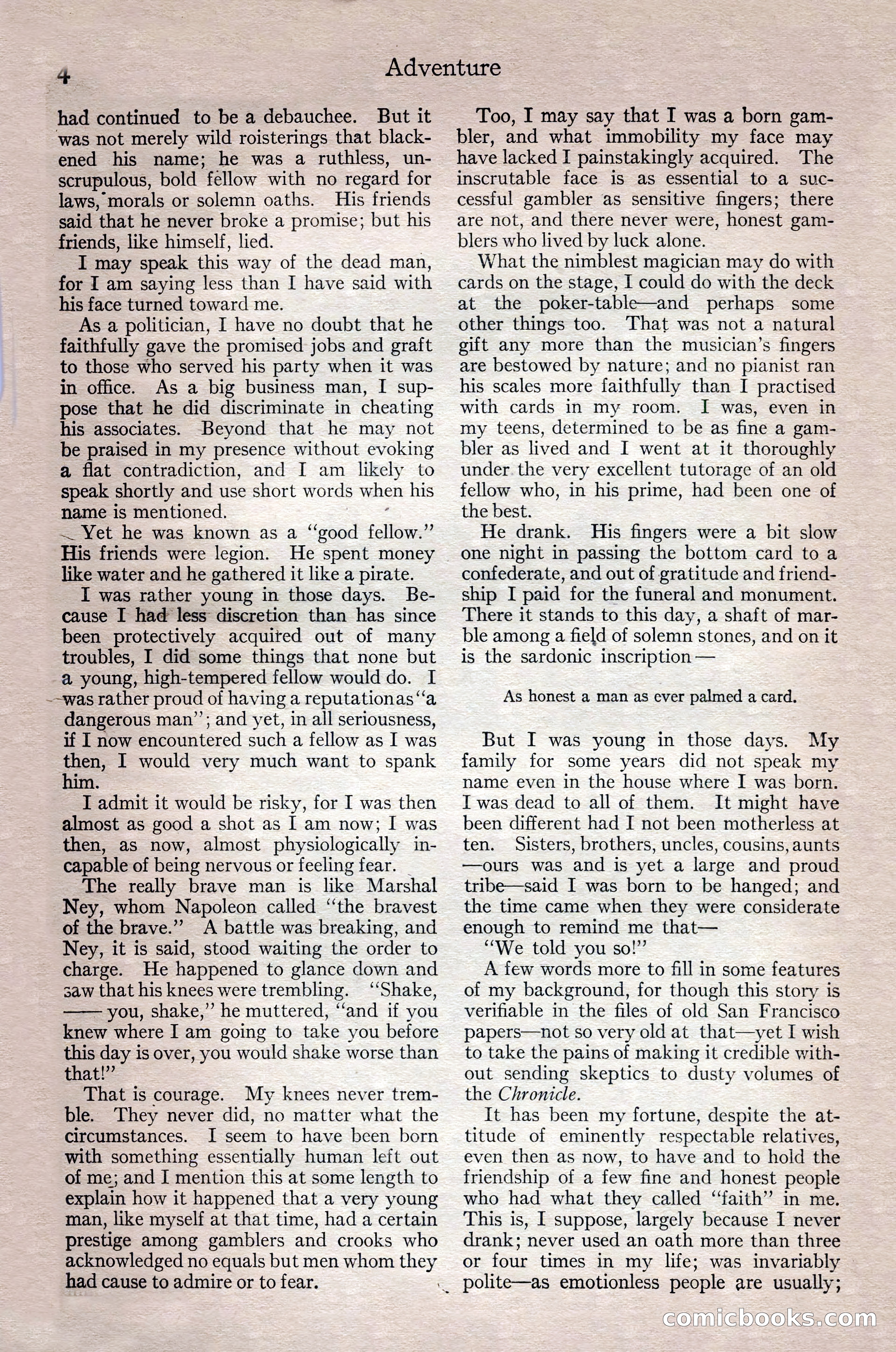
A restored page from Pulp Fiction, 1919. Page through the whole issue in the reader above.
📄 Transcribed text from this page (OCR, searchable)
Machine-transcribed from the original scan — historical spelling and the odd misread are preserved.
4 Adventure had continued to be a debauchee. But it was not merely wild roisterings that black- ened his name; he was a ruthless, un- scrupulous, bold fellow with no regard for laws, morals or solemn oaths. His friends said that he never broke a promise; but his friends, like himself, lied. I may speak this way of the dead man, for I am saying less than I have said with his face turned toward me. As a politician, I have no doubt that he faithfully gave the promised jobs and graft to those who served his party when it was in office. As a big business man, I sup- pose that he did discriminate in cheating his associates. Beyond that he may not be praised in my presence without evoking a flat contradiction, and I am likely to speak shortly and use short words when his name is mentioned. — Yet he was known as a “good fellow.” His friends were legion. He spent money like water and he gathered it like a pirate. I was rather young in those days. Be- cause I had less discretion than has since been protectively acquired out of many troubles, I did some things that none but a young, high-tempered fellow would do. I ~~was rather proud of having a reputationas“‘a dangerous man’; and yet, in all seriousness, if I now encountered such a fellow as I was then, I would very much want to spank I admit it would be risky, for I was then almost as good a shot as I am now; I was then, as now, almost physiologically in- capable of being nervous or feeling fear. The really brave man is like Marshal Ney, whom Napoleon called “the bravest of the brave.”” A battle was breaking, and Ney, it is said, stood waiting the order to charge. He happened to glance down and saw that his knees were trembling. ‘Shake, — you, shake,” he muttered, “and if you knew where I am going to take you before this day is over, you would shake worse than that!” That is courage. My knees never trem- ble. They never did, no matter what the circumstances. J seem to have been born with something essentially human left out of me; and I mention this at some length to explain how it happened that a very young man, like myself at that time, had a certain prestige among gamblers and crooks who acknowledged no equals but men whom they had cause to admire or to fear. Too, I may say that I was a born gam- bler, and what immobility my face may have lacked I painstakingly acquired. The inscrutable face is as essential to a suc- cessful gambler as sensitive fingers; there are not, and there never were, honest gam- blers who lived by luck alone. What the nimblest magician may do with cards on the stage, I could do with the deck at the poker-table—and perhaps some other things too. That was not a natural gift any more than the musician’s fingers are bestowed by nature; and no pianist ran his scales more faithfully than I practised with cards in my room. I was, even in my teens, determined to be as fine a gam- bler as lived and I went at it thoroughly under. the very excellent tutorage of an old fellow who, in his prime, had been one of the best. He drank. His fingers were a bit slow one night in passing the bottom card to a confederate, and out of gratitude and friend- ship I paid for the funeral and monument. There it stands to this day, a shaft of mar- ble among a field of solemn stones, and on it is the sardonic inscription — As honest a man as ever palmed a card. But I was young in those days. My family for some years did not speak my name even in the house where I was born. I was dead to all of them. It might have been different had I not been motherless at ten. Sisters, brothers, uncles, cousins, aunts —ours was and is yet a large and proud tribe—said I was born to be hanged; and the time came when they were considerate enough to remind me that— “We told you so!” A few words more to fill in some features of my background, for though this story is verifiable in the files of old San Francisco papers—not so very old at that—yet I wish to take the pains of making it credible with- out sending skeptics to dusty volumes of the Chronicle. It has been my fortune, despite the at- titude of eminently respectable relatives, even then as now, to have and to hold the friendship of a few fine and honest people who had what they called “faith” in me. This is, I suppose, largely because I never drank; never used an oath more than three or four times in my life; was invariably | ._ polite—as emotionless people are usually; (E@NMIE OCKe) S (E)