
Pulp Fiction, 1919 · page 176 of 208
Adventure Magazine Cover — page 176: what you’re looking at
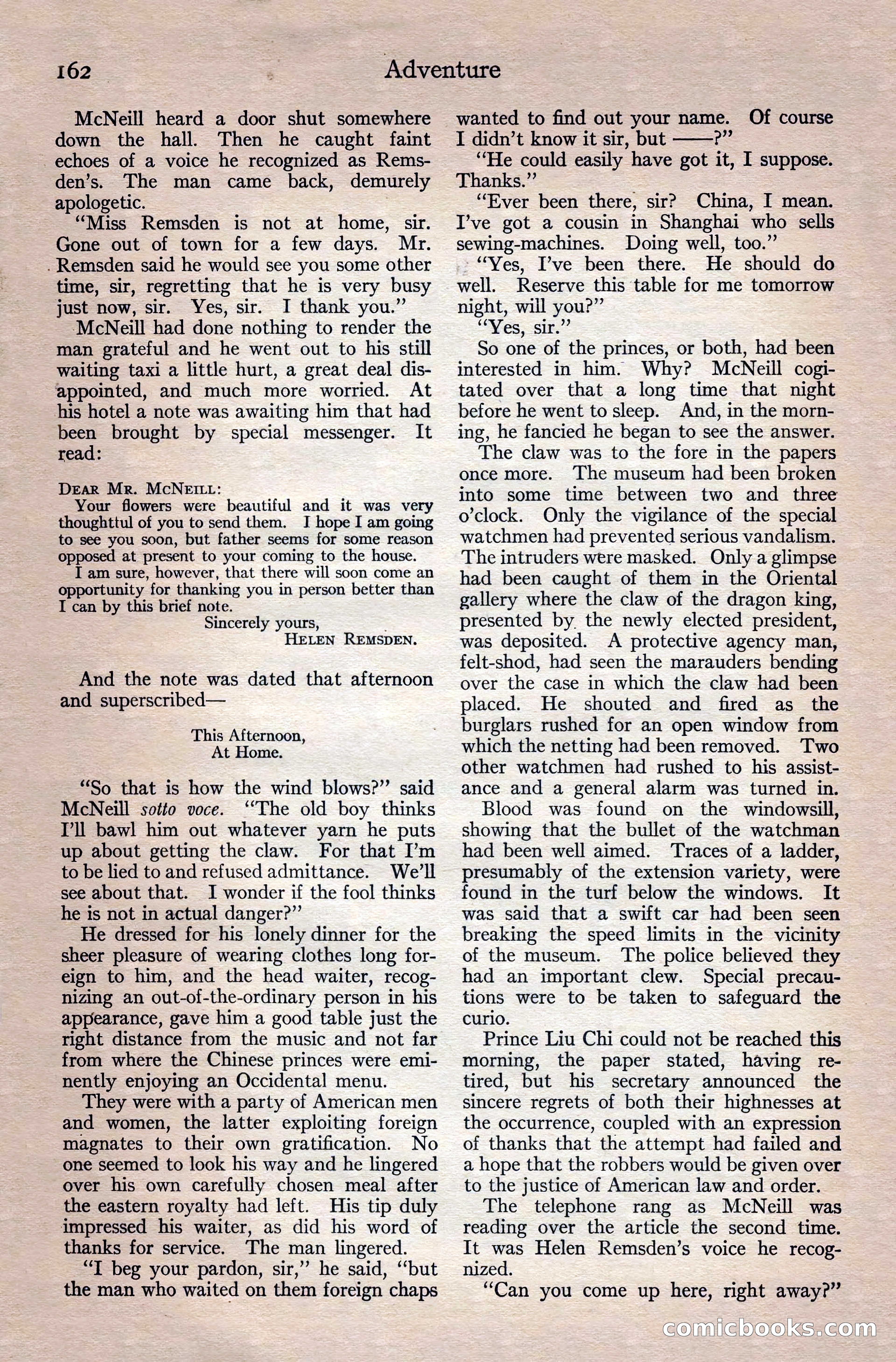
A restored page from Pulp Fiction, 1919. Page through the whole issue in the reader above.
📄 Transcribed text from this page (OCR, searchable)
Machine-transcribed from the original scan — historical spelling and the odd misread are preserved.
162 | McNeill heard a door shut somewhere down the hall. Then he caught faint _ echoes of a voice he recognized as Rems- den’s. The man came back, demurely apologetic. “Miss Remsden is not at home, sir. Gone out of town for a few days. Mr. .Remsden said he would see you some other time, sir, regretting that he is very busy just now, sir. Yes, sir. I thank you.” McNeill had done nothing to render the man grateful and he went out to his still waiting taxi a little hurt, a great deal dis- appointed, and much more worried. At his hotel a note was awaiting him that had been brought by special messenger. It read: DEAR Mr. McNEILL: Your flowers were beautiful and it was very thoughttul of you to send them. I hope I am going to see you soon, but father seems for some reason opposed at present to your coming to the house. I am sure, however, that there will soon come an opportunity for thanking you in person better than I can by this brief note. Sincerely yours, HELEN REMSDEN. And the note was dated that afternoon and superscribed— This Afternoon, At Home. “So that is how the wind blows?” said McNeill sotto voce. ‘The old boy thinks Tl bawl him out whatever yarn he puts up about getting the claw. For that I’m to be lied to and refused admittance. We'll see about that. I wonder if the fool thinks he is not in actual danger?”’ He dressed for his lonely dinner for the sheer pleasure of wearing clothes long for- eign to him, and the head waiter, recog- nizing an out-of-the-ordinary person in his appearance, gave him a good table just the right distance from the music and not far from where the Chinese princes were emi- nently enjoying an Occidental menu. They were with a party of American men and women, the latter exploiting foreign magnates to their own gratification. No one seemed to look his way and he lingered over his own carefully chosen meal after the eastern royalty had left. His tip duly impressed his waiter, as did his word of thanks for service. The man lingered. “YT beg your pardon, sir,” he said, “but the man who waited on them foreign chaps Adventure wanted to find out your name. Of course I didn’t know it sir, but ——?” “He could easily have got it, I suppose. Thanks.”’ “Ever been there, sir? China, I mean. I’ve got a cousin in Shanghai who sells sewing-machines. Doing well, too.” “Ves, I’ve been there. He should do well. Reserve this table for me tomorrow night, will you?” “Yes, sir.” So one of the princes, or both, had been interested in him. Why? McNeill cogi- tated over that a long time that night before he went to sleep. And, in the morn- ing, he fancied he began to see the answer. The claw was to the fore in the papers once more. The museum had been broken into some time between two and three o’clock. Only the vigilance of the special watchmen had prevented serious vandalism. The intruders were masked. Only a glimpse had been caught of them in the Oriental gallery where the claw of the dragon king, presented by the newly elected president, was deposited. <A protective agency man, felt-shod, had seen the marauders bending over the case in which the claw had been placed. He shouted and fired as the burglars rushed for an open window from which the netting had been removed. Two other watchmen had rushed to his assist- ance and a general alarm was turned in. Blood was found on the windowsill, showing that the bullet of the watchman had been well aimed. ‘Traces of a ladder, presumably of the extension variety, were found in the turf below the windows. It was said that a swift car had been seen breaking the speed limits in the vicinity of the museum. The police believed they had an important clew. Special precau- tions were to be taken to safeguard the curio. Prince Liu Chi could not be reached this morning, the paper stated, having re- tired, but his secretary announced the sincere regrets of both their highnesses at the occurrence, coupled with an expression of thanks that the attempt had failed and a hope that the robbers would be given over to the justice of American law and order. The telephone rang as McNeill was reading over the article the second time. It was Helen Remsden’s voice he recog- nized. “Can you come up here, right away?” Gomicboo S (E(@)