
Pulp Fiction, 1919 · page 175 of 208
Adventure Magazine Cover — page 175: what you’re looking at
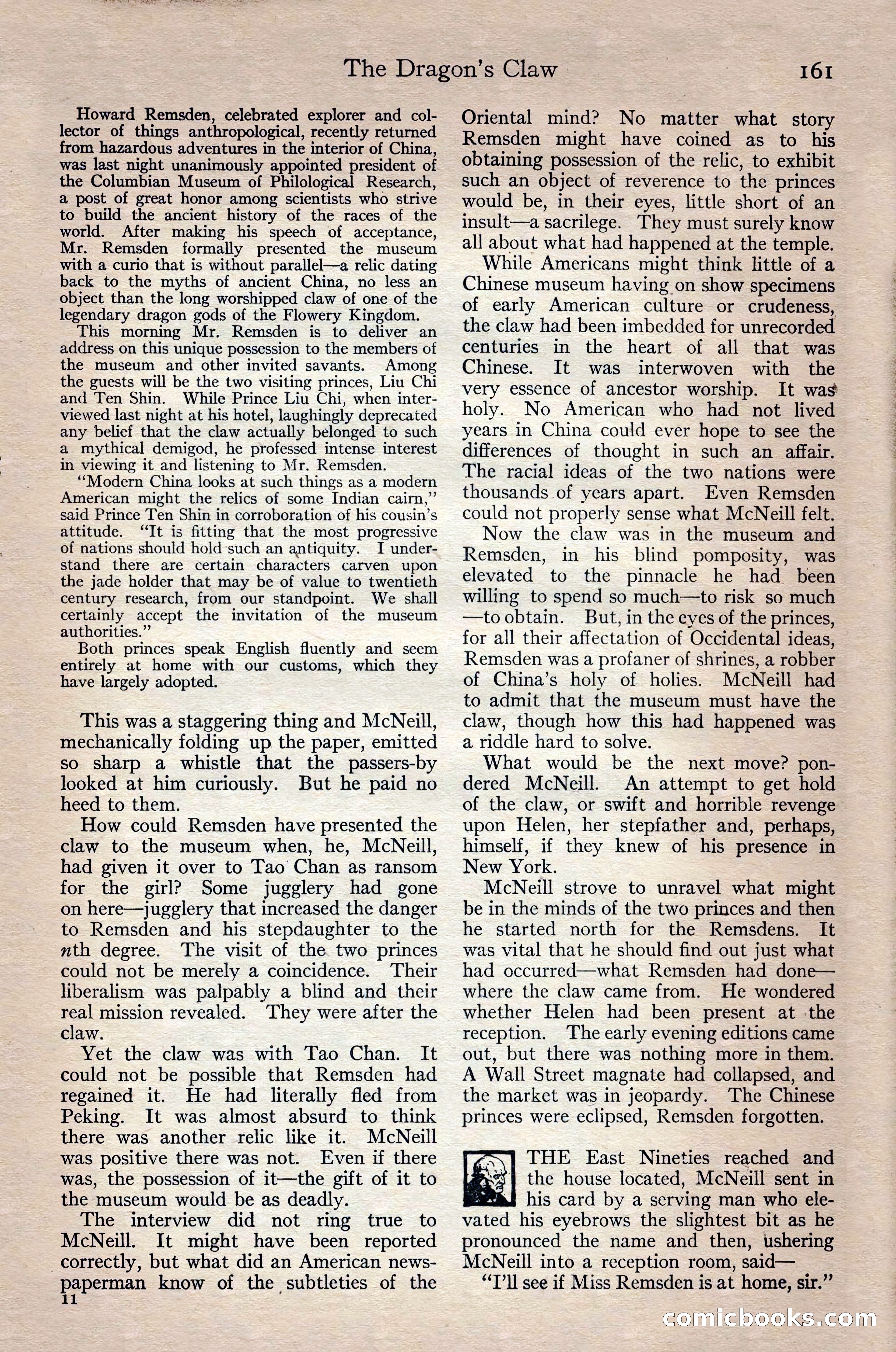
A restored page from Pulp Fiction, 1919. Page through the whole issue in the reader above.
📄 Transcribed text from this page (OCR, searchable)
Machine-transcribed from the original scan — historical spelling and the odd misread are preserved.
The Dragon’s Claw Howard Remsden, celebrated explorer and col- lector of things anthropological, recently returned from hazardous adventures in the interior of China, was last night unanimously appointed president of the Columbian Museum of Philological Research, a post of great honor among scientists who strive to build the ancient history of the races of the world. After making his speech of acceptance, Mr. Remsden formally presented the museum with a curio that is without parallel—a relic dating back to the myths of ancient China, no less an object than the long worshipped claw of one of the legendary dragon gods of the Flowery Kingdom. This morning Mr. Remsden is to deliver an address on this unique possession to the members of the museum and other invited savants. Among the guests will be the two visiting princes, Liu Chi and Ten Shin. While Prince Liu Chi, when inter- viewed last night at his hotel, laughingly deprecated any belief that the claw actually belonged to such a mythical demigod, he professed intense interest in viewing it and listening to Mr. Remsden. ““Modern China looks at such things as a modern American might the relics of some Indian cairn,” said Prince Ten Shin in corroboration of his cousin’s attitude. “It is fitting that the most progressive of nations should hold’such an antiquity. I under- stand there are certain characters carven upon the jade holder that may be of value to twentieth century research, from our standpoint. We shall certainly accept the invitation of the museum authorities.” Both princes speak English fluently and seem entirely at home with our customs, which they have largely adopted. This was a staggering thing and McNeill, mechanically folding up the paper, emitted so sharp a whistle that the passers-by looked at him curiously. But he paid no heed to them. How could Remsden have presented the claw to the museum when, he, McNeill, had given it over to Tao Chan as ransom for the girl? Some jugglery had gone on here—jugglery that increased the danger to Remsden and his stepdaughter to the mth degree. The visit of the two princes could not be merely a coincidence. Their liberalism was palpably a blind and their real mission revealed. They were after the claw. Yet the claw was with Tao Chan. It could not be possible that Remsden had regained it. He had literally fled from Peking. It was almost absurd to think there was another relic like it. McNeill was positive there was not. Even if there was, the possession of it—the gift of it to the museum would be as deadly. The interview did not ring true to McNeill. It might have been reported correctly, but what did an American news- paperman know of the subtleties of the 11 161 Oriental mind? No matter what story Remsden might have coined as to his obtaining possession of the relic, to exhibit such an object of reverence to the princes would be, in their eyes, little short of an insult—a sacrilege. They must surely know all about what had happened at the temple. While Americans might think little of a Chinese museum having on show specimens of early American culture or crudeness, the claw had been imbedded for unrecorded centuries in the heart of all that was Chinese. It was interwoven with the very essence of ancestor worship. It was holy. No American who had not lived years in China could ever hope to see the differences of thought in such an affair. The racial ideas of the two nations were thousands of years apart. Even Remsden could not properly sense what McNeill felt. Now the claw was in the museum and Remsden, in his blind pomposity, was elevated to the pinnacle he had been willing to spend so much—to risk so much —to obtain. But, in the eyes of the princes, for all their affectation of Occidental ideas, Remsden was a profaner of shrines, a robber of China’s holy of holies. McNeill had to admit that the museum must have the claw, though how this had happened was a riddle hard to solve. What would be the next move? pon- dered McNeill. An attempt to get hold of the claw, or swift and horrible revenge upon Helen, her stepfather and, perhaps, himself, if they knew of his presence in New York. McNeill strove to unravel what might be in the minds of the two princes and then he started north for the Remsdens. It was vital that he should find out just what had occurred—what Remsden had done— where the claw came from. He wondered whether Helen had been present at -the reception. The early evening editions came out, but there was nothing more in them. A Wall Street magnate had collapsed, and the market was in jeopardy. The Chinese princes were eclipsed, Remsden forgotten. THE East Nineties reached and the house located, McNeill sent in : his card by a serving man who ele- vated his eyebrows the slightest bit as he pronounced the name and then, ushering McNeill into a reception room, said— “T’ll see if Miss Remsden is at home, sir.”’ (EOAMCel evexey <S €o im