
Pulp Fiction, 1919 · page 172 of 208
Adventure Magazine Cover — page 172: what you’re looking at
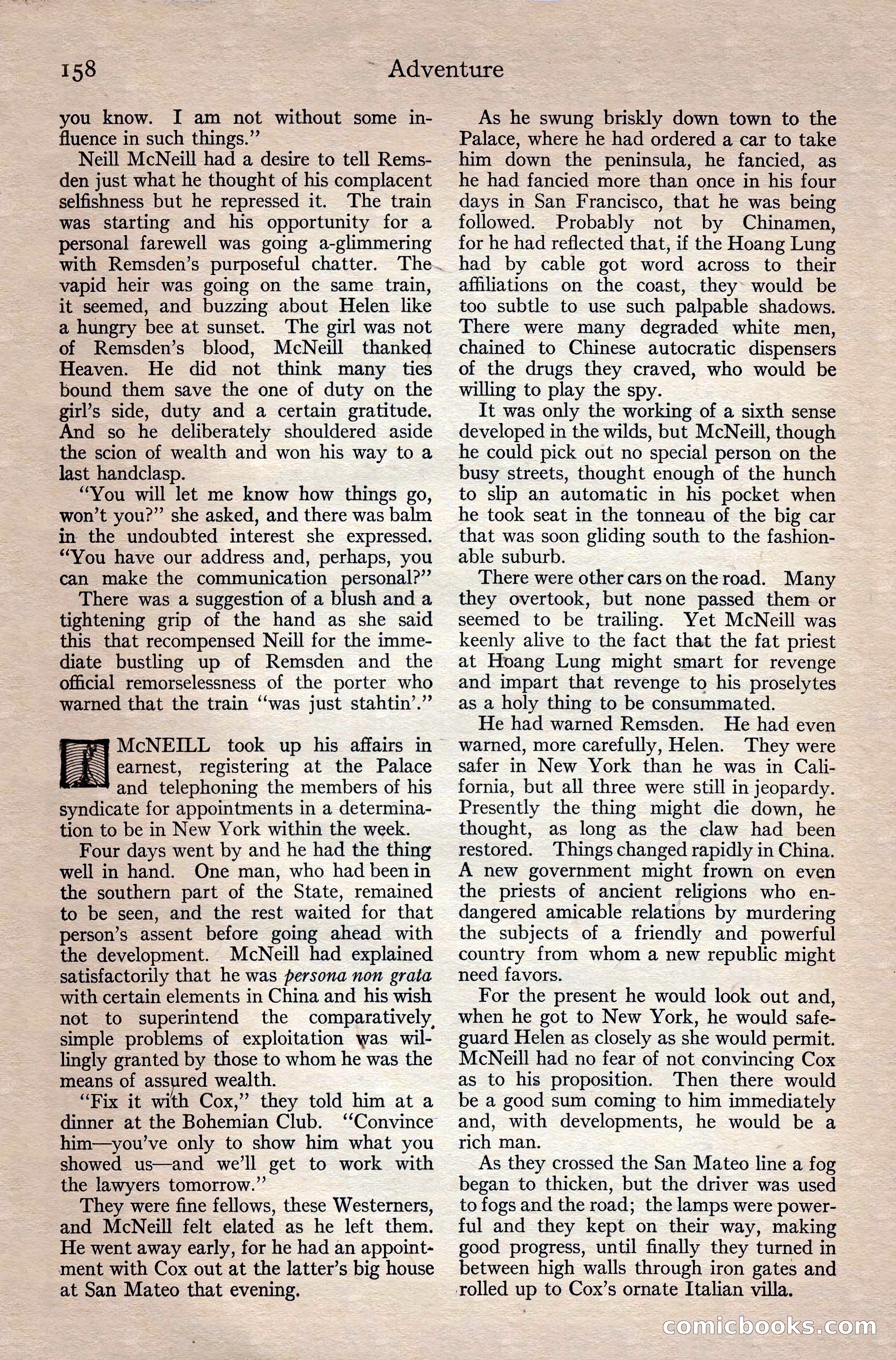
A restored page from Pulp Fiction, 1919. Page through the whole issue in the reader above.
📄 Transcribed text from this page (OCR, searchable)
Machine-transcribed from the original scan — historical spelling and the odd misread are preserved.
158 you know. I am not without some in- fluence in such things.”’ Neill McNeill had a desire to tell Rems- den just what he thought of his complacent selfishness but he repressed it. The train was starting and his opportunity for a personal farewell was going a-glimmering with Remsden’s purposeful chatter. vapid heir was going on the same train, it seemed, and buzzing about Helen like a hungry bee at sunset. The girl was not of Remsden’s blood, McNeill thanked Heaven. He did not think many ties bound them save the one of duty on the girl’s side, duty and a certain gratitude. And so he deliberately shouldered aside the scion of wealth and won his way to a last handclasp. “You will let me know how things go, won’t your” she asked, and there was balm in the undoubted interest she expressed. “You have our address and, perhaps, you can make the communication personal?’ There was a suggestion of a blush and a tightening grip of the hand as she said this that recompensed Neill for the imme- diate bustling up of Remsden and the official remorselessness of the porter who MPD warned that the train ‘‘was just stahtin’. N earnest, registering at the Palace “and telephoning the members of his syndicate for appointments in a determina- tion to be in New York within the week. Four days went by and he had the thing well in hand. One man, who had been in the southern part of the State, remained to be seen, and the rest waited for that person’s assent before going ahead with the development. McNeill had explained satisfactorily that he was persona non grata with certain elements in China and his wish not to superintend the comparatively, simple problems of exploitation was wil- lingly granted by those to whom he was the means of assured wealth. “Fix it with Cox,” they told him at a dinner at the Bohemian Club. ‘‘Convince him—you’ve only to show him what you showed us—and we’ll get to work with the lawyers tomorrow.” They were fine fellows, these Westerners, and McNeill felt elated as he left them. He went away early, for he had an appoint- ment with Cox out at the latter’s big house at San Mateo that evening. The~ McNEILL took up his affairs in~ ~ Adventure As he swung briskly down town to the Palace, where he had ordered a car to take him down the peninsula, he fancied, as he had fancied more than once in his four days in San Francisco, that he was being followed. Probably not by Chinamen, for he had reflected that, if the Hoang Lung had by cable got word across to their affiliations on the coast, they: would be too subtle to use such palpable shadows. There were many degraded white men, chained to Chinese autocratic dispensers of the drugs they craved, who would be willing to play the spy. It was only the working of a sixth sense developed in the wilds, but McNeill, though he could pick out no special person on the busy streets, thought enough of the hunch to slip an automatic in his pocket when he took seat in the tonneau of the big car that was soon gliding south to the fashion- able suburb. There were other cars on the road. Many they overtook, but none passed them or seemed to be trailing. Yet McNeill was keenly alive to the fact that the fat priest at Hoang Lung might smart for revenge and impart that revenge to his proselytes as a holy thing to be consummated. He had warned Remsden. He had even warned, more carefully, Helen. They were safer in New York than he was in Cali- fornia, but all three were still in jeopardy. Presently the thing might die down, he thought, as long as the claw had been restored. Things changed rapidly in China. A new government might frown on even the priests of ancient religions who en- dangered amicable relations by murdering the subjects of a friendly and powerful country from whom a new republic might need favors. For the present he would look out and, when he got to New York, he would safe- guard Helen as closely as she would permit. McNeill had no fear of not convincing Cox as to his proposition. Then there would be a good sum coming to him immediately and, with developments, he would be a rich man. As they crossed the San Mateo line a fog began to thicken, but the driver was used to fogs and the road; the lamps were power- ful and they kept on their way, making good progress, until finally they turned in between high walls through iron gates and rolled up to Cox’s ornate Italian villa. Gomicbooks (E)