
Pulp Fiction, 1919 · page 171 of 208
Adventure Magazine Cover — page 171: what you’re looking at
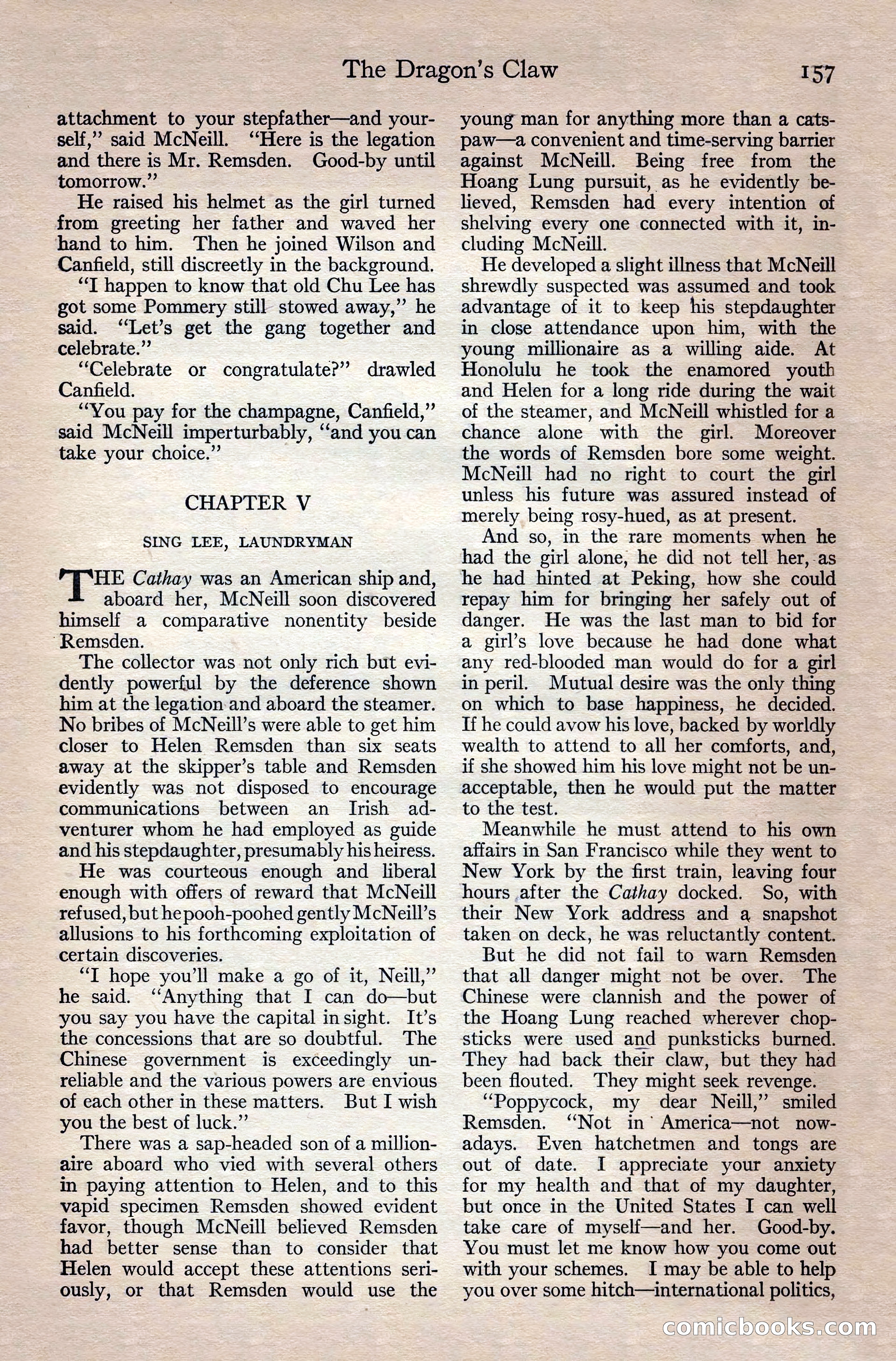
A restored page from Pulp Fiction, 1919. Page through the whole issue in the reader above.
📄 Transcribed text from this page (OCR, searchable)
Machine-transcribed from the original scan — historical spelling and the odd misread are preserved.
The Dragon’s Claw attachment to your stepfather—and your- self,” said McNeill. “Here is the legation and there is Mr. Remsden. Good-by until tomorrow.” He raised his helmet as the girl turned from greeting her father and waved her hand to him. Then he joined Wilson and Canfield, still discreetly in the background. “I happen to know that old Chu Lee has got some Pommery still stowed away,” he said. “Let’s get the gang together and celebrate.”’ “Celebrate or congratulate?” drawled Canfield. “You pay for the champagne, Canfield,” said McNeill imperturbably, ‘‘and you can take your choice.” CHAPTER V SING LEE, LAUNDRYMAN =| He Cathay was an American ship and, aboard her, McNeill soon discovered himself a comparative nonentity beside “Remsden. The collector was not only rich but evi- dently powerful by the deference shown him at the legation. and aboard the steamer. No bribes of McNeill’s were able to get him closer to Helen Remsden than six seats away at the skipper’s table and Remsden evidently was not disposed to encourage communications between an Irish ad- venturer whom he had employed as guide and his stepdaughter, presumably his heiress. He was courteous enough and liberal enough with offers of reward that McNeill refused, but he pooh-poohed gently McNeill’s allusions to his forthcoming exploitation of certain discoveries. “TI hope you’ll make a go of it, Neill,” he said. ‘Anything that I can do—but you say you have the capital insight. It’s the concessions that are so doubtful. The Chinese government is exceedingly un- reliable and the various powers are envious of each other in these matters. But I wish you the best of luck.” There was a sap-headed son of a million- aire aboard who vied with several others i paying attention to Helen, and to this vapid specimen Remsden showed evident favor, though McNeill believed Remsden had better sense than to consider that Helen would accept these attentions seri- ously, or that Remsden would use the 157 young man for anything more than a cats- paw—a convenient and time-serving barrier against McNeill. Being free from the Hoang Lung pursuit, as he evidently be- lieved, Remsden had every intention of shelving every one connected with it, in- cluding McNeill. He developed a slight illness that McNeill shrewdly suspected was assumed and took advantage of it to keep his stepdaughter in close attendance upon him, with the young millionaire as a willing aide. At Honolulu he took the enamored youth and Helen for a long ride during the wait of the steamer, and McNeill whistled for a chance alone with the girl. Moreover the words of Remsden bore some weight. McNeill had no right to court the girl unless his future was assured instead of merely being rosy-hued, as at present. And so, in the rare moments when he had the girl alone, he did not tell her,-as he had hinted at Peking, how she could repay him for bringing her safely out of danger. He was the last man to bid for a girl’s love because he had done what any red-blooded man would do for a girl in peril. Mutual desire was the only thing on which to base happiness, he decided. If he could avow his love, hacked by worldly wealth to attend to all her comforts, and, if she showed him his love might not be un- acceptable, then he would put the matter to the test. Meanwhile he must attend to his own affairs in San Francisco while they went to New York by the first train, leaving four hours .after the Cathay docked. So, with their New York address and a snapshot taken on deck, he was reluctantly content. But he did not fail to warn Remsden that all danger might not be over. The Chinese were clannish and the power of the Hoang Lung reached wherever chop- sticks were used and punksticks burned. They had back their claw, but they had been flouted. They might seek revenge. ‘“Poppycock, my dear Neill,” smiled Remsden. “Not in’ America—not now- adays. Even hatchetmen and tongs are out of date. I appreciate your anxiety for my health and that of my daughter, but once in the United States I can well take care of myself—and her. Good-by. You must let me know how you come out with your schemes. I may be able to help you over some hitch—international politics, GEomichbooks.co m