
Pulp Fiction, 1919 · page 142 of 208
Adventure Magazine Cover — page 142: what you’re looking at
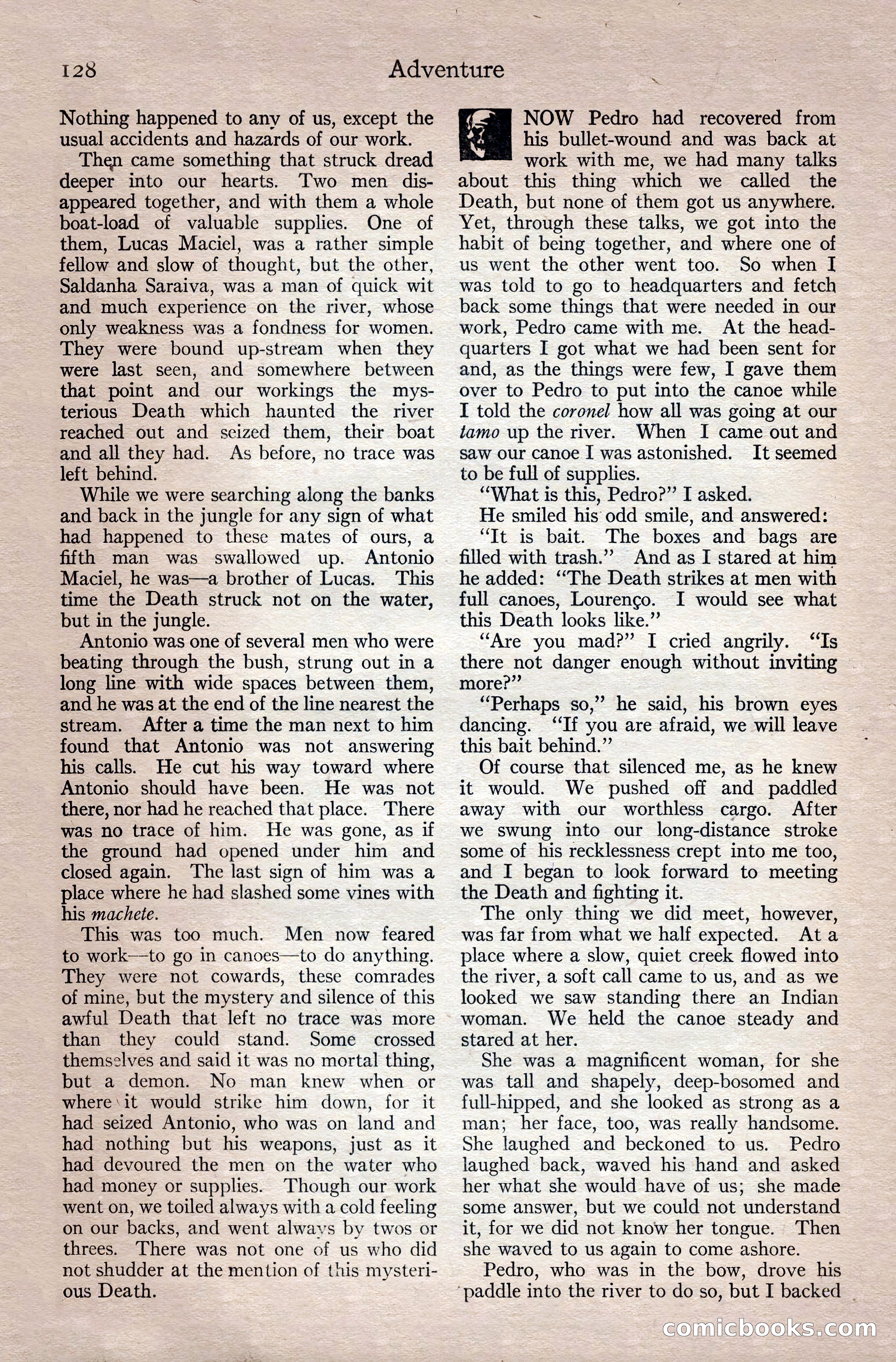
A restored page from Pulp Fiction, 1919. Page through the whole issue in the reader above.
📄 Transcribed text from this page (OCR, searchable)
Machine-transcribed from the original scan — historical spelling and the odd misread are preserved.
128 Nothing happened to any of us, except the usual accidents and hazards of our work. Then came something that struck dread deeper into our hearts. Two men dis- appeared together, and with them a whole boat-load of valuable supplies. One of them, Lucas Maciel, was a rather simple fellow and slow of thought, but the other, Saldanha Saraiva, was a man of quick wit and much experience on the river, whose only weakness was a fondness for women. They were bound up-stream when they were last seen, and somewhere between that point and our workings the mys- terious Death which haunted the river reached out and seized them, their boat and all they had. As before, no trace was left behind. While we were searching along the banks and back in the jungle for any sign of what had happened to these mates of ours, a fifth man was swallowed up. Antonio Maciel, he was—a brother of Lucas. This time the Death struck not on the water, but in the jungle. Antonio was one of several men who were beating through the bush, strung out in a long line with wide spaces between them, and he was at the end of the line nearest the stream. After a time the man next to him found that Antonio was not answering his calls. He cut his way toward where Antonio should have been. He was not there, nor had he reached that place. There was no trace of him. He was gone, as if the ground had opened under him and closed again. The last sign of him was a place where he had slashed some vines with his machete. This was too much. Men now feared to work—to go in canoes—to do anything. They were not cowards, these comrades of mine, but the mystery and silence of this awiul Death that left no trace was more than they could stand. Some crossed themselves and said it was no mortal thing, but a demon. No man knew when or where ‘it would strike him down, for it had seized Antonio, who was on land and had nothing but his weapons, just as it had devoured the men on the water who had money or supplies. Though our work went on, we toiled always with a cold feeling on our backs, and went always by twos or threes. There was not one of us who did not shudder at the mention of this mysteri- ous Death. Adventure \ © NOW Pedro had recovered from ai his bullet-wound and was back at work with me, we had many talks about this thing which we called the Death, but none of them got us anywhere. Yet, through these talks, we got into the habit of being together, and where one of us went the other went too. So when [I was told to go to headquarters and fetch back some things that were needed in our work, Pedro came with me. At the head- quarters I got what we had been sent for and, as the things were few, I gave them over to Pedro to put into the canoe while I told the coronel how all was going at our tamo up the river. When I came out and saw our canoe I was astonished. It seemed to be full of supplies. “What is this, Pedro?” I asked. He smiled his odd smile, and answered: ‘Tt is bait. The boxes and bags are filled with trash.”’ And as I stared at him he added: “‘The Death strikes at men with full canoes, Lourenco. I would see what this Death looks like.” “Are you mad?” I cried angrily. “Is there not danger enough without inviting © more?” “Perhaps so,” he said, his brown eyes dancing. “If you are afraid, we will leave this bait behind.” Of course that silenced me, as he knew it would. We pushed off and paddled away with our worthless cargo. After we swung into our long-distance stroke some of his recklessness crept into me too, and I began to look forward to meeting the Death and fighting it. The only thing we did meet, however, was far from what we half expected. Ata place where a slow, quiet creek flowed into the river, a soft call came to us, and as we looked we saw standing there an Indian woman. We held the canoe steady and stared at her. She was a magnificent woman, for she was tall and shapely, deep-bosomed and full-hipped, and she looked as strong as a man; her face, too, was really handsome. She laughed and beckoned to us. Pedro laughed back, waved his hand and asked her what she would have of us; she made some answer, but we could not understand it, for we did not know her tongue. Then she waved to us again to come ashore. Pedro, who was in the bow, drove his Eomichoo SS (E(@) ‘paddle into the river to do so, but I backed |