
Pulp Fiction, 1919 · page 141 of 208
Adventure Magazine Cover — page 141: what you’re looking at
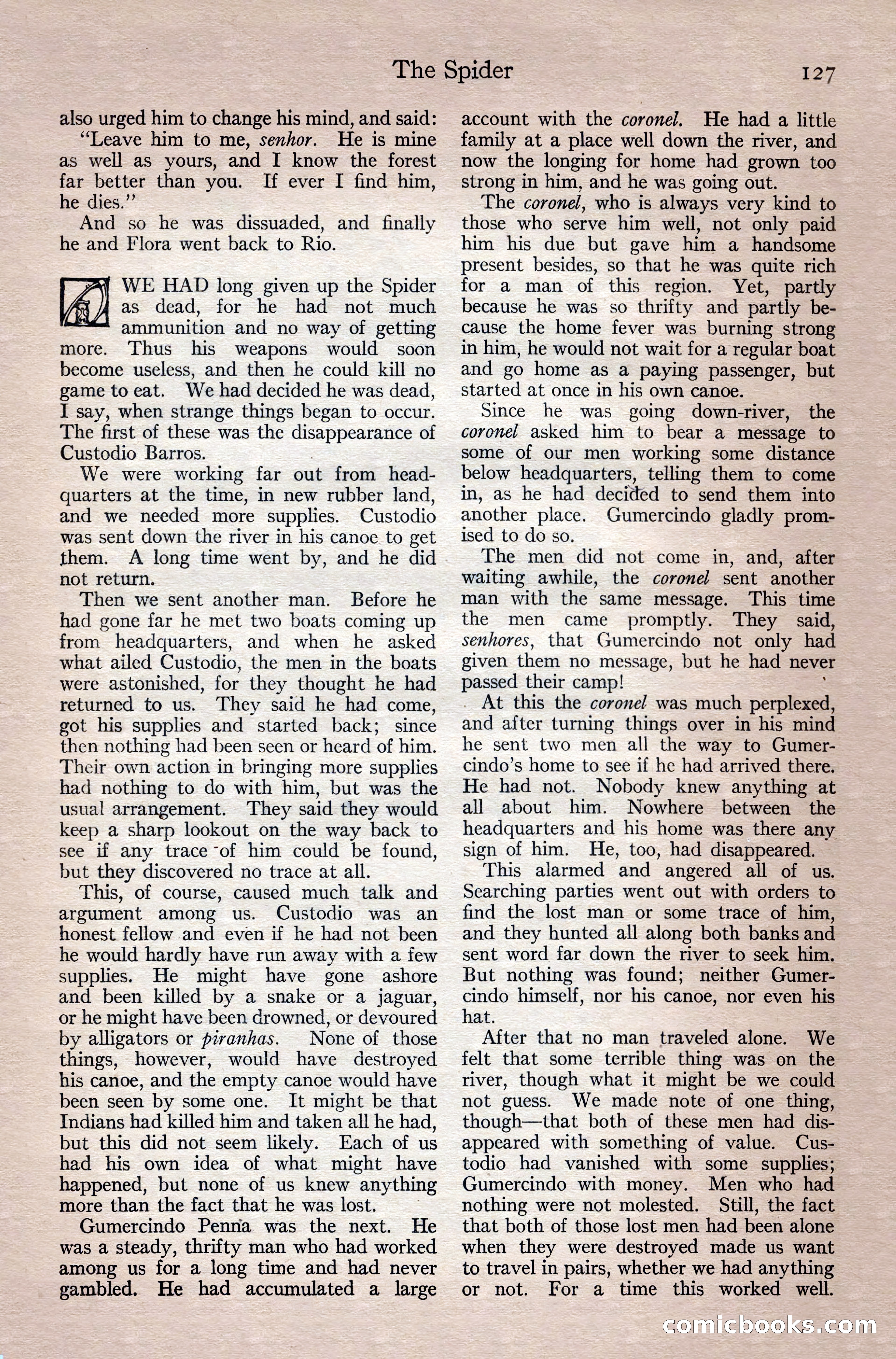
A restored page from Pulp Fiction, 1919. Page through the whole issue in the reader above.
📄 Transcribed text from this page (OCR, searchable)
Machine-transcribed from the original scan — historical spelling and the odd misread are preserved.
The Spider also urged him to change his mind, and said: ‘Leave him to me, senhor. He is mine as well as yours, and I know the forest far better than you. If ever I find him, he dies.” And so he was dissuaded, and finally he and Flora went back to Rio. V4) WE HAD long given up the Spider fa) as dead, for he had not much -““" ammunition and no way of getting more. Thus his weapons would soon become useless, and then he could kill no game toeat. We had decided he was dead, I say, when strange things began to occur. The first of these was the disappearance of Custodio Barros. We were working far out from head- quarters at the time, in new rubber land, and we needed more supplies. Custodio was sent down the river in his canoe to get them. <A long time went by, and he did not return. Then we sent another man. Before he had gone far he met two boats coming up from headquarters, and when he asked what ailed Custodio, the men in the boats were astonished, for they thought he had returned to us. They said he had come, got his supplies and started back; since then nothing had been seen or heard of him. Their own action in bringing more supplies had nothing to do with him, but was the usual arrangement. They said they would keep a sharp lookout on the way back to see if any trace-of him could be found, but they discovered no trace at all. This, of course, caused much talk and argument among us. Custodio was an honest fellow and even if he had not been he would hardly have run away with a few supplies. He might have gone ashore and been killed by a snake or a jaguar, or he might have been drowned, or devoured by alligators or piranhas. None of those things, however, would have destroyed his canoe, and the empty canoe would have been seen by some one. It might be that Indians had killed him and taken all he had, but this did not seem likely. Each of us had his own idea of what might have happened, but none of us knew anything more than the fact that he was lost. | Gumercindo Penna was the next. He was a steady, thrifty man who had worked among us for a long time and had never gambled. He had accumulated a large 127 account with the coronel. He had a little family at a place well down the river, and now the longing for home had grown too strong in him, and he was going out. The coronel, who is always very kind to those who serve him well, not only paid him his due but gave him a handsome present besides, so that he was quite rich for a man of this region. Yet, partly because he was so thrifty and partly be- cause the home fever was burning strong in him, he would not wait for a regular boat and go home as a paying passenger, but started at once in his own canoe. Since he was going down-river, the coronel asked him to bear a message to some of our men working some distance below headquarters, telling them to come in, as he had decided to send them into another place. Gumercindo gladly prom- ised to do so. The men did not come in, and, after waiting awhile, the coronel sent another man with the same message. This time the men came promptly. They said, senhores, that Gumercindo not only had given them no message, but he had never passed their camp! . At this the coronel was much perplexed, and after turning things over in his mind he sent two men all the way to Gumer- cindo’s home to see if he had arrived there. He had not. Nobody knew anything at all about him. Nowhere between the headquarters and his home was there any sign of him. He, too, had disappeared. This alarmed and angered all of us. Searching parties went out with orders to find the lost man or some trace of him, and they hunted all along both banks and sent word far down the river to seek him. But nothing was found; neither Gumer- cindo himself, nor his canoe, nor even his hat. After that no man traveled alone. We felt that some terrible thing was on the river, though what it might be we could not guess. We made note of one thing, though—that both of these men had dis- appeared with something of value. Cus- todio had vanished with some supplies; Gumercindo with money. Men who had nothing were not molested. Still, the fact that both of those lost men had been alone when they were destroyed made us want to travel in pairs, whether we had anything or not. For a time this worked well. GComicbooks.co