
Pulp Fiction, 1919 · page 122 of 208
Adventure Magazine Cover — page 122: what you’re looking at
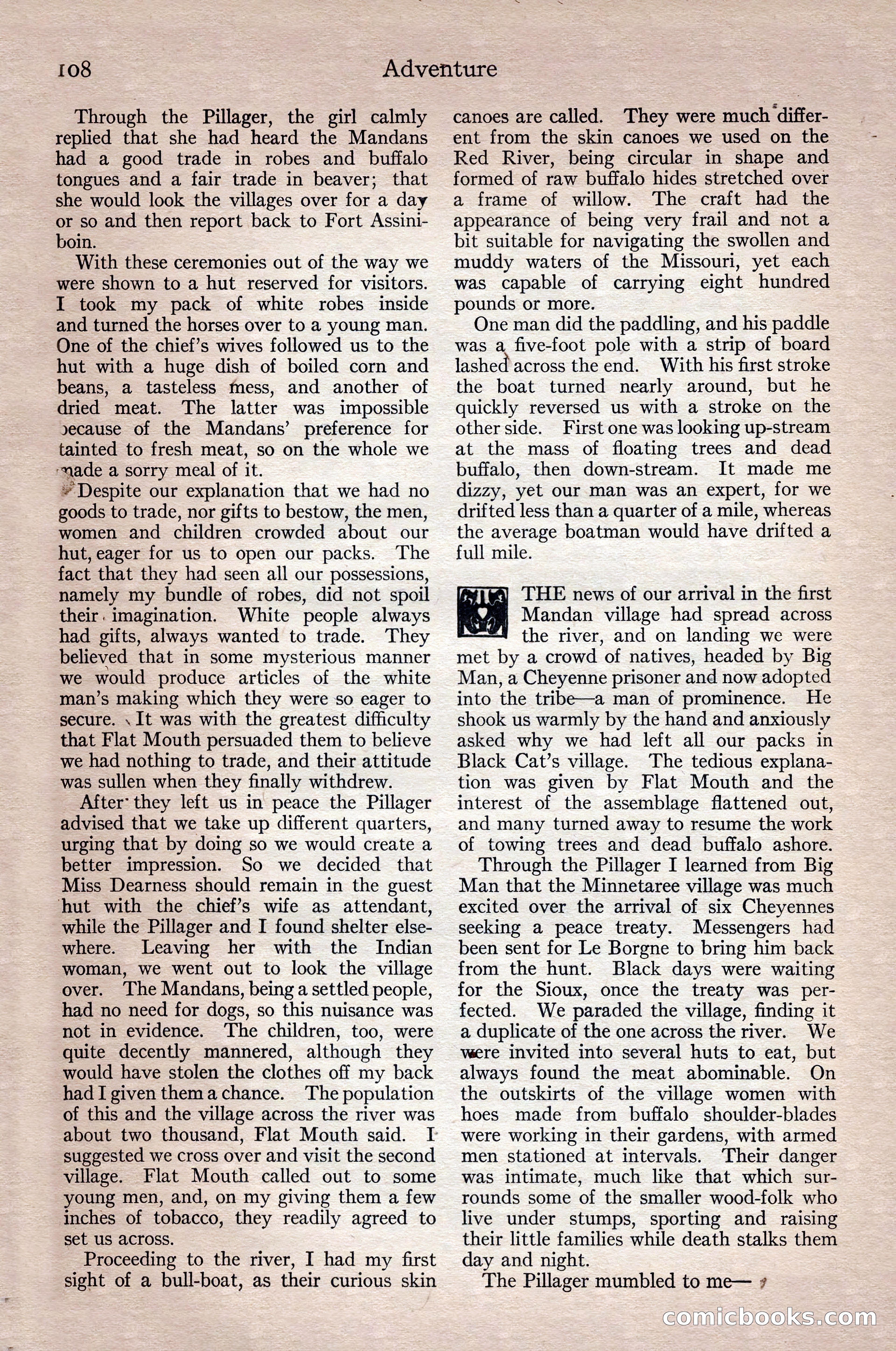
A restored page from Pulp Fiction, 1919. Page through the whole issue in the reader above.
📄 Transcribed text from this page (OCR, searchable)
Machine-transcribed from the original scan — historical spelling and the odd misread are preserved.
108 Through the Pillager, the girl calmly replied that she had heard the Mandans had a good trade in robes and buffalo tongues and a fair trade in beaver; that she would look the villages over for a day or so and then report back to Fort Assini- boin. With these ceremonies out of the way we were shown to a hut reserved for visitors. I took my pack of white robes inside and turned the horses over to a young man. One of the chief’s wives followed us to the hut with a huge dish of boiled corn and beans, a tasteless mess, and another of dried meat. The latter was impossible yecause of the Mandans’ preference for tainted to fresh meat, so on the whole we ‘made a sorry meal of it. » Despite our explanation that we had no goods to trade, nor gifts to bestow, the men, women and children crowded about our hut, eager for us to open our packs. The fact that they had seen all our possessions, namely my bundle of robes, did not spoil their. imagination. White people always had gifts, always wanted to trade. They believed that in some mysterious manner we would produce articles of the white man’s making which they were so eager to secure. , It was with the greatest difficulty that Flat Mouth persuaded them to believe we had nothing to trade, and their attitude was sullen when they finally withdrew. After’ they left us in peace the Pillager advised that we take up different quarters, urging that by doing so we would create a better impression. So we decided that Miss Dearness should remain in the guest hut with the chief’s wife as attendant, while the Pillager and I found shelter else- where. Leaving her with the Indian woman, we went out to look the village over. The Mandans, being a settled people, had no need for dogs, so this nuisance was not in evidence. The children, too, were quite decently mannered, although they would have stolen the clothes off my back hadI giventhemachance. The population of this and the village across the river was about two thousand, Flat Mouth said. I suggested we cross over and visit the second village. Flat Mouth called out to some young men, and, on my giving them a few inches of tobacco, they readily agreed to set us across. Proceeding to the river, I had my first sight of a bull-boat, as their curious skin Adventure canoes are called. They were much differ- ent from the skin canoes we used on the Red River, being circular in shape and formed of raw buffalo hides stretched over a frame of willow. The craft had the appearance of being very frail and not a bit suitable for navigating the swollen and muddy waters of the Missouri, yet each was capable of carrying eight hundred pounds or more. One man did the paddling, and his paddle was a five-foot pole with a strip of board lashed across the end. With his first stroke the boat turned nearly around, but he quickly reversed us with a stroke on the other side. First one was looking up-stream at the mass of floating trees and dead buffalo, then down-stream. It made me dizzy, yet our man was an expert, for we drifted less than a quarter of a mile, whereas the average boatman would have drifted a full mile. (410) THE news of our arrival in the first | Mandan village had spread across the river, and on landing we were met by a crowd of natives, headed by Big Man, a Cheyenne prisoner and now adopted into the tribe—a man of prominence. He shook us warmly by the hand and anxiously asked why we had left all our packs in Black Cat’s village. The tedious explana- tion was given by Flat Mouth and the interest of the assemblage flattened out, and many turned away to resume the work of towing trees and dead buffalo ashore. Through the Pillager I learned from Big Man that the Minnetaree village was much excited over the arrival of six Cheyennes seeking a peace treaty. Messengers had been sent for Le Borgne to bring him back from the hunt. Black days were waiting for the Sioux, once the treaty was per- fected. We paraded the village, finding it a duplicate of the one across the river. We were invited into several huts to eat, but always found the meat abominable. On the outskirts of the village women with hoes made from buffalo shoulder-blades were working in their gardens, with armed men stationed at intervals. Their danger was intimate, much like that which sur- rounds some of the smaller wood-folk who live under stumps, sporting and raising their little families while death stalks them day and night. The Pillager mumbled to me— # GEomicbooks (E(0)