
Pulp Fiction, 1919 · page 120 of 208
Adventure Magazine Cover — page 120: what you’re looking at
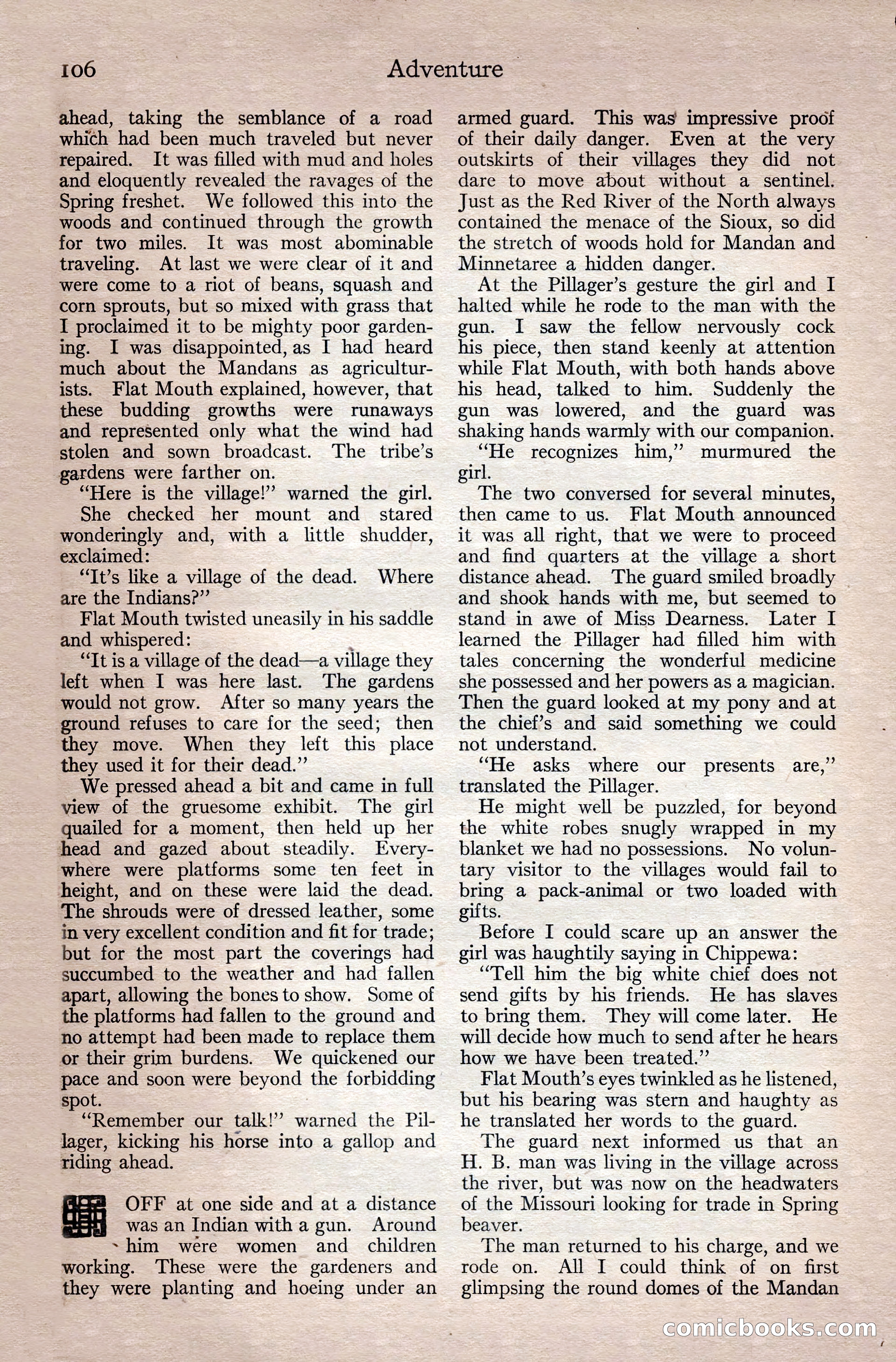
A restored page from Pulp Fiction, 1919. Page through the whole issue in the reader above.
📄 Transcribed text from this page (OCR, searchable)
Machine-transcribed from the original scan — historical spelling and the odd misread are preserved.
106 ahead, taking the semblance of a road which had been much traveled but never repaired. It was filled with mud and holes and eloquently revealed the ravages of the Spring freshet. We followed this into the woods and continued through the growth for two miles. It was most abominable traveling. At last we were clear of it and were come to a riot of beans, squash and corn sprouts, but so mixed with grass that I proclaimed it to be mighty poor garden- ing. I was disappointed, as I had heard much about the Mandans as agricultur- ists. Flat Mouth explained, however, that these budding growths were runaways and represented only what the wind had stolen and sown broadcast. The tribe’s gardens were farther on. “Here is the village!’ warned the girl. She checked her mount and _ stared wonderingly and, with a little shudder, exclaimed: “Tt’s like a village of the dead. Where are the Indians?” Flat Mouth twisted uneasily in his saddle and whispered: “It is a village of the dead—a village they left when I was here last. The gardens would not grow. After so many years the ground refuses to care for the seed; then they move. When they left this place they used it for their dead.” We pressed ahead a bit and came in full view of the gruesome exhibit. The girl quailed for a moment, then held up her head and gazed about steadily. Every- where were platforms some ten feet in height, and on these were laid the dead. The shrouds were of dressed leather, some in very excellent condition and fit for trade; but for the most part the coverings had succumbed to the weather and had fallen apart, allowing the bones to show. Some of the platforms had fallen to the ground and no attempt had been made to replace them or their grim burdens. We quickened our pace and soon were beyond the forbidding spot. “Remember our talk!” warned the Pil- lager, kicking his horse into a gallop and riding ahead. OFF at one side and at a distance was an Indian with a gun. Around ~him were women and children working. These were the gardeners and they were planting and hoeing under an Adventure © armed guard. This was impressive proof of their daily danger. Even at the very outskirts of their villages they did not dare to move about without a sentinel. Just as the Red River of the North always contained the menace of the Sioux, so did the stretch of woods hold for Mandan and Minnetaree a hidden danger. At the Pillager’s gesture the girl and I halted while he rode to the man with the gun. I saw the fellow nervously cock his piece, then stand keenly at attention while Flat Mouth, with both hands above his head, talked to him. Suddenly the gun was lowered, and the guard was shaking hands warmly with our companion. “He recognizes him,’ murmured the girl. The two conversed for several minutes, then came to us. Flat Mouth announced it was all right, that we were to proceed and find quarters at the village a short distance ahead. The guard smiled broadly | and shook hands with me, but seemed to stand in awe of Miss Dearness. Later I learned the Pillager had filled him with tales concerning the wonderful medicine she possessed and her powers as a magician. Then the guard looked at my pony and at the chief’s and said something we could not understand. “He asks where our presents are,” translated the Pillager. He might well be puzzled, for beyond the white robes snugly wrapped in my blanket we had no possessions. No volun- tary visitor to the villages would fail to bring a pack-animal or two loaded with gifts. Before I could scare up an answer the girl was haughtily saying in Chippewa: “Tell him the big white chief does not send gifts by his friends. He has slaves to bring them. They will come later. He will decide how much to send after he hears how we have been treated.” Flat Mouth’s eyes twinkled as he listened, but his bearing was stern and haughty as he translated her words to the guard. The guard next informed us that an H. B. man was living in the village across the river, but was now on the headwaters of the Missouri looking for trade in Spring beaver. The man returned to his charge, and we rode on. All I could think of on first glimpsing the round domes of the Mandan Gomichbooks (EO)