
Pulp Fiction, 1918 · page 183 of 194
Adventure Magazine Cover, April 3, 1918 — page 183: what you’re looking at
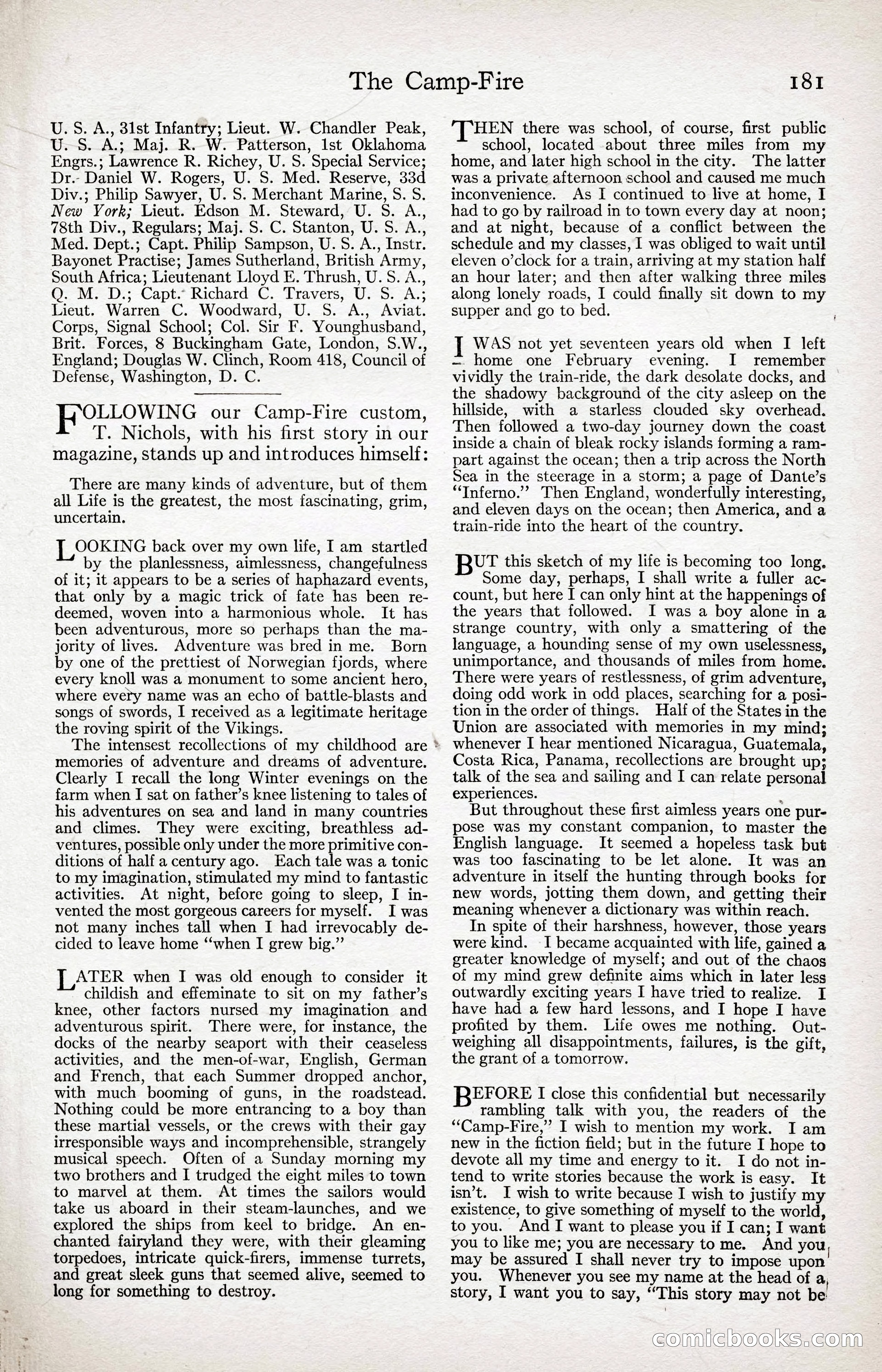
A restored page from Pulp Fiction, 1918. Page through the whole issue in the reader above.
📄 Transcribed text from this page (OCR, searchable)
Machine-transcribed from the original scan — historical spelling and the odd misread are preserved.
The Camp-Fire U.S. A., 31st Infantry; Lieut. W. Chandler Peak, U. S. A.; Maj. R. W. Patterson, Ist Oklahoma Engrs.; Lawrence R. Richey, U. S. Special Service; Dr.- Daniel W. Rogers, U. 5. Med. Reserve, 33d Div.; Philip Sawyer, U. S. Merchant Marine, S. S. New York; Lieut. Edson M. Steward, U. S. A., 78th Div., Regulars; Maj. S. C. Stanton, U.S. A., Med. Dept.; Capt. Philip Sampson, U. S. A., Instr. Bayonet Practise; James Sutherland, British Army, South Africa; Lieutenant Lloyd E. Thrush, U.S. A., Q. M. D.; Capt. Richard C. Travers, U. S. A.; Lieut. Warren C. Woodward, U. S. A., Aviat. Corps, Signal School; Col. Sir F. Younghusband, Brit. Forces, 8 Buckingham Gate, London, S.W., England; Douglas W. Clinch, Room 418, Council of Defense, Washington, D. C. Fe OLLOWEN G our Camp-Fire custom, T. Nichols, with his first story in our magazine, stands up and introduces himself: There are many kinds of adventure, but of them all Life is the greatest, the most fascinating, grim, uncertain. LOOKING back over my own life, I am startled by the planlessness, aimlessness, changefulness of it; it appears to be a series of haphazard events, that only by a magic trick of fate has been re- deemed, woven into a harmonious whole. It has been adventurous, more so perhaps than the ma- jority of lives. Adventure was bred in me. Born by one of the prettiest of Norwegian fjords, where every knoll was a monument to some ancient hero, where every name was an echo of battle-blasts and songs of swords, I received as a legitimate heritage the roving spirit of the Vikings. The intensest recollections of my childhood are memories of adventure and dreams of adventure. Clearly I recall the long Winter evenings on the farm when I sat on father’s knee listening to tales of his adventures on sea and land in many countries and climes. They were exciting, breathless ad- ventures, possible only under the more primitive con- ditions of half a century ago. Each tale was a tonic to my imagination, stimulated my mind to fantastic activities. At night, before going to sleep, I in- vented the most gorgeous careers for myself. I was not many inches tall when I had irrevocably de- cided to leave home ‘‘when I grew big.” ATER when I was old enough to consider it childish and effeminate to sit on my father’s knee, other factors nursed my imagination and adventurous spirit. ‘There were, for instance, the docks of the nearby seaport with their ceaseless activities, and the men-of-war, English, German and French, that each Summer dropped anchor, with much booming of guns, in the roadstead. Nothing could be more entrancing to a boy than these martial vessels, or the crews with their gay irresponsible ways and incomprehensible, strangely musical speech. Often of a Sunday morning my two brothers and I trudged the eight miles to town to marvel at them. At times the sailors would take us aboard in their steam-launches, and we explored the ships from keel to bridge. An en- chanted fairyland they were, with their gleaming torpedoes, intricate quick-firers, immense turrets, and great sleek guns that seemed alive, seemed to long for something to destroy. ff ISI HEN there was school, of course, first public school, located about three miles from my home, and later high school in the city. The latter was a private afternoon school and caused me much inconvenience. As I continued to live at home, I had to go by railroad in to town every day at noon; and at night, because of a conflict between the schedule and my classes, I was obliged to wait until eleven o’clock for a train, arriving at my station half an hour later; and then after walking three miles along lonely roads, I could finally sit down to my supper and go to bed. | WAS not yet seventeen years old when I left — home one February evening. I remember vividly the train-ride, the dark desolate docks, and the shadowy background of the city asleep on the hillside, with a starless clouded sky overhead. Then followed a two-day journey down the coast inside a chain of bleak rocky islands forming a ram- part against the ocean; then a trip across the North Sea in the steerage in a storm; a page of Dante’s “Inferno.” Then England, wonderfully interesting, and eleven days on the ocean; then America, and a train-ride into the heart of the country. UT this sketch of my life is becoming too long, Some day, perhaps, I shall write a fuller ac- count, but here I can only hint at the happenings of the years that followed. I was a boy alone in a strange country, with only a smattering of the language, a hounding sense of my own uselessness, unimportance, and thousands of miles from home. There were years of restlessness, of grim adventure, doing odd work in odd places, searching for a posi- tion in the order of things. Half of the States in the Union are associated with memories in my mind; whenever I hear mentioned Nicaragua, Guatemala, Costa Rica, Panama, recollections are brought up; talk of the sea and sailing and I can relate personal experiences. : But throughout these first aimless years one pur- pose was my constant companion, to master the English language. It seemed a hopeless task but was too fascinating to be let alone. It was an adventure in itself the hunting through books for new words, jotting them down, and getting their meaning whenever a dictionary was within reach. In spite of their harshness, however, those years were kind. I became acquainted with life, gained a greater knowledge of myself; and out of the chaos of my mind grew definite aims which in later less outwardly exciting years I have tried to realize. I have had a few hard lessons, and I hope I have profited by them. Life owes me nothing. Out- weighing all disappointments, failures, is the gift, the grant of a tomorrow. BEFORE I close this confidential but necessarily rambling talk with you, the readers of the ‘“Camp-Fire,”’ I wish to mention my work. I am new in the fiction field; but in the future I hope to devote all my time and energy to it. I do not in- tend to write stories because the work is easy. It isn’t. I wish to write because I wish to justify my existence, to give something of myself to the world, to you. And I want to please you if I can; I want you to like me; you are necessary tome. And you may be assured I shall never try to impose upon you. Whenever you see my name at the head of a story, I want you to say, “This story may not be MICLOOOKS (C@