
Pulp Fiction, 1918 · page 182 of 194
Adventure Magazine Cover, April 3, 1918 — page 182: what you’re looking at
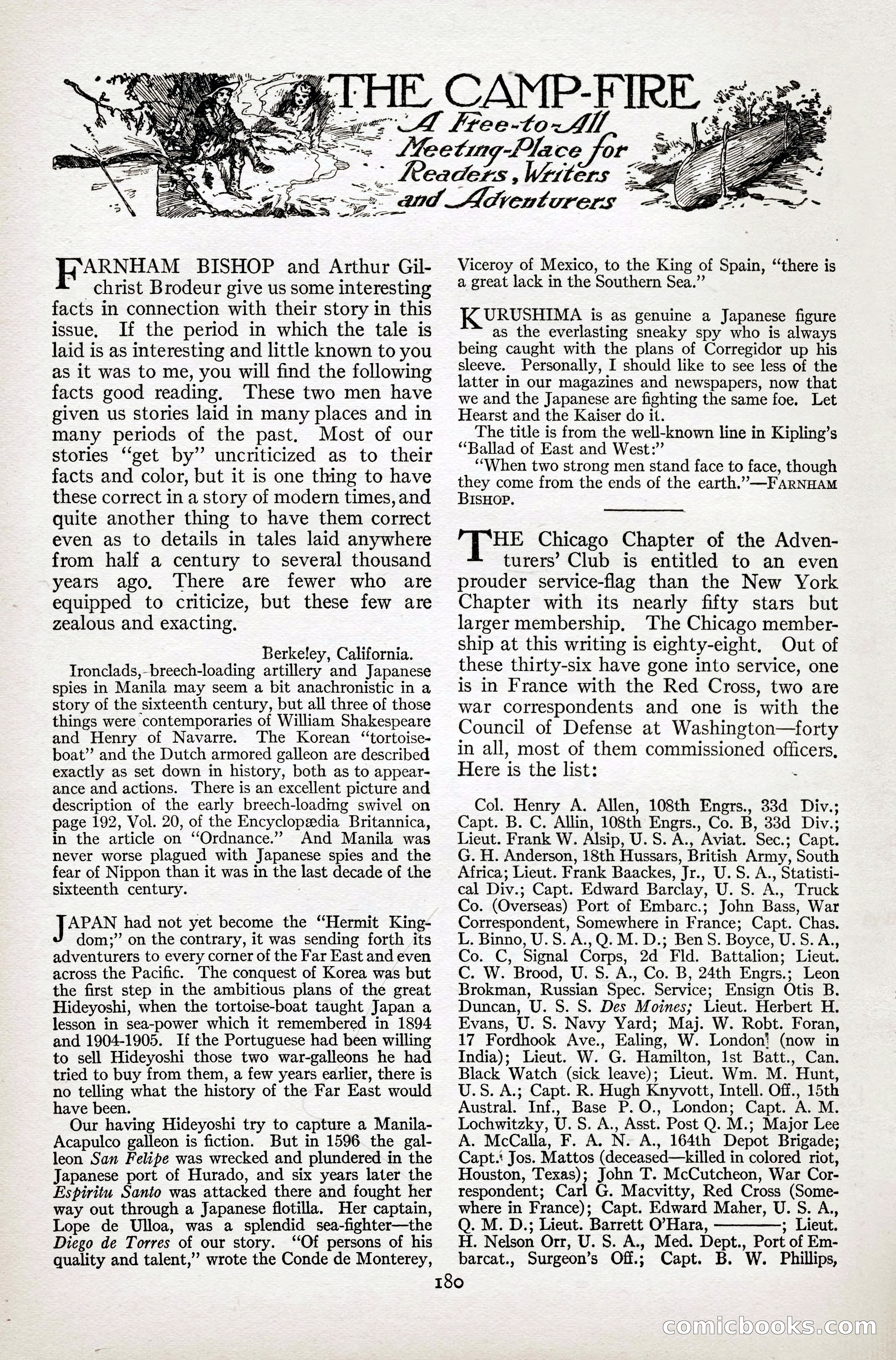
A restored page from Pulp Fiction, 1918. Page through the whole issue in the reader above.
📄 Transcribed text from this page (OCR, searchable)
Machine-transcribed from the original scan — historical spelling and the odd misread are preserved.
WN \H oN 4ARNHAM BISHOP and Arthur Gil- christ Brodeur give us some interesting facts in connection with their story in this issue, If the period in which the tale is laid is as interesting and little known to you as it was to me, you will find the following facts good reading. These two men have given us stories laid in many places and in many periods of the past. Most of our stories “‘get by” uncriticized as to their facts and color, but it is one thing to have these correct in a story of modern times, and quite another thing to have them correct even as to details in tales laid anywhere from half a century to several thousand years ago. There are fewer who are equipped to criticize, but these few are zealous and exacting. Berkeley, California. Tronclads,- breech-loading artillery and Japanese spies in Manila may seem a bit anachronistic in a story of the sixteenth century, but all three of those things were contemporaries of William Shakespeare and Henry of Navarre. The Korean “tortoise- boat” and the Dutch armored galleon are described exactly as set down in history, both as to appear- ance and actions. There is an excellent picture and description of the early breech-loadmg swivel on page 192, Vol. 20, of the Encyclopedia Britannica, in the article on ‘‘Ordnance.” And Manila was never worse plagued with Japanese spies and the fear of Nippon than it was in the last decade of the sixteenth century. aN had not yet become the “Hermit King- dom;”’ on the contrary, it was sending forth its adventurers to every corner of the Far East and even across the Pacific. The conquest of Korea was but the first step in the ambitious plans of the great Hideyoshi, when the tortoise-boat taught Japan a lesson in sea-power which it remembered in 1894 and 1904-1905. If the Portuguese had been willing to sell Hideyoshi those two war-galleons he had tried to buy from them, a few years earlier, there is no telling what the history of the Far East would have been. Our having Hideyoshi try to capture a Manila- Acapulco galleon is fiction. But in 1596 the gal- leon San Felipe was wrecked and plundered in the Japanese port of Hurado, and six years later the Espiritu Sanio was attacked there and fought her way out through a Japanese flotilla. Her captain, Lope de Ulloa, was a splendid sea-fighter—the Diego de Torres of our story. “Of persons of his quality and talent,’”’ wrote the Conde de Monterey, Viceroy of Mexico, to the King of Spain, “there is a great lack in the Southern Sea.” K URUSHIMA is as genuine a Japanese figure as the everlasting sneaky spy who is always being caught with the plans of Corregidor up his sleeve. Personally, I should like to see less of the latter in our magazines and newspapers, now that we and the Japanese are fighting the same foe. Let Hearst and the Kaiser do it. The title is from the well-known line in Kipling’s “Ballad of East and West:” ‘When two strong men stand face to face, though they come from the ends of the earth. ”__FARNHAM BISHOP. "THE Chicago Chapter of the Adven- turers’ Club is entitled to an even prouder service-flag than the New York Chapter with its nearly fifty stars but larger membership, ‘The Chicago member- ship at this writing is eighty-eight, Out of these thirty-six have gone into service, one is in France with the Red Cross, two are war correspondents and one is with the Council of Defense at Washington—forty in all, most of them commissioned officers, Here is the list: Col. Henry A. Allen, 108th Engrs., 33d Div.; Capt. B. C. Allin, 108th Engrs., Co. B, 33d Div.: . Lieut. Frank W. Alsip, U.S: As; "Aviat. Sec.; Capt. G. H. Anderson, 18th Hussars, British Army, South Africa; Lieut. Frank Baackes, Tr., U.5. A., Statisti- cal Div.; ; Capt. Edward Barclay, Ud. Ac. Truck Co. (Overseas) Port of Embarc.; John Bass, War Correspondent, Somewhere in France; Capt. Chas. L. Binno, U.S. A.,Q. M. D.; BenS. Boyce, U.S. Aa Co. C, Signal Corps, 2d Fld. Battalion; Lieut. C. W. Brood, U. S. A., Co. B, 24th Engrs.; Leon Brokman, Russian Spec. Service; Ensign Otis B. Duncan, U. S. S. Des Moines; Lieut. Herbert H. Evans, U. S. Navy Yard; Maj. W. Robt. Foran, 17 Fordhook Ave., Ealing, W. London! (now in India); Lieut. W. G. Hamilton, 1st Batt., Can. Black Watch (sick leave); Lieut. Wm. M. Hunt, U.S. A.; Capt. R. Hugh Knyvott, Intell. Off., 15th Austral. Inf., Base P.O., London; Capt. A. M. Lochwitzky, U.S. A., Asst. Post Q. M.; Major Lee A. McCalla, F. A. N. A., 164th Depot Brigade; Capt. Jos. Mattos (deceased—killed i in colored riot, Houston, Texas); John T. McCutcheon, War Cor- respondent; Carl G. Macvitty, Red Cross (Some- where in France); Capt. Edward Maher, U. S. A, Q. M. D.; Lieut. ‘Barrett O’Hara, : Lieut. H. Nelson Orr, U. S. A., Med. Dept., Port of Em- barcat., Surgeon’s Off.; Capt. B. W. Phillips, 180 Gomichbooks (C@)