
Pulp Fiction, 1918 · page 171 of 194
Adventure Magazine Cover, April 3, 1918 — page 171: what you’re looking at
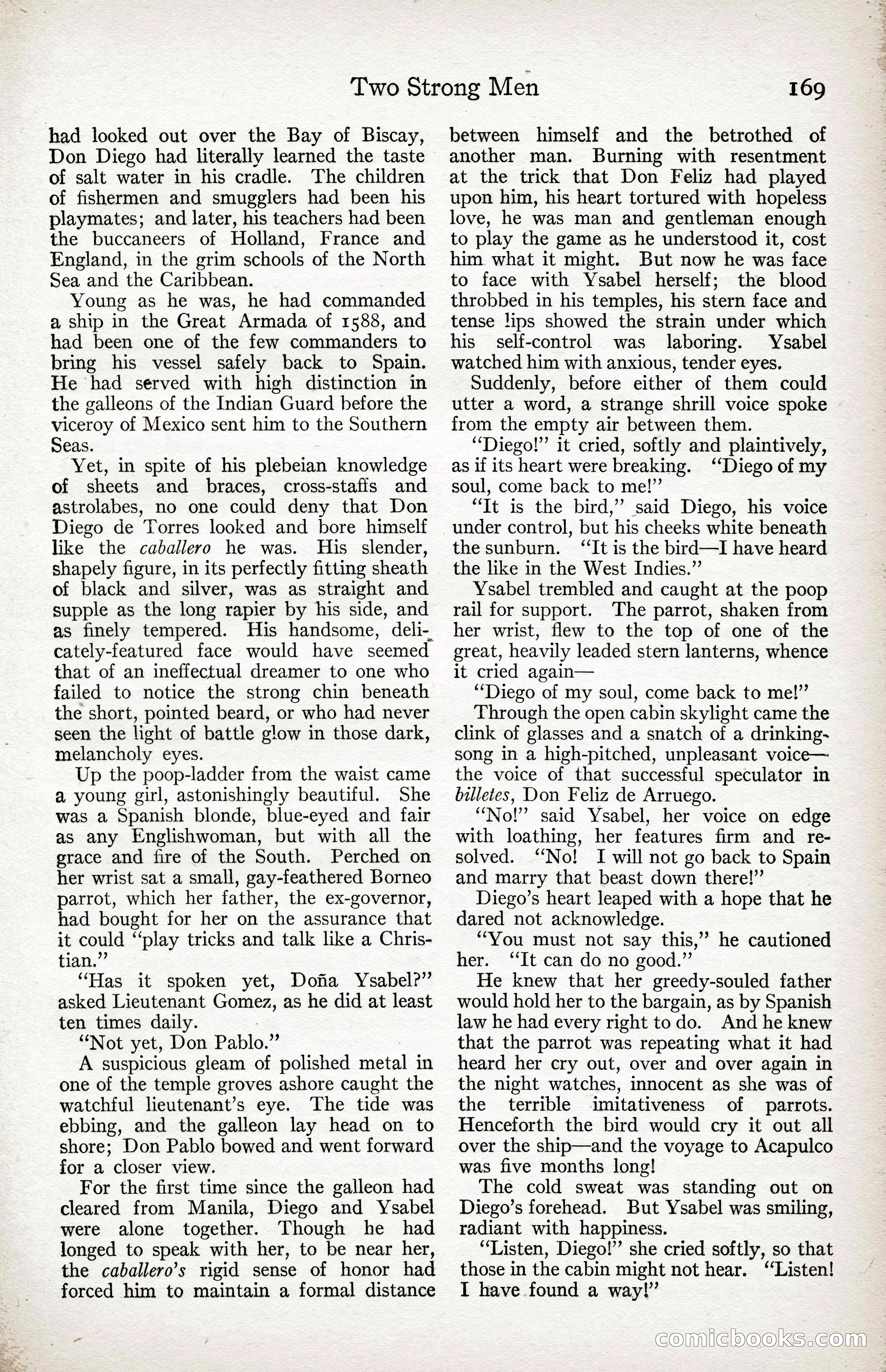
A restored page from Pulp Fiction, 1918. Page through the whole issue in the reader above.
📄 Transcribed text from this page (OCR, searchable)
Machine-transcribed from the original scan — historical spelling and the odd misread are preserved.
Two Strong Men had looked out over the Bay of Biscay, Don Diego had literally learned the taste of salt water in his cradle. The children of fishermen and smugglers had been his playmates; and later, his teachers had been the buccaneers of Holland, France and England, in the grim schools of the North Sea and the Caribbean. Young as he was, he had commanded a ship in the Great Armada of 1588, and had been one of the few commanders to bring his vessel safely back to Spain. He had served with high distinction in the galleons of the Indian Guard before the viceroy of Mexico sent him to the Southern Seas. Yet, in spite of his plebeian knowledge of sheets and braces, cross-stafis and astrolabes, no one could deny that Don Diego de Torres looked and bore himself like the caballero he was. His slender, shapely figure, in its perfectly fitting sheath of black and silver, was as straight and supple as the long rapier by his side, and as finely tempered. His handsome, deli- cately-featured face would have seemed that of an ineffectual dreamer to one who failed to notice the strong chin beneath the short, pointed beard, or who had never seen the light of battle glow in those dark, melancholy eyes. Up the poop-ladder from the waist came a young girl, astonishingly beautiful. She was a Spanish blonde, blue-eyed and fair as any Englishwoman, but with all the grace and fire of the South. Perched on her wrist sat a small, gay-feathered Borneo parrot, which her father, the ex-governor, had bought for her on the assurance that it could “‘play tricks and talk like a Chris- tian.” “Has it spoken yet, Dofia Ysabel?” asked Lieutenant Gomez, as he did at least ten times daily. , “Not yet, Don Pablo.” A suspicious gleam of polished metal in one of the temple groves ashore caught the watchful lieutenant’s eye. The tide was ebbing, and the galleon lay head on to shore; Don Pablo bowed and went forward for a closer view. For the first time since the galleon had cleared from Manila, Diego and Ysabel were alone together. Though he had longed to speak with her, to be near her, the caballero’s rigid sense of honor had forced him to maintain a formal distance 169 between himself and the betrothed of another man. Burning with resentment at the trick that Don Feliz had played upon him, his heart tortured with hopeless love, he was man and gentleman enough to play the game as he understood it, cost him what it might. But now he was face to face with Ysabel herself; the blood throbbed in his temples, his stern face and tense lips showed the strain under which his self-control was laboring. Ysabel watched him with anxious, tender eyes. Suddenly, before either of them could utter a word, a strange shrill voice spoke from the empty air between them. “Diego!” it cried, softly and plaintively, as if its heart were breaking. “Diego of my soul, come back to me!” “It is the bird,” said Diego, his voice under control, but his cheeks white beneath the sunburn. “It is the bird—I have heard the like in the West Indies.” Ysabel trembled and caught at the poop rail for support. The parrot, shaken from her wrist, flew to the top of one of the great, heavily leaded stern lanterns, whence it cried again— “Diego of my soul, come back to me!” Through the open cabin skylight came the clink of glasses and a snatch of a drinking- song in a high-pitched, unpleasant voice— the voice of that successful speculator in billetes, Don Feliz de Arruego. “No!” said Ysabel, her voice on edge with loathing, her features firm and re- solved. ‘‘No! I will not go back to Spain and marry that beast down there!’ Diego’s heart leaped with a hope that he dared not acknowledge. ‘You must not say this,” he cautioned her. ‘It can do no good.” He knew that her greedy-souled father would hold her to the bargain, as by Spanish law he had every right todo. And he knew that the parrot was repeating what it had heard her cry out, over and over again in the night watches, innocent as she was of the terrible imitativeness of parrots. Henceforth the bird would cry it out all over the ship—and the voyage to Acapulco was five months long! The cold sweat was standing out on Diego’s forehead. But Ysabel was smiling, radiant with happiness. “Listen, Diego!” she cried softly, so that those in the cabin might not hear. ‘Listen! I have found a way!” CORnnICLOO S (C@