
Pulp Fiction, 1918 · page 170 of 194
Adventure Magazine Cover, April 3, 1918 — page 170: what you’re looking at
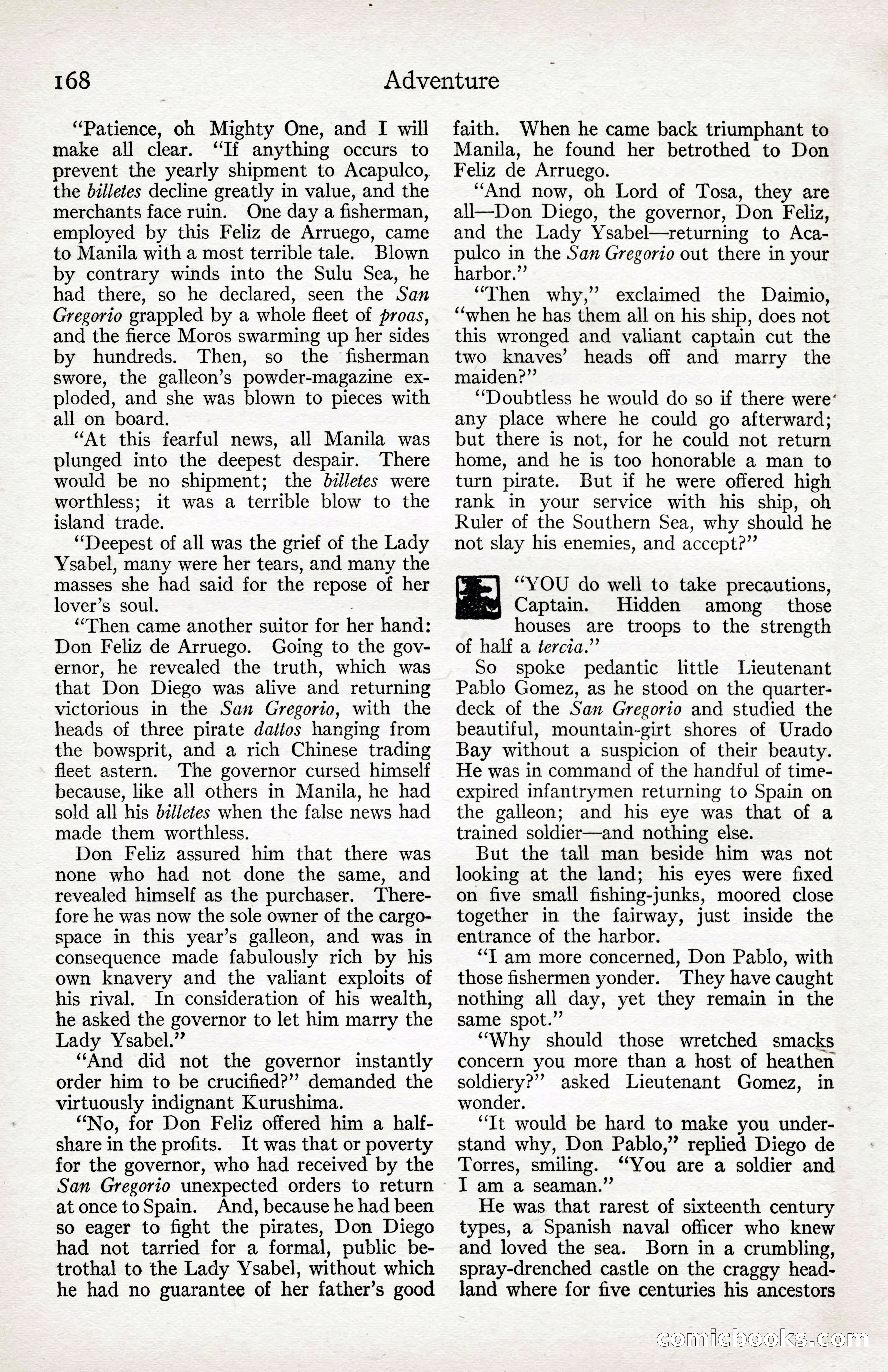
A restored page from Pulp Fiction, 1918. Page through the whole issue in the reader above.
📄 Transcribed text from this page (OCR, searchable)
Machine-transcribed from the original scan — historical spelling and the odd misread are preserved.
168 “Patience, oh Mighty One, and I will make all clear. “If anything occurs to prevent the yearly shipment to Acapulco, the billetes decline greatly in value, and the merchants face ruin. One day a fisherman, employed by this Feliz de Arruego, came to Manila with a most terrible tale. Blown by contrary winds into the Sulu Sea, he had there, so he declared, seen the San Gregorio grappled by a whole fleet of proas, and the fierce Moros swarming up her sides by hundreds. Then, so the fisherman swore, the galleon’s powder-magazine ex- ploded, and she was blown to pieces with all on board. “At this fearful news, all Manila was plunged into the deepest despair. There would be no shipment; the dzlletes were worthless; it was a terrible blow to the island trade. “Deepest of all was the grief of the Lady Ysabel, many were her tears, and many the masses she had said for the repose of her lover’s soul. : “Then came another suitor for her hand: Don Feliz de Arruego. Going to the gov- ernor, he revealed the truth, which was that Don Diego was alive and returning victorious in the San Gregorio, with the heads of three pirate dattos hanging from the bowsprit, and a rich Chinese trading fleet astern. The governor cursed himself because, like all others in Manila, he had sold all his billetes when the false news had made them worthless. Don Feliz assured him that there was none who had not done the same, and revealed himself as the purchaser. There- fore he was now the sole owner of the cargo- space in this year’s galleon, and was in consequence made fabulously rich by his own knavery and the valiant exploits of his rival. In consideration of his wealth, he asked the governor to let him marry the Lady Ysabel.” “And did not the governor instantly order him to be crucified?’’ demanded the virtuously indignant Kurushima. “No, for Don Feliz offered him a half- share in the profits. It was that or poverty for the governor, who had received by the San Gregorio unexpected orders to return at once toSpain. And, because he had been so eager to fight the pirates, Don Diego had not tarried for a formal, public be- trothal to the Lady Ysabel, without which he had no guarantee of her father’s good Adventure faith. When he came back triumphant to Manila, he found her betrothed to Don Feliz de Arruego. ‘And now, oh Lord of Tosa, they are all—Don Diego, the governor, Don Feliz, and the Lady Ysabel—returning to Aca- pulco in the San Gregorio out there in your harbor.”’ “Then why,’ exclaimed the Daimio, ‘“‘when he has them all on his ship, does not this wronged and valiant captain cut the two knaves’ heads off and marry the maiden?” ‘Doubtless he would do so if there were‘ any place where he could go afterward; but there is not, for he could not return home, and he is too honorable a man to turn pirate. But if he were offered high rank in your service with his ship, oh Ruler of the Southern Sea, why should he not slay his enemies, and accept?” “YOU do well to take precautions, Captain. Hidden among _ those houses are troops to the strength of half a fercia.” So spoke pedantic little Lieutenant Pablo Gomez, as he stood on the quarter- deck of the San Gregorio and studied the beautiful, mountain-girt shores of Urado Bay without a suspicion of their beauty. He was in command of the handful of time- expired infantrymen returning to Spain on the galleon; and his eye was that of a trained soldier—and nothing else. But the tall man beside him was not looking at the land; his eyes were fixed on five small fishing-junks, moored close together in the fairway, just inside the entrance of the harbor. ‘“‘T am more concerned, Don Pablo, with those fishermen yonder. They have caught nothing all day, yet they remain in the same spot.” “Why should those wretched smacks concern you more than a host of heathen soldiery?” asked Lieutenant Gomez, in wonder. “Tt would be hard to make you under- | stand why, Don Pablo,” replied Diego de Torres, smiling. “You are a soldier and I] am a seaman.” He was that rarest of sixteenth century types, a Spanish naval officer who knew and loved the sea. Born in a crumbling, spray-drenched castle on the craggy head- land where for five centuries his ancestors CORNICL@Oo S (C@)