
Pulp Fiction, 1918 · page 154 of 194
Adventure Magazine Cover, April 3, 1918 — page 154: what you’re looking at
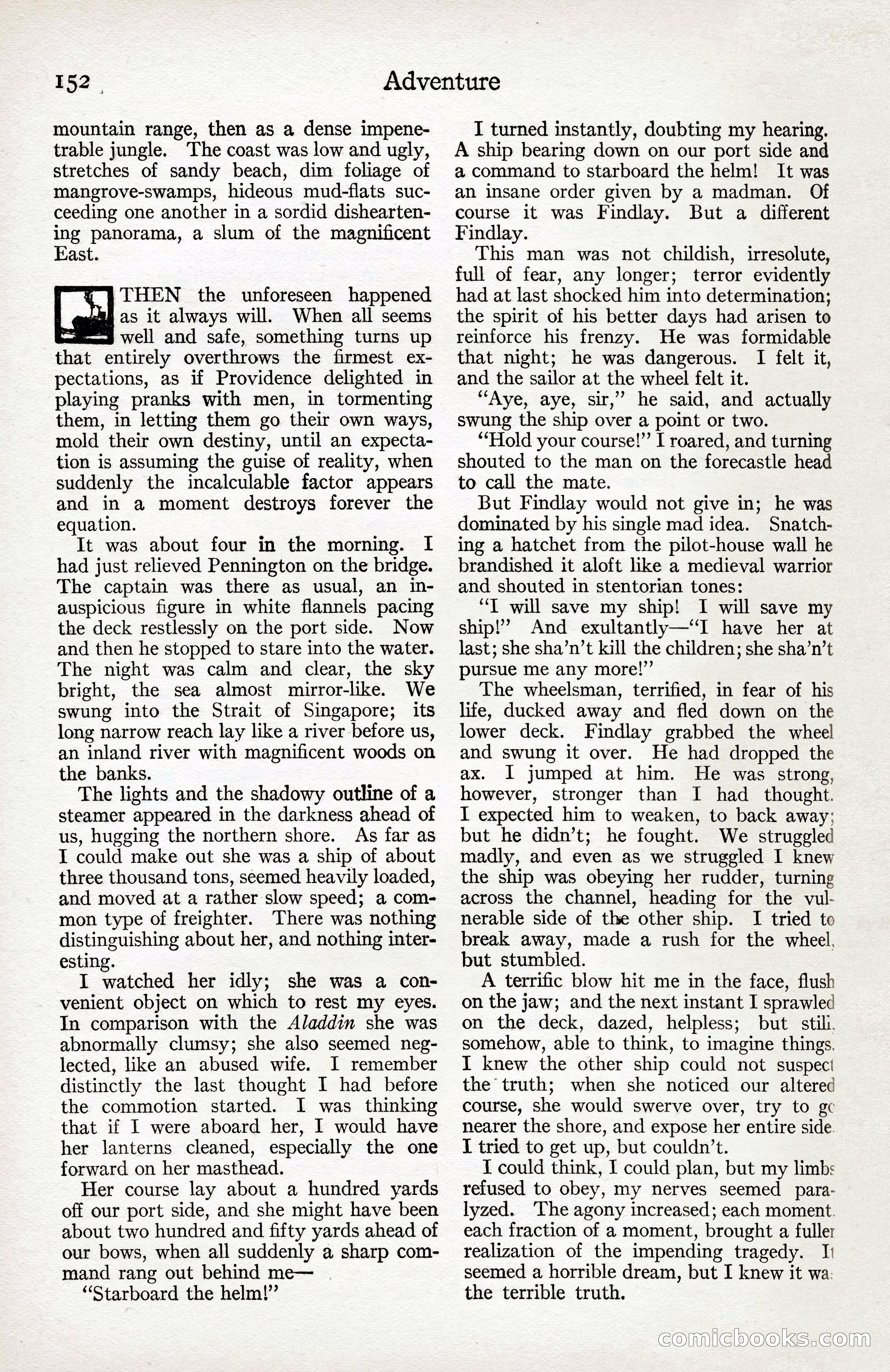
A restored page from Pulp Fiction, 1918. Page through the whole issue in the reader above.
📄 Transcribed text from this page (OCR, searchable)
Machine-transcribed from the original scan — historical spelling and the odd misread are preserved.
152_ mountain range, then as a dense impene- trable jungle. The coast was low and ugly, stretches of sandy beach, dim foliage of mangrove-swamps, hideous mud-flats suc- ceeding one another in a sordid dishearten- ing panorama, a slum of the magnificent Fast. 3 THEN the unforeseen happened 7 fas it always will. When all seems tiie’ Well and safe, something turns up that entirely overthrows the firmest ex- pectations, as if Providence delighted in playing pranks with men, in tormenting them, in letting them go their own ways, mold their own destiny, until an expecta- tion is assuming the guise of reality, when suddenly the incalculable factor appears and in a moment destroys forever the equation. It was about four in the morning. I had just relieved Pennington on the bridge. The captain was there as usual, an in- auspicious figure in white flannels pacing the deck restlessly on the port side. Now and then he stopped to stare into the water. The night was calm and clear, the sky bright, the sea almost mirror-like. We swung into the Strait of Singapore; its long narrow reach lay like a river before us, an inland river with magnificent woods on the banks. The lights and the shadowy outline of a steamer appeared in the darkness ahead of us, hugging the northern shore. As far as I could make out she was a ship of about three thousand tons, seemed heavily loaded, and moved at a rather slow speed; a com- mon type of freighter. There was nothing distinguishing about her, and nothing inter- esting. I watched her idly; she was a con- venient object on which to rest my eyes. In comparison with the Aladdin she was abnormally clumsy; she also seemed neg- lected, like an abused wife. I remember distinctly the last thought I had before the commotion started. I was thinking that if I were aboard her, I would have her lanterns cleaned, especially the one forward on her masthead. Her course lay about a hundred yards off our port side, and she might have been about two hundred and fifty yards ahead of our bows, when all suddenly a sharp com- mand rang out behind me— | “Starboard the helm!” Adventure I turned instantly, doubting my hearing. A ship bearing down on our port side and a command to starboard the helm! It was an insane order given by a madman. Of course it was Findlay. But a different Findlay. This man was not childish, irresolute, full of fear, any longer; terror evidently had at last shocked him into determination; the spirit of his better days had arisen to reinforce his frenzy. He was formidable that night; he was dangerous. I felt it, and the sailor at the wheel felt it. “Aye, aye, sir,” he said, and actually swung the ship over a point or two. “Hold your course!’’ I roared, and turning shouted to the man on the forecastle head to call the mate. But Findlay would not give in; he was dominated by his single mad idea. Snatch- ing a hatchet from the pilot-house wall he brandished it aloft like a medieval warrior and shouted in stentorian tones: “T will save my ship! I will save my ship!’ And exultantly—T have her at last; she sha’n’t kill the children; she sha’n’t pursue me any more!”’ The wheelsman, terrified, in fear of his life, ducked away and fled down on the lower deck. Findlay grabbed the wheel and swung it over. He had dropped the ax. JI jumped at him. He was strong, however, stronger than I had thought. I expected him to weaken, to back away; but he didn’t; he fought. We struggled madly, and even as we struggled I knew the ship was obeying her rudder, turning across the channel, heading for the vul- nerable side of the other ship. I tried to break away, made a rush for the wheel, but stumbled. A terrific blow hit me in the face, flush on the jaw; and the next instant I sprawled on the deck, dazed, helpless; but stili. somehow, able to think, to imagine things. I knew the other ship could not suspect the truth; when she noticed our altered course, she would swerve over, try to gc nearer the shore, and expose her entire side. I tried to get up, but couldn’t. I could think, I could plan, but my limb: refused to obey, my nerves seemed para- lyzed. ‘The agony increased; each moment. each fraction of a moment, brought a fuller realization of the impending tragedy. Ii seemed a horrible dream, but I knew it wa: the terrible truth. COnniclooo S (C@)