
Pulp Fiction, 1918 · page 153 of 194
Adventure Magazine Cover, April 3, 1918 — page 153: what you’re looking at
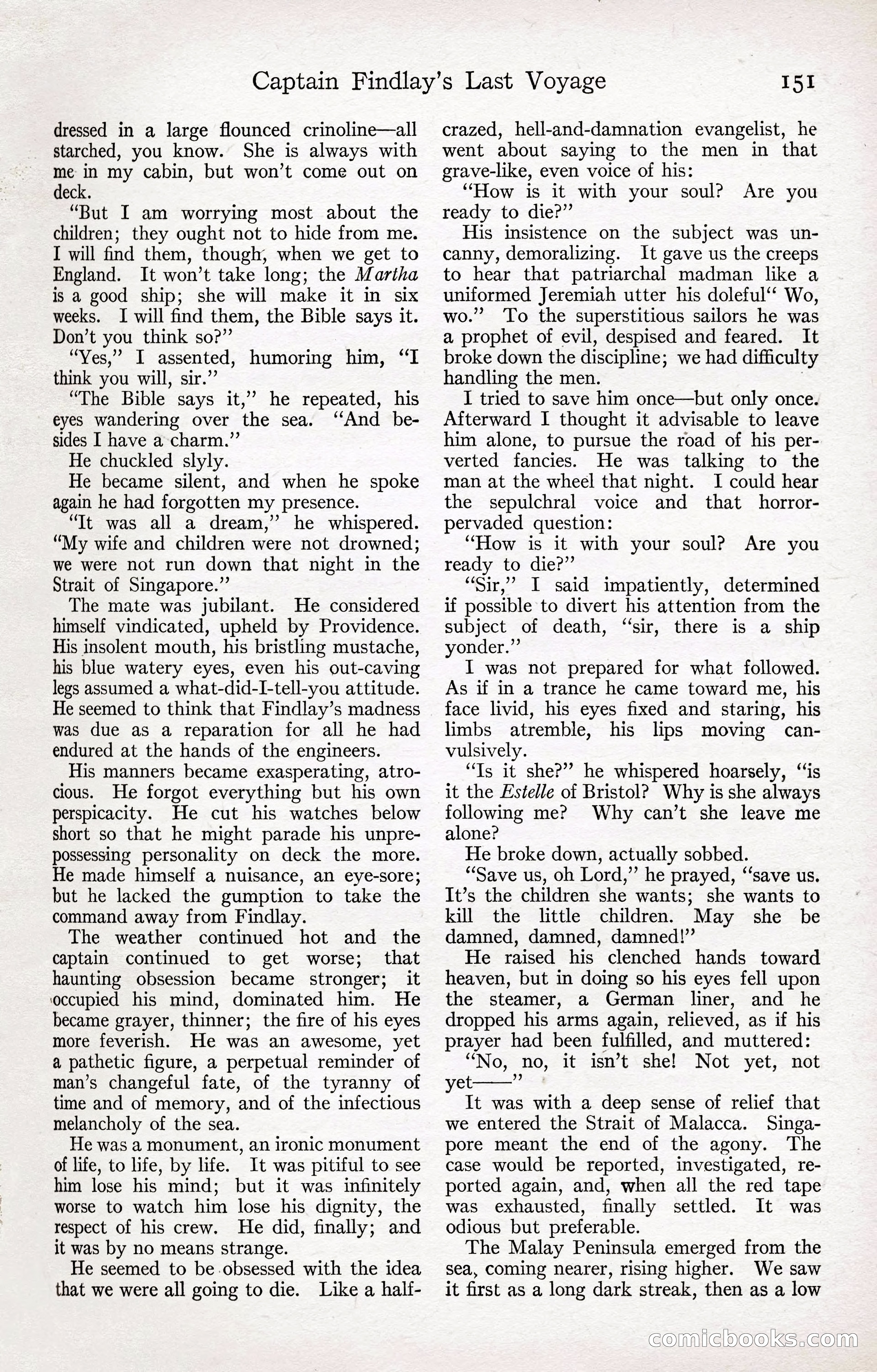
A restored page from Pulp Fiction, 1918. Page through the whole issue in the reader above.
📄 Transcribed text from this page (OCR, searchable)
Machine-transcribed from the original scan — historical spelling and the odd misread are preserved.
Captain Findlay’s Last Voyage dressed in a large flounced crinoline—all starched, you know. She is always with me in my cabin, but won’t come out on deck. “But I am worrying most about the children; they ought not to hide from me. I will find them, though, when we get to England. It won’t take long; the Martha is a good ship; she will make it in six weeks. I will find them, the Bible says it. Don’t you think so?’’ “Yes,” I assented, humoring him, “I think you will, sir.” “The Bible says it,’’ he repeated, his eyes wandering over the sea. “And be- sides I have a charm.” He chuckled slyly. He became silent, and when he spoke again he had forgotten my presence. “It was all a dream,” he whispered. “My wife and children were not drowned; we were not run down that night in the Strait of Singapore.” The mate was jubilant. He considered himself vindicated, upheld by Providence. His insolent mouth, his bristling mustache, his blue watery eyes, even his out-caving legs assumed a what-did-I-tell-you attitude. He seemed to think that Findlay’s madness was due as a reparation for all he had endured at the hands of the engineers. His manners became exasperating, atro- cious. He forgot everything but his own perspicacity. He cut his watches below short so that he might parade his unpre- possessing personality on deck the more. He made himself a nuisance, an eye-sore; but he lacked the gumption to take the command away from Findlay. The weather continued hot and the captain continued to get worse; that haunting obsession became stronger; it occupied his mind, dominated him. He became grayer, thinner; the fire of his eyes more feverish. He was an awesome, yet a pathetic figure, a perpetual reminder of man’s changeful fate, of the tyranny of time and of memory, and of the infectious melancholy of the sea. He was a monument, an ironic monument of life, to life, by life. It was pitiful to see him lose his mind; but it was infinitely worse to watch him lose his dignity, the respect of his crew. He did, finally; and it was by no means strange. He seemed to be obsessed with the idea that we were all going to die. Like a half- I51 crazed, hell-and-damnation evangelist, he went about saying to the men in that grave-like, even voice of his: “How is it with your soul? ready to die?” His insistence on the subject was un- canny, demoralizing. It gave us the creeps to hear that patriarchal madman like a uniformed Jeremiah utter his doleful‘‘ Wo, wo.” To the superstitious sailors he was a prophet of evil, despised and feared. It broke down the discipline; we had difficulty handling the men. : I tried to save him once—but only once. Afterward I thought it advisable to leave him alone, to pursue the road of his per- verted fancies. He was talking to the man at the wheel that night. I could hear the sepulchral voice and that _ horror- pervaded question: “How is it with your soul? ready to die?” “Sir,” I said impatiently, determined if possible to divert his attention from the subject of death, “sir, there is a ship yonder.” I was not prepared for what followed. As if in a trance he came toward me, his face livid, his eyes fixed and staring, his limbs atremble, his lips moving can- vulsively. “Ts it she?” he whispered hoarsely, “‘is it the Estelle of Bristol? Why is she always following me? Why can’t she leave me alone? He broke down, actually sobbed. “Save us, oh Lord,” he prayed, “‘save us. It’s the children she wants; she wants to kill the little children. May she be damned, damned, damned!” He raised his clenched hands toward heaven, but in doing so his eyes fell upon the steamer, a German liner, and he dropped his arms again, relieved, as if his prayer had been fulfilled, and muttered: “No, no, it isn’t she! Not yet, not yet d9 It was with a deep sense of relief that we entered the Strait of Malacca. Singa- pore meant the end of the agony. The case would be reported, investigated, re- ported again, and, when all the red tape was exhausted, finally settled. It was odious but preferable. The Malay Peninsula emerged from the sea, coming nearer, rising higher. We saw it first as a long dark streak, then as a low Are you Are you COnniclooolkxs (C@