
Pulp Fiction, 1918 · page 143 of 194
Adventure Magazine Cover, April 3, 1918 — page 143: what you’re looking at
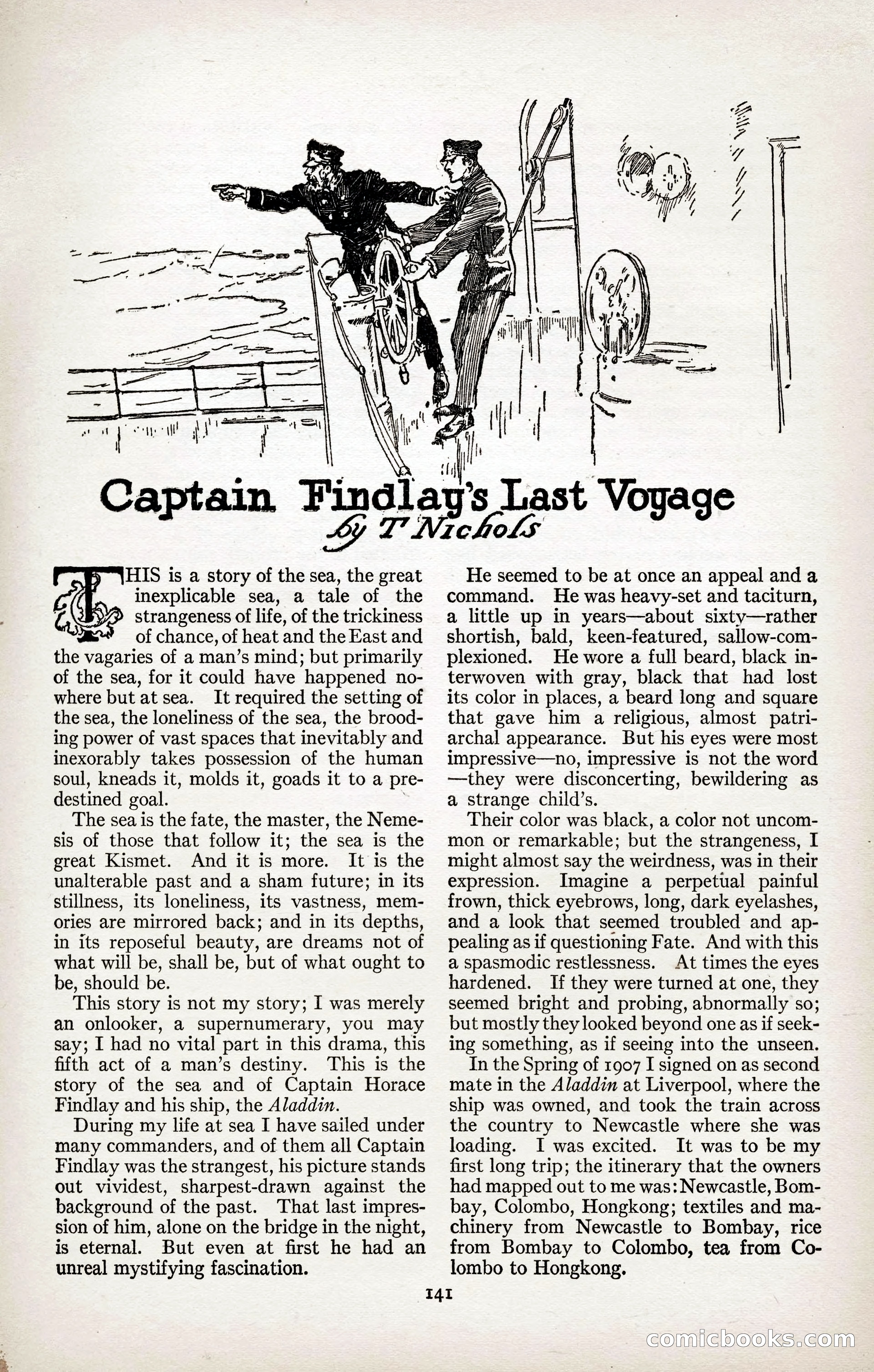
A restored page from Pulp Fiction, 1918. Page through the whole issue in the reader above.
📄 Transcribed text from this page (OCR, searchable)
Machine-transcribed from the original scan — historical spelling and the odd misread are preserved.
“ i cf Ps if 5 ain 1 Fandadh, s Last ‘Voyage Ly T Niche ols HIS is a story of the sea, the great inexplicable sea, a tale of the Gs strangeness of life, of the trickiness of chance, of heat and the East and the vagaries of a man’s mind; but primarily of the sea, for it could have happened no- where but at sea. It required the setting of the sea, the loneliness of the sea, the brood- ing power of vast spaces that inevitably and inexorably takes possession of the human soul, kneads it, molds it, goads it to a pre- destined goal. The sea is the fate, the master, the Neme- sis of those that follow it; the sea is the great Kismet. And it is more. It is the unalterable past and a sham future; in its stillness, its loneliness, its vastness, mem- ories are mirrored back; and in its depths, in its reposeful beauty, are dreams not of what will be, shall be, but of what ought to be, should be. This story is not my story; I was merely an onlooker, a supernumerary, you may say; I had no vital part in this drama, this fifth act of a man’s destiny. This is the story of the sea and of Captain Horace Findlay and his ship, the Aladdin. During my life at sea I have sailed under many commanders, and of them all Captain Findlay was the strangest, his picture stands out vividest, sharpest-drawn against the background of the past. That last impres- sion of him, alone on the bridge in the night, is eternal. But even at first he had an unreal mystifying fascination. He seemed to be at once an appeal and a command. He was heavy-set and taciturn, a little up in years—about sixty—rather shortish, bald, keen-featured, sallow-com- plexioned. He wore a full beard, black in- terwoven with gray, black that had lost its color in places, a beard long and square that gave him a religious, almost patri- archal appearance. But his eyes were most impressive—no, impressive is not the word —they were disconcerting, bewildering as a strange child’s. Their color was black, a color not uncom- mon or remarkable; but the strangeness, I might almost say the weirdness, was in their expression. Imagine a perpetual painful frown, thick eyebrows, long, dark eyelashes, and a look that seemed troubled and ap- pealing as if questioning Fate. And with this a spasmodic restlessness. At times the eyes hardened. If they were turned at one, they seemed bright and probing, abnormally so; but mostly they looked beyond one as if seek- ing something, as if seeing into the unseen. In the Spring of 1907 I signed on as second mate in the Aladdin at Liverpool, where the ship was owned, and took the train across the country to Newcastle where she was loading. I was excited. It was to be my first long trip; the itinerary that the owners had mapped out to me was: Newcastle, Bom- bay, Colombo, Hongkong; textiles and ma-~ chinery from Newcastle to Bombay, rice from Bombay to Colombo, tea from Co- lombo to Hongkong. I41 Gomichbook (C@)