
Pulp Fiction, 1918 · page 141 of 194
Adventure Magazine Cover, April 3, 1918 — page 141: what you’re looking at
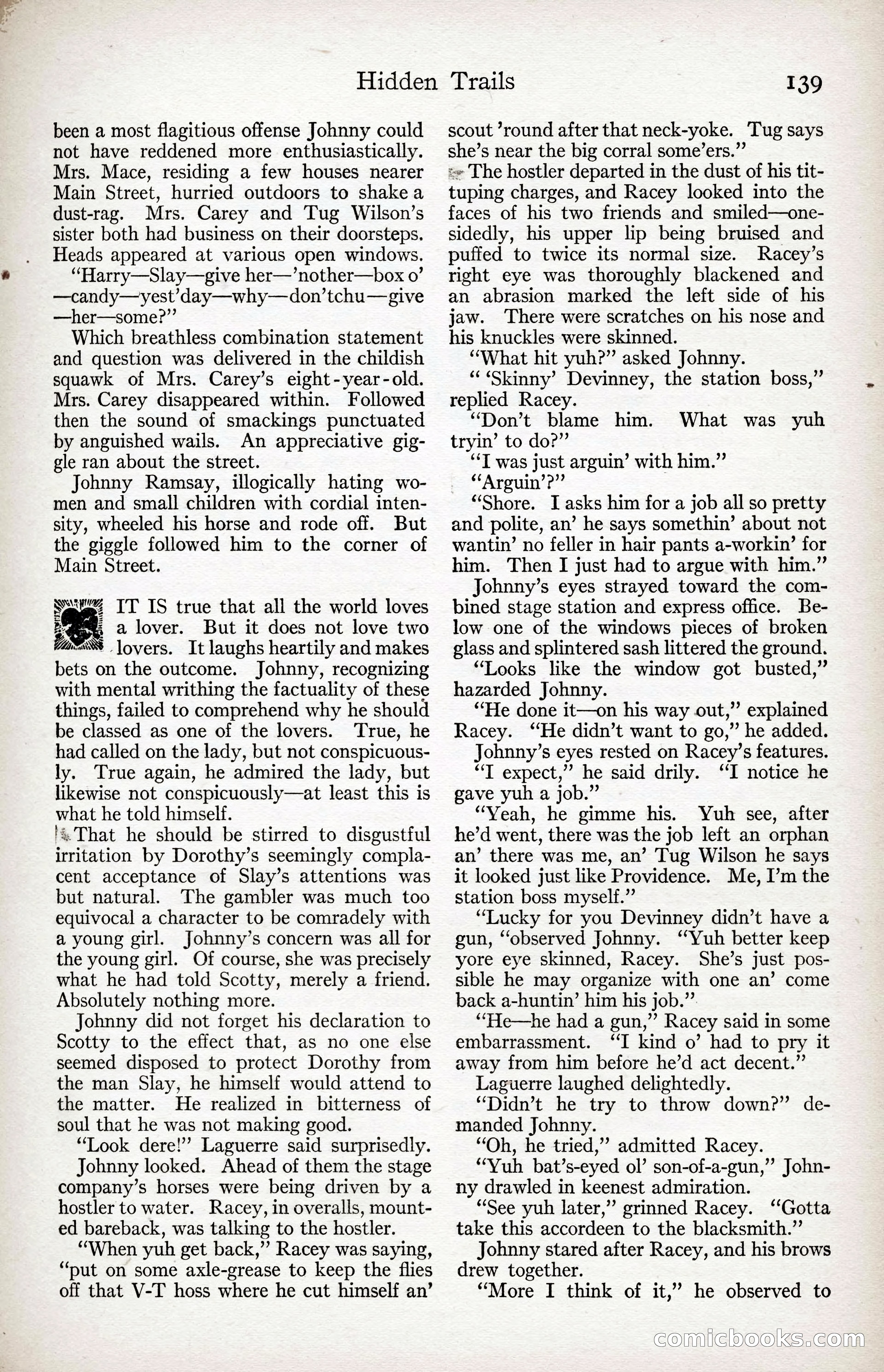
A restored page from Pulp Fiction, 1918. Page through the whole issue in the reader above.
📄 Transcribed text from this page (OCR, searchable)
Machine-transcribed from the original scan — historical spelling and the odd misread are preserved.
Hidden Trails been a most flagitious offense Johnny could not have reddened more enthusiastically. Mrs. Mace, residing a few houses nearer Main Street, hurried outdoors to shake a dust-rag. Mrs. Carey and Tug Wilson’s sister both had business on their doorsteps. Heads appeared at various open windows. “Harry—Slay—give her—’nother—box 0’ —candy—yest’day—why—don’tchu— give —her—some?”’ Which breathless combination statement and question was delivered in the childish squawk of Mrs. Carey’s eight-year-old. Mrs. Carey disappeared within. Followed then the sound of smackings punctuated by anguished wails. An appreciative gig- gle ran about the street. Johnny Ramsay, illogically hating wo- men and small children with cordial inten- sity, wheeled his horse and rode off. But the giggle followed him to the corner of Main Street. Nal? IT IS true that all the world loves wee. a lover. But it does not love two WE lovers. It laughs heartily and makes Johnny, recognizing bets on the outcome. with mental writhing the factuality of these things, failed to comprehend why he should be classed as one of the lovers. True, he had called on the lady, but not conspicuous- ly. True again, he admired the lady, but likewise not conspicuously—at least this is what he told himself. '« That he should be stirred to disgustful irritation by Dorothy’s seemingly compla- cent acceptance of Slay’s attentions was but natural. The gambler was much too equivocal a character to be comradely with a young girl. Johnny’s concern was all for the young girl. Of course, she was precisely what he had told Scotty, merely a friend. Absolutely nothing more. Johnny did not forget his declaration to Scotty to the effect that, as no one else seemed disposed to protect Dorothy from the man Slay, he himself would attend to the matter. He realized in bitterness of soul that he was not making good. “Look dere!’ Laguerre said surprisedly. Johnny looked. Ahead of them the stage company’s horses were being driven by a hostler to water. Racey, in overalls, mount- ed bareback, was talking to the hostler. “When yuh get back,” Racey was saying, “put on some axle-grease to keep the flies off that V-T hoss where he cut himself an’ 139 scout ’round after that neck-yoke. Tug says she’s near the big corral some’ers.”’ «« The hostler departed in the dust of his tit- tuping charges, and Racey looked into the faces of his two friends and smiled—one- sidedly, his upper lip being bruised and puffed to twice its normal size. Racey’s right eye was thoroughly blackened and an abrasion marked the left side of his jaw. ‘There were scratches on his nose and his knuckles were skinned. “What hit yuh?” asked Johnny. ‘Skinny’ Devinney, the station boss,” replied Racey. “Don’t blame him. What was yuh tryin’ to do?” “T was just arguin’ with him.” *‘Arguin’P”’ “Shore. I asks him for a job all so pretty and polite, an’ he says somethin’ about not wantin’ no feller in hair pants a-workin’ for him. Then I just had to argue with him.” Johnny’s eyes strayed toward the com- bined stage station and express office. Be- low one of the windows pieces of broken glass and splintered sash littered the ground. “Looks like the window got busted,” hazarded Johnny. ‘“‘He done it—on his way out,”’ explained Racey. ‘He didn’t want to go,” he added. Johnny’s eyes rested on Racey’s features. “T expect,” he said drily. “I notice he gave yuh a job.” “Yeah, he gimme his. Yuh see, after he’d went, there was the job left an orphan an’ there was me, an’ Tug Wilson he says it looked just like Providence. Me, I’m the station boss myself.” “Lucky for you Devinney didn’t have a gun, “‘observed Johnny. “Yuh better keep yore eye skinned, Racey. She’s just pos- sible he may organize with one an’ come back a-huntin’ him his job.” ‘““He—he had a gun,” Racey said in some embarrassment. ‘I kind o’ had to pry it away from him before he’d act decent.” Laguerre laughed delightedly. “Didn’t he try to throw down?” de- manded Johnny. “Oh, he tried,”’ admitted Racey. “Yuh bat’s-eyed ol’ son-of-a-gun,” John- ny drawled in keenest admiration. ‘See yuh later,” grinned Racey. “Gotta take this accordeen to the blacksmith.” Johnny stared after Racey, and his brows drew together. “More I think of it,” he observed to GomGcoooksEeo