
Pulp Fiction, 1918 · page 140 of 194
Adventure Magazine Cover, April 3, 1918 — page 140: what you’re looking at
A restored page from Pulp Fiction, 1918. Page through the whole issue in the reader above.
📄 Transcribed text from this page (OCR, searchable)
Machine-transcribed from the original scan — historical spelling and the odd misread are preserved.
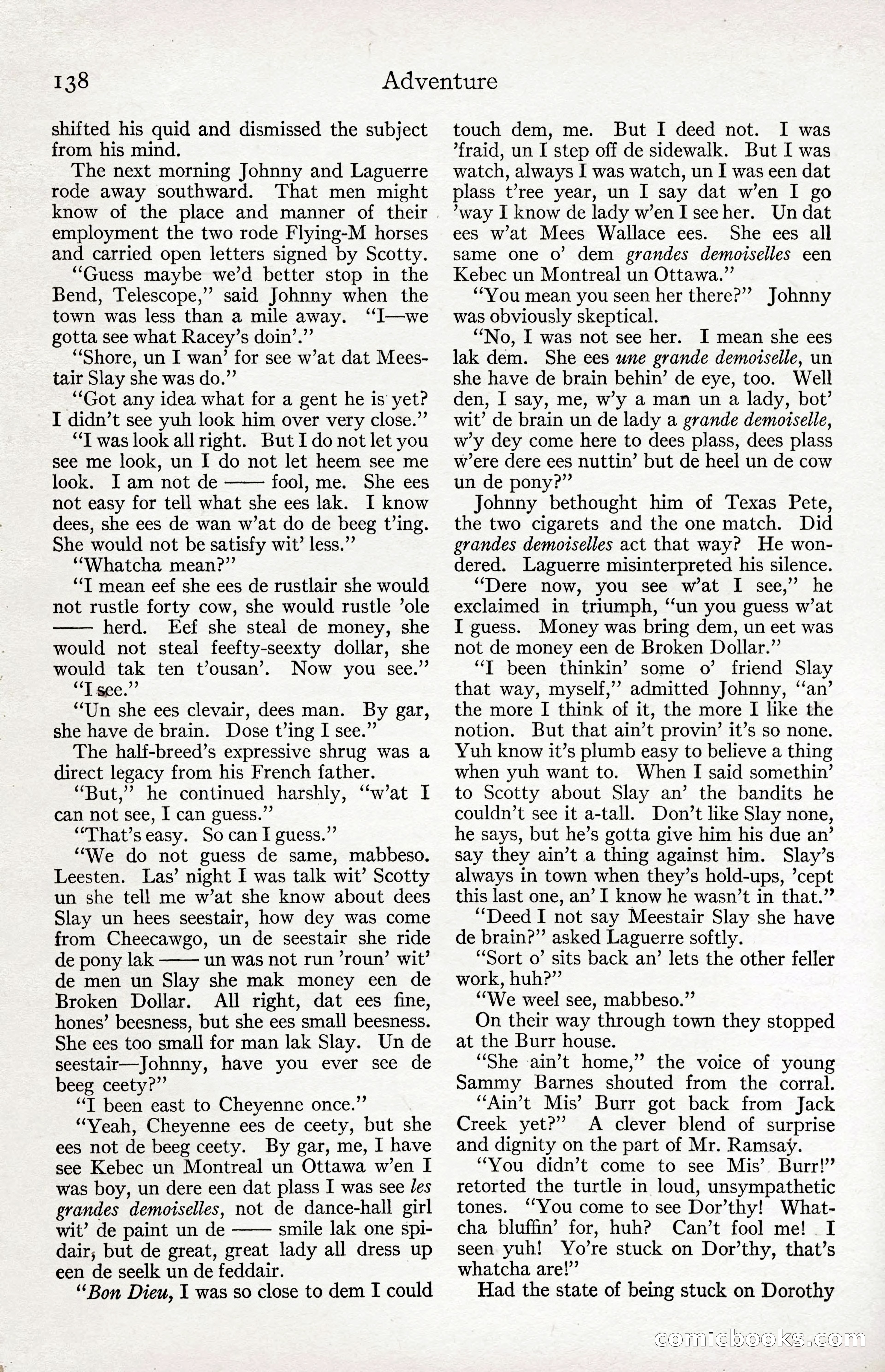
138 shifted his quid and dismissed the subject from his mind. The next morning Johnny and Laguerre rode away southward. That men might know of the place and manner of their | employment the two rode Flying-M horses and carried open letters signed by Scotty. “Guess maybe we’d better stop in the Bend, Telescope,” said Johnny when the town was less than a mile away. ‘‘I—we gotta see what Racey’s doin’.”’ “Shore, un I wan’ for see w’at dat Mees- tair Slay she was do.” “Got any idea what for a gent he is yet? I didn’t see yuh look him over very close.” “IT was look allright. But Ido not let you see me look, un I do not let heem see me look. I am not de fool, me. She ees not easy for tell what she ees lak. I know dees, she ees de wan w’at do de beeg t’ing. She would not be satisfy wit’ less.” “Whatcha mean?” “‘T mean eef she ees de rustlair she would not rustle forty cow, she would rustle ’ole herd. Eef she steal de money, she would not steal feefty-seexty dollar, she would tak ten t’ousan’. Now you see.” “T see.”’ “Un she ees clevair, dees man. By gar, she have de brain. Dose t’ing I see.” The half-breed’s expressive shrug was a direct legacy from his French father. “But,” he continued harshly, “w’at I can not see, I can guess.” “That’s easy. Socan I guess.” “We do not guess de same, mabbeso. Leesten. Las’ night I was talk wit’ Scotty un she tell me w’at she know about dees Slay un hees seestair, how dey was come from Cheecawgo, un de seestair she ride de pony lak un was not run ’roun’ wit’ de men un Slay she mak money een de Broken Dollar. All right, dat ees fine, hones’ beesness, but she ees small beesness. She ees too small for man lak Slay. Un de seestair—Johnny, have you ever see de beeg ceety?” “T been east to Cheyenne once.” “Veah, Cheyenne ees de ceety, but she ees not de beeg ceety. By gar, me, I have see Kebec un Montreal un Ottawa w’en I was boy, un dere een dat plass I was see /es grandes demoiselles, not de dance-hall girl wit’ de paint un de —— smile lak one spi- dair; but de great, great lady all dress up een de seelk un de feddair. “Bon Dieu, I was so close to dem I could Adventure touch dem, me. But I deed not. I was *fraid, un I step off de sidewalk. But I was watch, always I was watch, un I was een dat plass t’ree year, un I say dat w’en I go ’way I know de lady w’enIseeher. Un dat ees wat Mees Wallace ees. She ees all same one o’ dem grandes demotselles een Kebec un Montreal un Ottawa.” ‘““You mean you seen her there?”’ Johnny was obviously skeptical. ‘“‘No, I was not see her. I mean she ees lak dem. She ees une grande demoiselle, un she have de brain behin’ de eye, too. Well den, I say, me, w’y a man un a lady, bot’ wit’ de brain un de lady a grande demoiselle, w’y dey come here to dees plass, dees plass w’ere dere ees nuttin’ but de heel un de cow un de pony?” Johnny bethought him of Texas Pete, the two cigarets and the one match. Did grandes demotselles act that way? He won- dered. Laguerre misinterpreted his silence. “Dere now, you see wat I see,” he exclaimed in triumph, “un you guess w’at I guess. Money was bring dem, un eet was not de money een de Broken Dollar.” “T been thinkin’ some o’ friend Slay that way, myself,’’ admitted Johnny, ‘‘an’ the more I think of it, the more I like the notion. But that ain’t provin’ it’s so none. Yuh know it’s plumb easy to believe a thing when yuh want to. When I said somethin’ to Scotty about Slay an’ the bandits he couldn’t see it a-tall. Don’t like Slay none, he says, but he’s gotta give him his due an’ say they ain’t a thing against him. Slay’s always in town when they’s hold-ups, ’cept this last one, an’ I know he wasn’t in that.” “Deed I not say Meestair Slay she have de brain?” asked Laguerre softly. “Sort 0’ sits back an’ lets the other feller work, huh?” ‘“We weel see, mabbeso.” On their way through town they stopped at the Burr house. “She ain’t home,” the voice of young Sammy Barnes shouted from the corral. “Ain’t Mis’ Burr got back from Jack Creek yet?” A clever blend of surprise and dignity on the part of Mr. Ramsay. “You didn’t come to see Mis’ Burr!” retorted the turtle in loud, unsympathetic tones. ‘You come to see Dor’thy! What- cha bluffin’ for, huh? Can’t fool me! I seen yuh! Yo’re stuck on Dor’thy, that’s whatcha are!” Had the state of being stuck on Dorothy COnniclooo SS (C@ S|