
Pulp Fiction, 1918 · page 109 of 194
Adventure Magazine Cover, April 3, 1918 — page 109: what you’re looking at
A restored page from Pulp Fiction, 1918. Page through the whole issue in the reader above.
📄 Transcribed text from this page (OCR, searchable)
Machine-transcribed from the original scan — historical spelling and the odd misread are preserved.
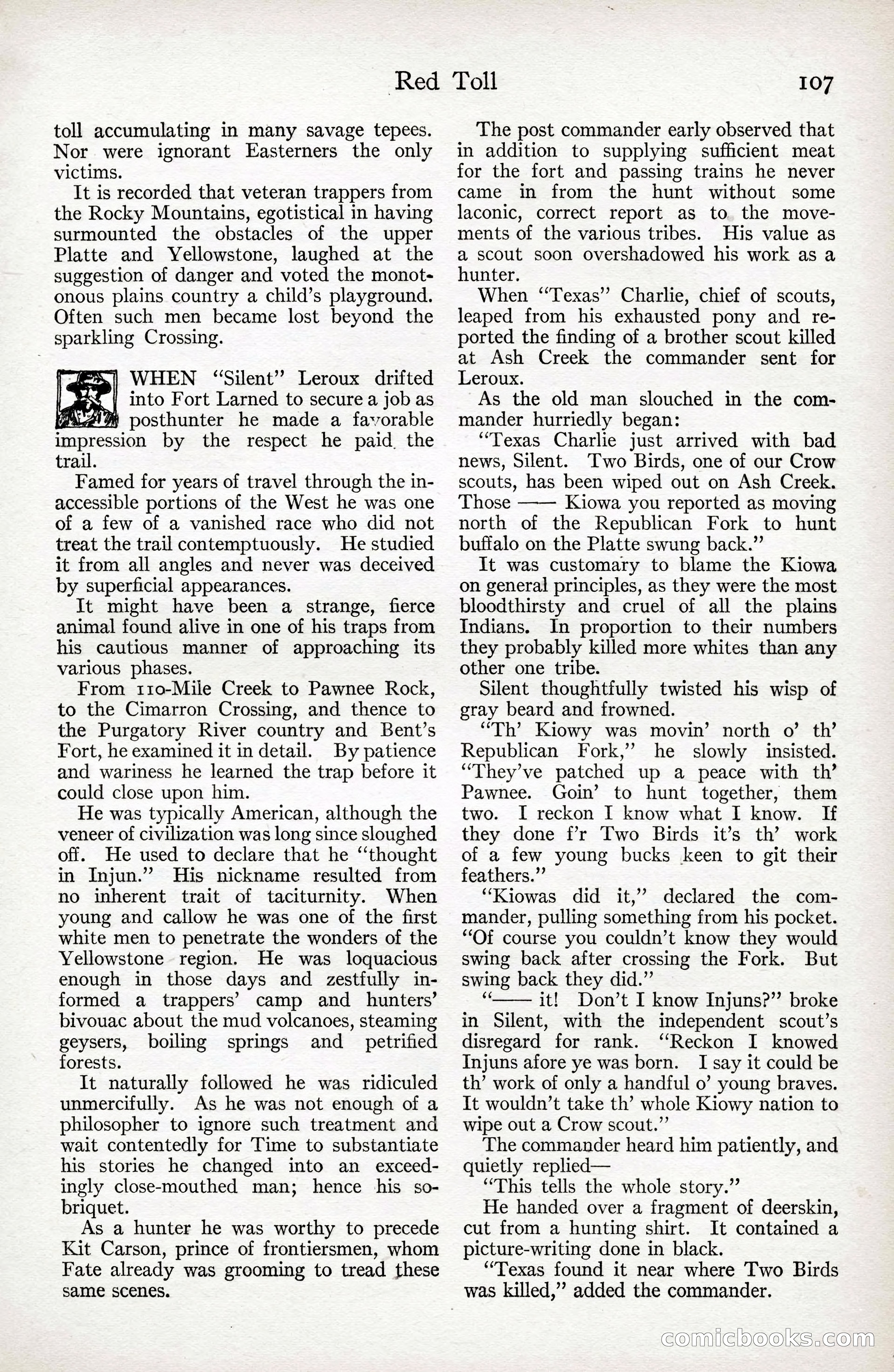
Red Toll toll accumulating in many savage tepees. Nor were ignorant Easterners the only victims. It is recorded that veteran trappers from the Rocky Mountains, egotistical in having surmounted the obstacles of the upper Platte and Yellowstone, laughed at the suggestion of danger and voted the monot- onous plains country a child’s playground. Often such men became lost beyond the sparkling Crossing. | | WHEN “Silent” Leroux drifted be into Fort Larned to secure a job as orn } posthunter he made a favorable impression by the respect he paid. the trail. Famed for years of travel through the in- accessible portions of the West he was one of a few of a vanished race who did not treat the trail contemptuously. He studied it from all angles and never was deceived by superficial appearances. It might have been a strange, fierce animal found alive in one of his traps from his cautious manner of approaching its various phases. From 110o-Mile Creek to Pawnee Rock, to the Cimarron Crossing, and thence to the Purgatory River country and Bent’s Fort, he examined it in detail. By patience and wariness he learned the trap before it could close upon him. He was typically American, although the veneer of civilization was long since sloughed off. He used to declare that he “thought in Injun.” His nickname resulted from no inherent trait of taciturnity. When young and callow he was one of the first white men to penetrate the wonders of the Yellowstone region. He was loquacious enough in those days and zestfully in- formed a trappers’ camp and _ hunters’ bivouac about the mud volcanoes, steaming geysers, boiling springs and_ petrified forests. It naturally followed he was ridiculed unmercifully. As he was not enough of a philosopher to ignore such treatment and wait contentedly for Time to substantiate his stories he changed into an _ exceed- ingly close-mouthed man; hence his so- briquet. As a hunter he was worthy to precede Kit Carson, prince of frontiersmen, whom Fate already was grooming to tread these same scenes. 107 The post commander early observed that in addition to supplying sufficient meat for the fort and passing trains he never came in from the hunt without some laconic, correct report as to. the move- ments of the various tribes. His value as a scout soon overshadowed his work as a hunter. When ‘Texas’ Charlie, chief of scouts, leaped from his exhausted pony and re- ported the finding of a brother scout killed at Ash Creek the commander sent for Leroux. As the old man slouched in the com- mander hurriedly began: “Texas Charlie just arrived with bad news, Silent. Two Birds, one of our Crow scouts, has been wiped out on Ash Creek. Those —— Kiowa you reported as moving north of the Republican Fork to hunt buffalo on the Platte swung back.” It was customary to blame the Kiowa on general principles, as they were the most bloodthirsty and cruel of all the plains Indians. In proportion to their numbers they probably killed more whites than any other one tribe. Silent thoughtfully twisted his wisp of gray beard and frowned. “Th’ Kiowy was movin’ north o’ th’ Republican Fork,’ he slowly insisted. “They’ve patched up a peace with th’ Pawnee. Goin’ to hunt together, them two. I reckon I know what I know. If they done f’r Two Birds it’s th’ work of a few young bucks keen to git their feathers.” “Kiowas did it,’ declared the com- mander, pulling something from his pocket. “Of course you couldn’t know they would swing back after crossing the Fork. But swing back they did.” —— it! Don’t I know Injuns?” broke in Silent, with the independent scout’s disregard for rank. ‘“‘Reckon I knowed Injuns afore ye was born. I say it could be th’ work of only a handful o’ young braves. It wouldn’t take th’ whole Kiowy nation to wipe out a Crow scout.” The commander heard him patiently, and quietly replied— “This tells the whole story.” He handed over a fragment of deerskin, cut from a hunting shirt. It contained a picture-writing done in black. “Texas found it near where Two Birds was killed,”’ added the commander. COnnicloool< (C@ 5}