
Pulp Fiction, 1917 · page 92 of 196
Adventure Magazine, Mid-September 1917 — page 92: what you’re looking at
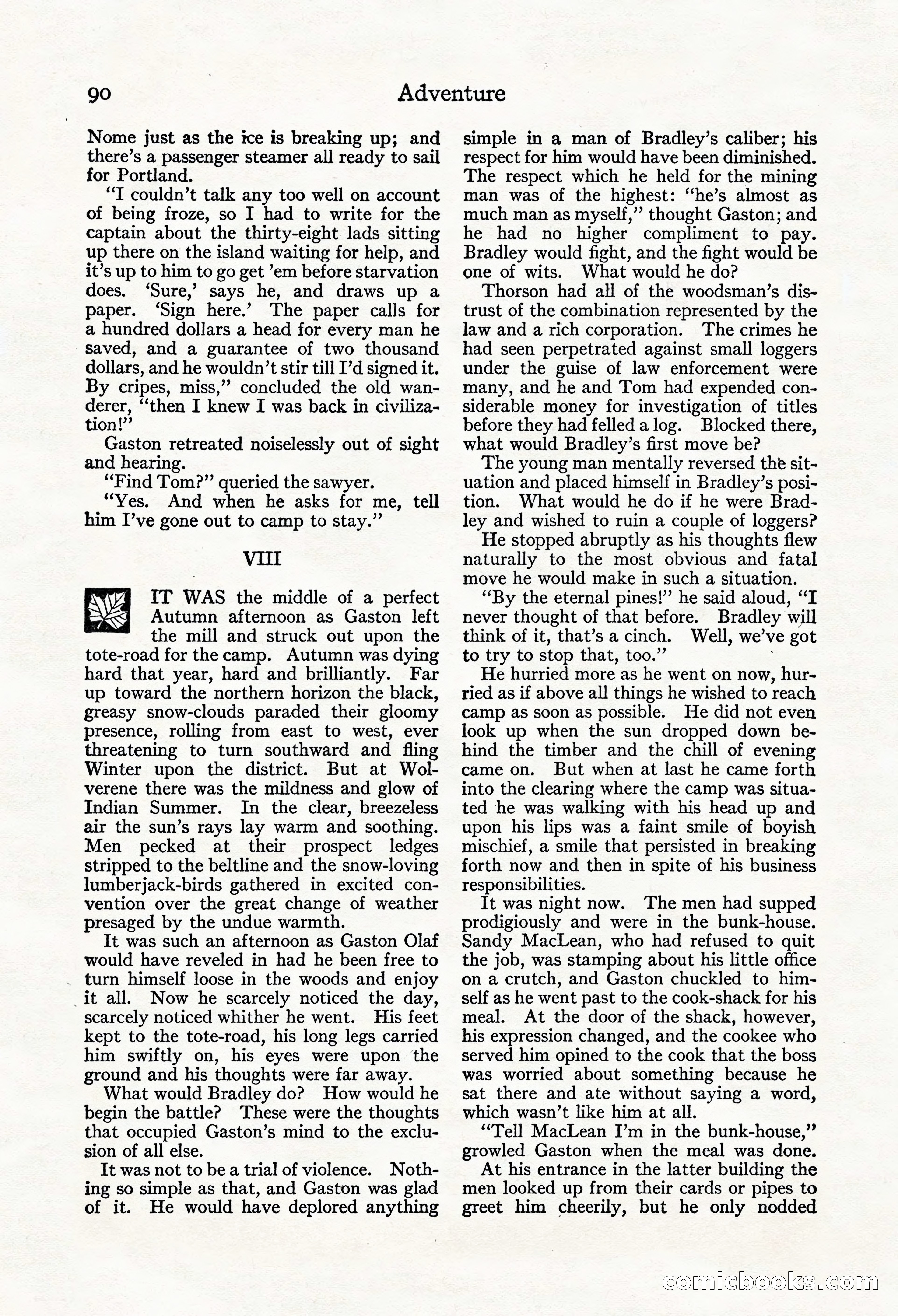
A restored page from Pulp Fiction, 1917. Page through the whole issue in the reader above.
📄 Transcribed text from this page (OCR, searchable)
Machine-transcribed from the original scan — historical spelling and the odd misread are preserved.
90 Nome just as the ice is breaking up; and there’s a passenger steamer all ready to sail for Portland. “T couldn’t talk any too well on account of being froze, so I had to write for the captain about the thirty-eight lads sitting up there on the island waiting for help, and it’s up to him to go get ’em before starvation does. ‘Sure,’ says he, and draws up a paper. ‘Sion here.’ The paper calls for a hundred dollars a head for every man he saved, and a guarantee of two thousand dollars, and he wouldn’t stir till I’d signed it. By cripes, miss,” concluded the old wan- derer, ‘‘then I knew I was back in civiliza- tion!” Gaston retreated noiselessly out of sight and hearing. “Find Tom?” queried the sawyer. ““YVes. And when he asks for me, tell him I’ve gone out to camp to stay.” Vir IT WAS the middle of a perfect NZ Autumn afternoon as Gaston left the mill and struck out upon the tote-road for the camp. Autumn was dying hard that year, hard and brilliantly. Far up toward the northern horizon the black, greasy snow-clouds paraded their gloomy presence, rolling from east to west, ever threatening to turn southward and fling Winter upon the district. But at Wol- verene there was the mildness and glow of Indian Summer. In the clear, breezeless air the sun’s rays lay warm and soothing. Men pecked at their prospect ledges stripped to the beltline and the snow-loving lumberjack-birds gathered in excited con- vention over the great change of weather presaged by the undue warmth. It was such an afternoon as Gaston Olaf would have reveled in had he been free to turn himself loose in the woods and enjoy _it all. Now he scarcely noticed the day, scarcely noticed whither he went. His feet kept to the tote-road, his long legs carried him swiftly on, his eyes were upon the ground and his thoughts were far away. What would Bradley do? How would he begin the battle? These were the thoughts that occupied Gaston’s mind to the exclu- sion of all else. It was not to bea trial of violence. Noth- ing so simple as that, and Gaston was glad of it. He would have deplored anything Adventure simple in a man of Bradley’s caliber; his respect for him would have been diminished. The respect which he held for the mining man was of the highest: “he’s almost as much man as myself,’”’ thought Gaston; and he had no higher compliment to pay. Bradley would fight, and the fight would be one of wits. What would he do? Thorson had all of the woodsman’s dis- trust of the combination represented by the law and a rich corporation. The crimes he had seen perpetrated against small loggers under the guise of law enforcement were many, and he and Tom had expended con- siderable money for investigation of titles before they had felled alog. Blocked there, what would Bradley’s first move be? The young man mentally reversed the sit- uation and placed himself in Bradley’s posi- tion. What would he do if he were Brad- ley and wished to ruin a couple of loggers? He stopped abruptly as his thoughts flew naturally to the most obvious and fatal move he would make in such a situation. “‘By the eternal pines!” he said aloud, “I never thought of that before. Bradley will think of it, that’s a cinch, Well, we’ ve got to try to stop that, too.” He hurried more as he went on now, hur- ried as if above all things he wished to reach camp as soon as possible. He did not even look up when the sun dropped down be- hind the timber and the chill of evening came on. But when at last he came forth into the clearing where the camp was situa- ted he was walking with his head up and upon his lips was a faint smile of boyish mischief, a smile that persisted in breaking forth now and then in spite of his business responsibilities. It was night now. The men had supped prodigiously and were in the bunk-house. Sandy MacLean, who had refused to quit the job, was stamping about his little office on a crutch, and Gaston chuckled to him- self as he went past to the cook-shack for his meal. At the door of the shack, however, his expression changed, and the cookee who served him opined to the cook that the boss was worried about something because he sat there and ate without saying a word, which wasn’t like him at all. “Tell MacLean I’m in the bunk-house,”’ growled Gaston when the meal was done. At his entrance in the latter building the men looked up from their cards or pipes to greet him cheerily, but he only nodded CoOMmiclsoo CO