
Pulp Fiction, 1917 · page 84 of 196
Adventure Magazine, Mid-September 1917 — page 84: what you’re looking at
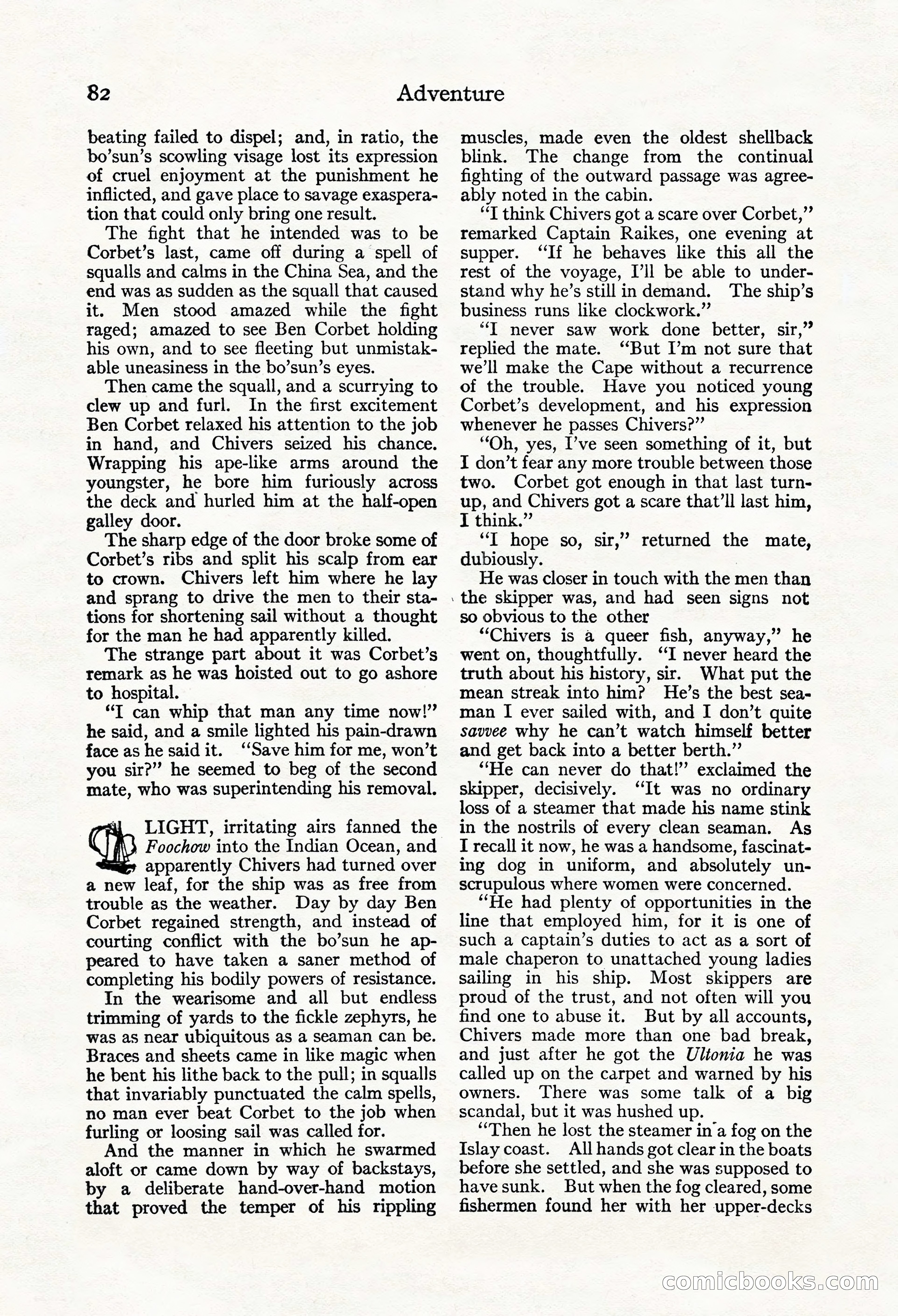
A restored page from Pulp Fiction, 1917. Page through the whole issue in the reader above.
📄 Transcribed text from this page (OCR, searchable)
Machine-transcribed from the original scan — historical spelling and the odd misread are preserved.
82 beating failed to dispel; and, in ratio, the bo’sun’s scowling visage lost its expression of cruel enjoyment at the punishment he inflicted, and gave place to savage exaspera- tion that could only bring one result. The fight that he intended was to be Corbet’s last, came off during a spell of squalls and calms in the China Sea, and the end was as sudden as the squall that caused it. Men stood amazed while the fight raged; amazed to see Ben Corbet holding his own, and to see fleeting but unmistak- able uneasiness in the bo’sun’s eyes. Then came the squall, and a scurrying to clew up and furl. In the first excitement Ben Corbet relaxed his attention to the job in hand, and Chivers seized his chance. Wrapping his ape-like arms around the youngster, he bore him furiously across the deck and hurled him at the half-open galley door. The sharp edge of the door broke some of Corbet’s ribs and split his scalp from ear to crown. Chivers left him where he lay and sprang to drive the men to their sta- tions for shortening sail without a thought for the man he had apparently killed. The strange part about it was Corbet’s remark as he was hoisted out to go ashore to hospital. “T can whip that man any time now!” he said, and a smile lighted his pain-drawn face ashe said it. ‘Save him for me, won’t you sir?” he seemed to beg of the second mate, who was superintending his removal. Gp Foochow into the Indian Ocean, and apparently Chivers had turned over a new leaf, for the ship was as free from trouble as the weather. Day by day Ben Corbet regained strength, and instead of courting conflict with the bo’sun he ap- peared to have taken a saner method of completing his bodily powers of resistance. In the wearisome and all but endless trimming of yards to the fickle zephyrs, he was as near ubiquitous as a seaman can be. Braces and sheets came in like magic when he bent his lithe back to the pull; in squalls that invariably punctuated the calm spells, no man ever beat Corbet to the job when furling or loosing sail was called for. And the manner in which he swarmed aloft or came down by way of backstays, by a deliberate hand-over-hand motion that proved the temper of his rippling LIGHT, irritating airs fanned the Adventure muscles, made even the oldest shellback blink. The change from the continual fighting of the outward passage was agree- ably noted in the cabin. “T think Chivers got a scare over Corbet,” remarked Captain Raikes, one evening at supper. “If he behaves like this all the rest of the voyage, I’ll be able to under- stand why he’s still in demand. The ship’s business runs like clockwork.” “IT never saw work done better, sir,” replied the mate. “But I’m not sure that we'll make the Cape without a recurrence of the trouble. Have you noticed young Corbet’s development, and his expression whenever he passes Chivers?” “Oh, yes, I’ve seen something of it, but I don’t fear any more trouble between those two. Corbet got enough in that last turn- up, and Chivers got a scare that'll last him, I think.” “I hope so, sir,” returned the mate, dubiously. : He was closer in touch with the men than . the skipper was, and had seen signs not so obvious to the other “Chivers is a queer fish, anyway,” he went on, thoughtfully. “I never heard the truth about his history, sir. What put the mean streak into hime He’s the best sea- man I ever sailed with, and I don’t quite savvee why he can’t watch himself better and get back into a better berth.” “He can never do that!” exclaimed the skipper, decisively. “It was no ordinary loss of a steamer that made his name stink in the nostrils of every clean seaman. As I recall it now, he was a handsome, fascinat- ing dog in uniform, and absolutely un- scrupulous where women were concerned. ‘“‘He had plenty of opportunities in the line that employed him, for it is one of such a captain’s duties to act as a sort of male chaperon to unattached young ladies sailing in his ship. Most skippers are proud of the trust, and not often will you find one to abuse it. But by all accounts, Chivers made more than one bad break, and just after he got the Ultonia he was called up on the carpet and warned by his owners. There was some talk of a big scandal, but it was hushed up. ‘Then he lost the steamer in a fog on the Islay coast. All hands got clear in the boats before she settled, and she was supposed to have sunk. But when the fog cleared, some fishermen found her with her upper-decks COMGHOO ©