
Pulp Fiction, 1917 · page 7 of 196
Adventure Magazine, Mid-September 1917 — page 7: what you’re looking at
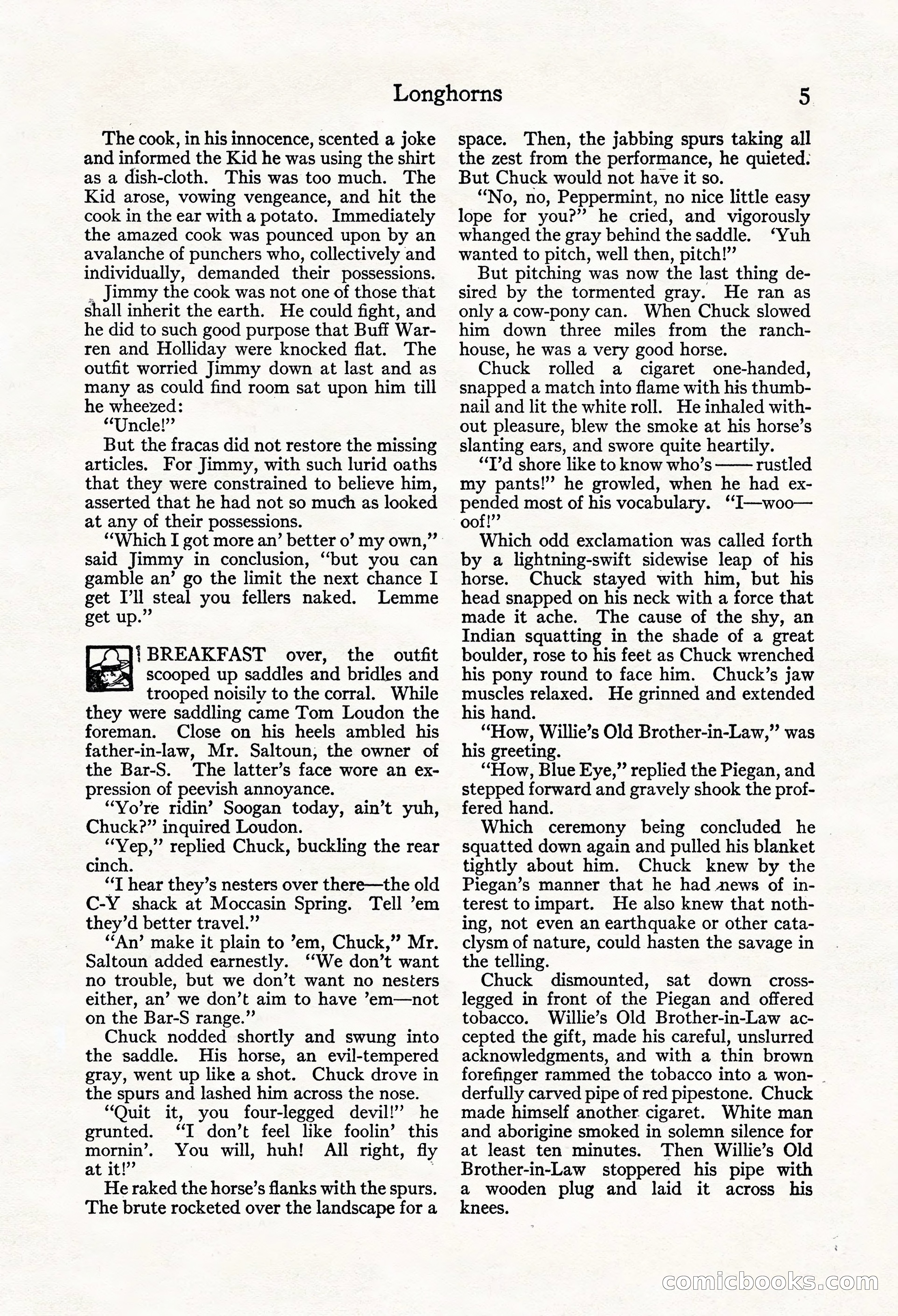
A restored page from Pulp Fiction, 1917. Page through the whole issue in the reader above.
📄 Transcribed text from this page (OCR, searchable)
Machine-transcribed from the original scan — historical spelling and the odd misread are preserved.
Longhorns 5. The cook, in his innocence, scented a joke and informed the Kid he was using the shirt as a dish-cloth. This was too much. The Kid arose, vowing vengeance, and hit the cook in the ear with a potato. Immediately the amazed cook was pounced upon by an avalanche of punchers who, collectively and individually, demanded their possessions, Jimmy the cook was not one of those that shall inherit the earth. He could fight, and he did to such good purpose that Buff War- ren and Holliday were knocked flat. The outfit worried Jimmy down at last and as many as could find room sat upon him till he wheezed: “Uncle!” But the fracas did not restore the missing articles. For Jimmy, with such lurid oaths that they were constrained to believe him, asserted that he had not so much as looked at any of their possessions. ‘Which I got more an’ better 0’ my own,” said Jimmy in conclusion, ‘‘but you can gamble an’ go the limit the next chance I get I’ll steal you fellers naked. Lemme get up.” [£i]i BREAKFAST over, the outfit Bt= x scooped up saddles and bridles and ™—" trooped noisily to the corral. While they were saddling came Tom Loudon the foreman. Close on his heels ambled his father-in-law, Mr. Saltoun, the owner of the Bar-S. The latter’s face wore an ex- pression of peevish annoyance. “Yo’re ridin’ Soogan today, ain’t yuh, Chuck?” inquired Loudon. “Yep,” replied Chuck, poce ns the rear cinch. “T hear they’s nesters over there—the old C-Y shack at Moccasin Spring. Tell ’em they’d better travel.” ‘An’ make it plain to ’em, Chuck,” Mr. Saltoun added earnestly. ‘‘We don’t want no trouble, but we don’t want no nesters either, an’ we don’t aim to have ’em—not on the Bar-S range.” Chuck nodded shortly and swung into the saddle. His horse, an evil-tempered gray, went up like a shot. Chuck drove in the spurs and lashed him across the nose. “Quit it, you four-legged devil!’ he grunted. “I don’t feel like foolin’ this mornin’. You will, huh! All right, fly at it!”’ He raked the horse’s flanks with the spurs. The brute rocketed over the landscape for a space. Then, the jabbing spurs taking all the zest from the performance, he quieted. But Chuck would not have it so. “No, no, Peppermint, no nice little easy lope for you?” he cried, and vigorously whanged the gray behind the saddle. ‘Yuh wanted to pitch, well then, pitch!” But pitching was now the last thing de- sired by the tormented gray. He ran as only a cow-pony can. When Chuck slowed him down three miles from the ranch- house, he was a very good horse. Chuck rolled a cigaret one-handed, snapped a match into flame with his thumb- nail and lit the white roll. He inhaled with- out pleasure, blew the smoke at his horse’s slanting ears, and swore quite heartily. “I’d shore like to know who’s rustled my pants!” he growled, when he had ex- pended most of his vocabulary. ‘‘I—woo— oof!” Which odd exclamation was called forth by a lightning-swift sidewise leap of his horse. Chuck stayed with him, but his head snapped on his neck with a force that made it ache. The cause of the shy, an Indian squatting in the shade of a great boulder, rose to his feet as Chuck wrenched his pony round to face him. Chuck’s jaw muscles relaxed. He grinned and extended his hand. “How, Willie’s Old Brother-in-Law,’”’ was his greeting. “How, Blue Eye,” replied the Piegan, and stepped forward and gravely shook the prof- fered hand. Which ceremony being concluded he © squatted down again and pulled his blanket tightly about him. Chuck knew by the Piegan’s manner that he had mews of in- terest toimpart. He also knew that noth- ing, not even an earthquake or other cata- clysm of nature, could hasten the savage in the telling. Chuck dismounted, sat down cross- legged in front of the Piegan and offered tobacco. Willie’s Old Brother-in-Law ac- cepted the gift, made his careful, unslurred acknowledgments, and with a thin brown forefinger rammed the tobacco into a won- . derfully carved pipe of red pipestone. Chuck made himself another cigaret. White man and aborigine smoked in solemn silence for at least ten minutes. Then Willie’s Old Brother-in-Law stoppered his pipe with a wooden plug and laid it across his knees. COmicloo CO