
Pulp Fiction, 1917 · page 67 of 196
Adventure Magazine, Mid-September 1917 — page 67: what you’re looking at
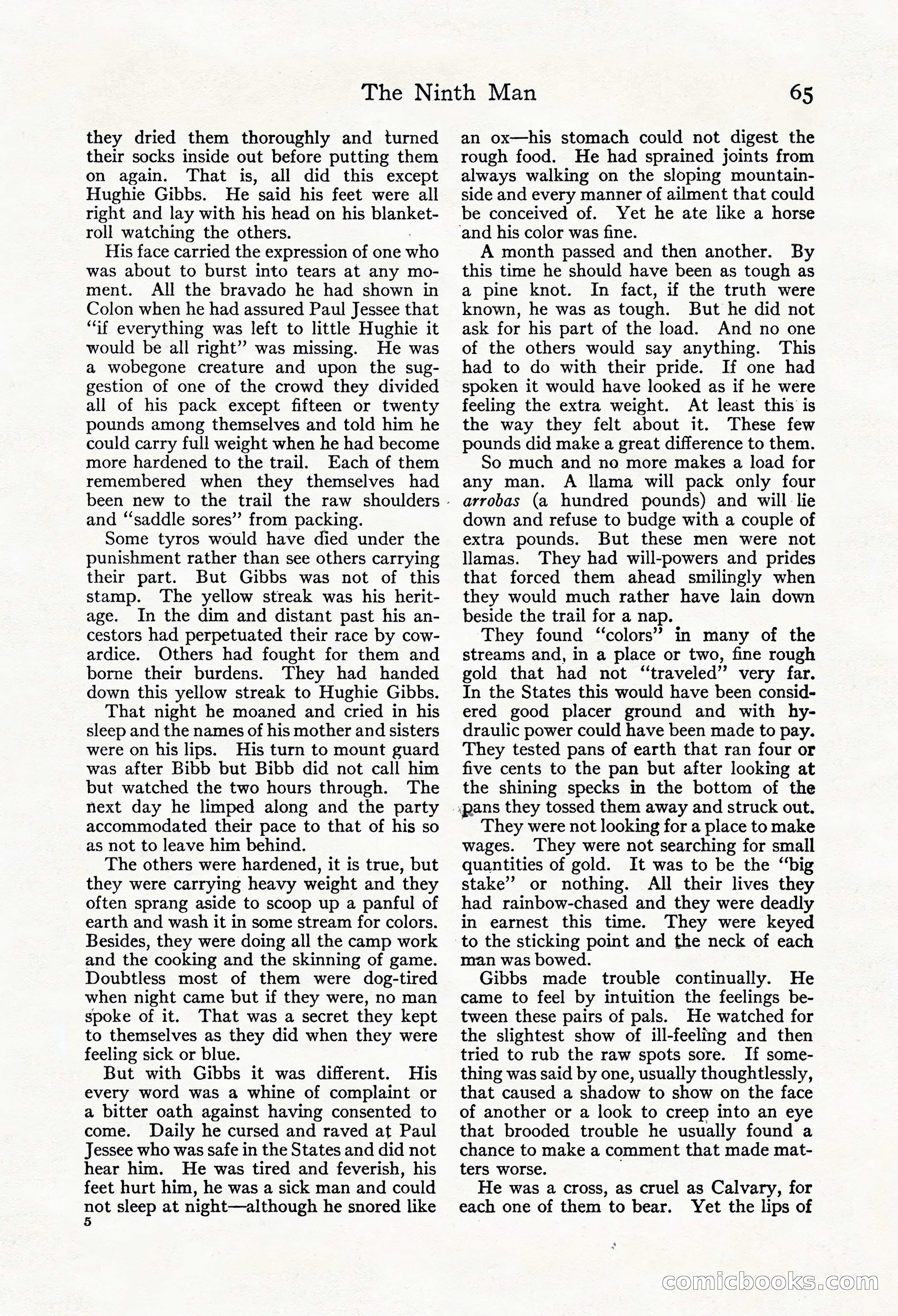
A restored page from Pulp Fiction, 1917. Page through the whole issue in the reader above.
📄 Transcribed text from this page (OCR, searchable)
Machine-transcribed from the original scan — historical spelling and the odd misread are preserved.
The Ninth Man they dried them thoroughly and turned their socks inside out before putting them on again. That is, all did this except Hughie Gibbs. He said his feet were all right and lay with his head on his blanket- roll watching the others. His face carried the expression of one who was about to burst into tears at any mo- ment. All the bravado he had shown in Colon when he had assured Paul Jessee that ‘if everything was left to little Hughie it would be all right” was missing. He was a wobegone creature and upon the sug- gestion of one of the crowd they divided all of his pack except fifteen or twenty pounds among themselves and told him he could carry full weight when he had become more hardened to the trail. Each of them remembered when they themselves had been new to the trail the raw shoulders - and “saddle sores” from packing. Some tyros would have died under the punishment rather than see others carrying their part. But Gibbs was not of this stamp. The yellow streak was his herit- age. In the dim and distant past his an- cestors had perpetuated their race by cow- ardice. Others had fought for them and borne their burdens. They had handed down this yellow streak to Hughie Gibbs. That night he moaned and cried in his sleep and the names of his mother and sisters were on his lips. His turn to mount guard was after Bibb but Bibb did not call him but watched the two hours through. The next day he limped along and the party accommodated their pace to that of his so as not to leave him behind. The others were hardened, it is true, but they were carrying heavy weight and they often sprang aside to scoop up a panful of earth and wash it in some stream for colors. Besides, they were doing all the camp work and the cooking and the skinning of game. Doubtless most of them were dog-tired when night came but if they were, no man spoke of it. That was a secret they kept to themselves as they did when they were feeling sick or blue. But with Gibbs it was different. His every word was a whine of complaint or a bitter oath against having consented to come. Daily he cursed and raved at Paul Jessee who was safe in the States and did not hear him. He was tired and feverish, his feet hurt him, he was a sick man and could not sleep at night—although he snored like 5 65 an ox—his stomach could not digest the rough food. He had sprained joints from always walking on the sloping mountain- side and every manner of ailment that could be conceived of. Yet he ate like a horse ‘and his color was fine. A month passed and then another. By this time he should have been as tough as a pine knot. In fact, if the truth were known, he was as tough. But he did not ask for his part of the load. And no one of the others would say anything. This had to do with their pride. If one had spoken it would have looked as if he were feeling the extra weight. At least this is the way they felt about it. These few pounds did make a great difference to them. So much and no more makes a load for any man. A llama will pack only four arrobas (a hundred pounds) and will lie down and refuse to budge with a couple of extra pounds. But these men were not llamas. They had will-powers and prides that forced them ahead smilingly when they would much rather have lain down beside the trail for a nap. They found “colors” in many of the streams and, in a place or two, fine rough gold that had not “traveled” very far. In the States this would have been consid- ered good placer ground and with hy- draulic power could have been made to pay. They tested pans of earth that ran four or five cents to the pan but after looking at the shining specks in the bottom of the pans they tossed them away and struck out. They were not looking for a place to make wages. They were not searching for small quantities of gold. It was to be the “big stake’? or nothing. All their lives they had rainbow-chased and they were deadly in earnest this time. They were keyed ‘to the sticking point and the neck of each man was bowed. Gibbs made trouble continually. He came to feel by intuition the feelings be- tween these pairs of pals. He watched for the slightest show of ill-feeling and then tried to rub the raw spots sore. If some- thing was said by one, usually thoughtlessly, that caused a shadow to show on the face of another or a look to creep into an eye that brooded trouble he usually found a chance to make a comment that made mat- ters worse. He was a cross, as cruel as Calvary, for each one of them to bear. Yet the lips of COmicloo (©