
Pulp Fiction, 1917 · page 62 of 196
Adventure Magazine, Mid-September 1917 — page 62: what you’re looking at
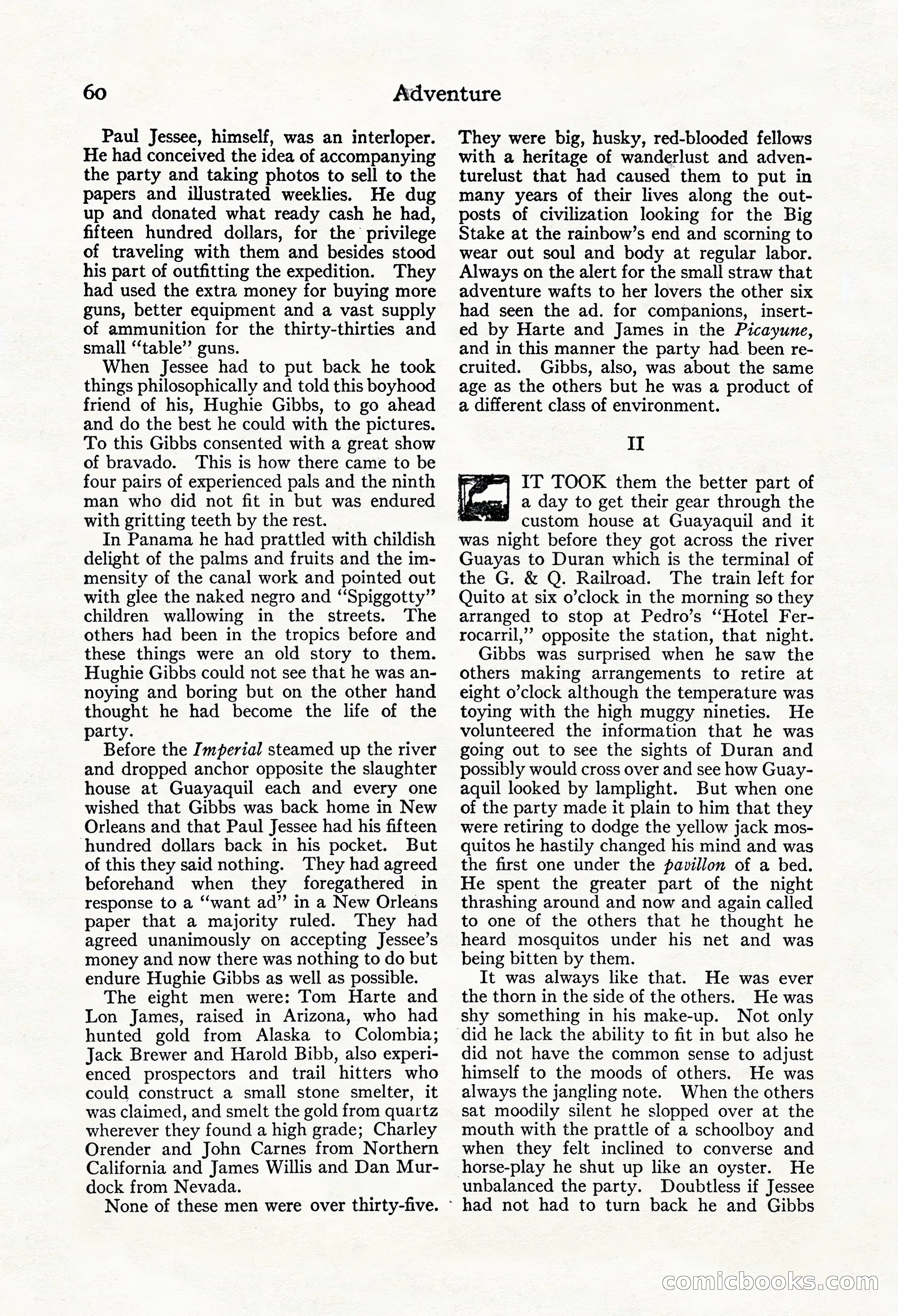
A restored page from Pulp Fiction, 1917. Page through the whole issue in the reader above.
📄 Transcribed text from this page (OCR, searchable)
Machine-transcribed from the original scan — historical spelling and the odd misread are preserved.
60 Paul Jessee, himself, was an interloper. He had conceived the idea of accompanying the party and taking photos to sell to the papers and illustrated weeklies. He dug up and donated what ready cash he had, fifteen hundred dollars, for the privilege of traveling with them and besides stood his part of outfitting the expedition. They had used the extra money for buying more guns, better equipment and a vast supply of ammunition for the thirty-thirties and small “table” guns. When Jessee had to put back he took things philosophically and told this boyhood friend of his, Hughie Gibbs, to go ahead and do the best he could with the pictures. To this Gibbs consented with a great show of bravado. This is how there came to be four pairs of experienced pals and the ninth man who did not fit in but was endured with gritting teeth by the rest. In Panama he had prattled with childish delight of the palms and fruits and the im- mensity of the canal work and pointed out with glee the naked negro and “‘Spiggotty”’ children wallowing in the streets. The others had been in the tropics before and these things were an old story to them. Hughie Gibbs could not see that he was an- noying and boring but on the other hand thought he had become the life of the party. Before the Imperial steamed up the river and dropped anchor opposite the slaughter house at Guayaquil each and every one wished that Gibbs was back home in New Orleans and that Paul Jessee had his fifteen hundred dollars back in his pocket. But of this they said nothing. They had agreed beforehand when they foregathered in response to a “want ad” in a New Orleans paper that a majority ruled. They had agreed unanimously on accepting Jessee’s money and now there was nothing to do but endure Hughie Gibbs as well as possible. The eight men were: Tom Harte and Lon James, raised in Arizona, who had hunted gold from Alaska to Colombia; Jack Brewer and Harold Bibb, also experi- enced prospectors and trail hitters who could construct a small stone smelter, it was claimed, and smelt the gold from quartz wherever they found a high grade; Charley Orender and John Carnes from Northern California and James Willis and Dan Mur- dock from Nevada. None of these men were over thirty-five. ~ horse-play he shut up like an oyster. Adventure They were big, husky, red-blooded fellows with a heritage of wanderlust and adven- turelust that had caused them to put in many years of their lives along the out- posts of civilization looking for the Big Stake at the rainbow’s end and scorning to wear out soul and body at regular labor. Always on the alert for the small straw that adventure wafts to her lovers the other six had seen the ad. for companions, insert- ed by Harte and James in the Picayune, and in this manner the party had. been re- cruited. Gibbs, also, was about the same age as the others but he was a product of a different class of environment. II we IT TOOK them the better part of sj a day to get their gear through the , ” custom house at Guayaquil and it was night before they got across the river Guayas to Duran which is the terminal of the G. & Q. Railroad. The train left for Quito at six o’clock in the morning so they arranged to stop at Pedro’s “Hotel Fer- rocarril,’’ opposite the station, that night. Gibbs was surprised when he saw the others making arrangements to retire at eight o’clock although the temperature was toying with the high muggy nineties. He volunteered the information that he was going out to see the sights of Duran and possibly would cross over and see how Guay- aquil looked by lamplight. But when one of the party made it plain to him that they were retiring to dodge the yellow jack mos- quitos he hastily changed his mind and was the first one under the pavillon of a bed. He spent the greater part of the night thrashing around and now and again called to one of the others that he thought he heard mosquitos under his net and was being bitten by them. It was always like that. He was ever the thorn in the side of the others. He was shy something in his make-up. Not only did he lack the ability to fit in but also he did not have the common sense to adjust himself to the moods of others. He was always the jangling note. When the others sat moodily silent he slopped over at the mouth with the prattle of a schoolboy and when they felt inclined to converse and He unbalanced the party. Doubtless if Jessee had not had to turn back he and Gibbs CoOMmiclsoo CO