
Pulp Fiction, 1917 · page 26 of 196
Adventure Magazine, Mid-September 1917 — page 26: what you’re looking at
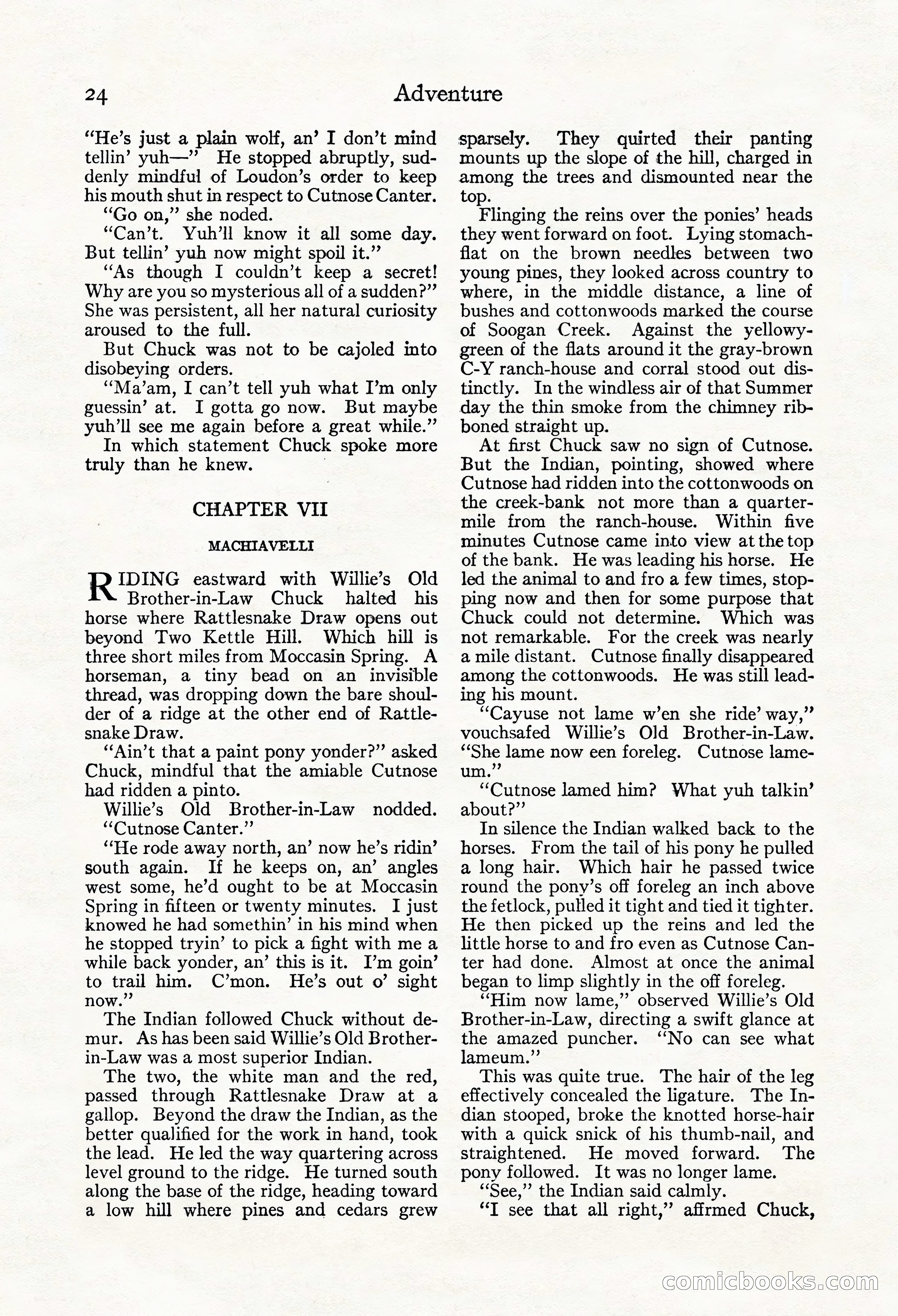
A restored page from Pulp Fiction, 1917. Page through the whole issue in the reader above.
📄 Transcribed text from this page (OCR, searchable)
Machine-transcribed from the original scan — historical spelling and the odd misread are preserved.
24 “He’s just a plain wolf, an’ I don’t mind tellin’? yuh—”’ He stopped abruptly, sud- denly mindful of Loudon’s order to keep his mouth shut in respect to Cutnose Canter. “Go on,” she noded. “Can’t. Yuh’ll know it all some day. But tellin’ yuh now might spoil it.” ‘As though I couldn’t keep a secret! Why are you so mysterious all of a sudden?” She was persistent, all her natural curiosity aroused to the full. But Chuck was not to be cajoled into disobeying orders. ‘““Ma’am, I can’t tell yuh what I’m only guessin’ at. I gotta go now. But maybe yuh’ll see me again before a great while.” In which statement Chuck spoke more truly than he knew. CHAPTER VII MACHIAVELLI IDING eastward with Willie’s Old Brother-in-Law Chuck halted his horse where Rattlesnake Draw opens out beyond Two Kettle Hill. Which hill is three short miles from Moccasin Spring. A horseman, a tiny bead on an invisible thread, was dropping down the bare shoul- der of a ridge at the other end of Rattle- snake Draw. ‘“‘Ain’t that a paint pony yonder?” asked Chuck, mindful that the amiable Cutnose had ridden a pinto. Willie’s Old Brother-in-Law nodded. ‘“‘Cutnose Canter.” ‘“He rode away north, an’ now he’s ridin’ south again. If he keeps on, an’ angles west some, he’d ought to be at Moccasin Spring in fifteen or twenty minutes. I just knowed he had somethin’ in his mind when he stopped tryin’ to pick a fight with me a while back yonder, an’ this is it. I’m goin’ to trail him. C’mon. He’s out o’ sight now.” The Indian followed Chuck without de- mur. As has been said Willie’s Old Brother- in-Law was a most superior Indian. The two, the white man and the red, passed through Rattlesnake Draw at a gallop. Beyond the draw the Indian, as the better qualified for the work in hand, took the lead. He led the way quartering across level ground to the ridge. He turned south along the base of the ridge, heading toward a low hill where pines and cedars grew Adventure sparsely. They quirted their panting mounts up the slope of the hill, charged in among the trees and dismounted near the top. Flinging the reins over the ponies’ heads they went forward on foot. Lying stomach- flat on the brown needles between two young pines, they looked across country to where, in the middle distance, a line of bushes and cottonwoods marked the course of Soogan Creek. Against the yellowy- green of the flats around it the gray-brown C-Y ranch-house and corral stood out dis- tinctly. In the windless air of that Summer day the thin smoke from the chimney rib- boned straight up. At first Chuck saw no sign of Cutnose. But the Indian, pointing, showed where Cutnose had ridden into the cottonwoods on the creek-bank not more than a quarter- mile from the ranch-house. Within five minutes Cutnose came into view at the top of the bank. He was leading his horse. He led the animal to and fro a few times, stop- ping now and then for some purpose that Chuck could not determine. Which was not remarkable. For the creek was nearly a mile distant. Cutnose finally disappeared among the cottonwoods. He was still lead- ing his mount. “Cayuse not lame w’en she ride’ way,” vouchsafed Willie’s Old Brother-in-Law. ‘‘She lame now een foreleg. Cutnose lame- um.”’ “‘Cutnose lamed him? What yuh talkin’ about?” In silence the Indian walked back to the horses. From the tail of his pony he pulled a long hair. Which hair he passed twice round the pony’s off foreleg an inch above the fetlock, pulled it tight and tied it tighter. He then picked up the reins and led the little horse to and fro even as Cutnose Can- ter had done. Almost at once the animal began to limp slightly in the off foreleg. ‘Him now lame,” observed Willie’s Old Brother-in-Law, directing a swift glance at the amazed puncher. ‘‘No can see what lameum.”’ This was quite true. The hair of the leg effectively concealed the ligature. The In- dian stooped, broke the knotted horse-hair with a quick snick of his thumb-nail, and straightened. He moved forward. The pony followed. It was no longer lame. ‘‘See,”’ the Indian said calmly. “IT see that all right,’’ affrmed Chuck, CoOMmiclsoo CO