
Pulp Fiction, 1917 · page 183 of 196
Adventure Magazine, Mid-September 1917 — page 183: what you’re looking at
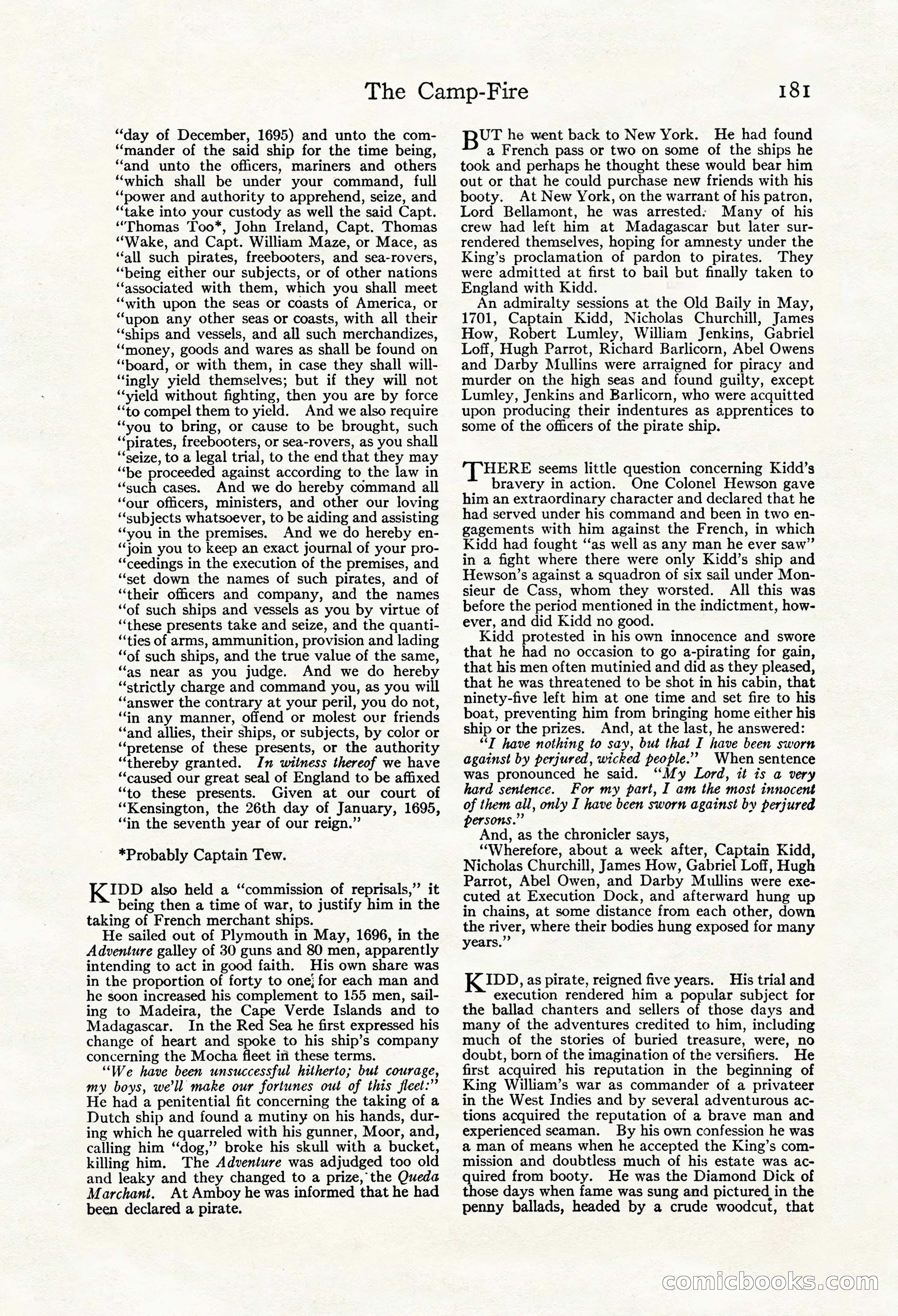
A restored page from Pulp Fiction, 1917. Page through the whole issue in the reader above.
📄 Transcribed text from this page (OCR, searchable)
Machine-transcribed from the original scan — historical spelling and the odd misread are preserved.
The Camp-Fire “day of December, 1695) and unto the com- “‘mander of the said ship for the time being, ‘and unto the officers, mariners and others “‘which shall be under your command, full ‘“‘power and authority to apprehend, seize, and “‘take into your custody as well the said Capt. “Thomas Too*, John Ireland, Capt. Thomas ‘‘Wake, and Capt. William Maze, or Mace, as ‘‘all such pirates, freebooters, and sea-rovers, “being either our subjects, or of other nations ‘associated with them, which you shall meet “with upon the seas or coasts of America, or ‘upon any other seas or coasts, with all their ‘“‘ships and vessels, and all such merchandizes, ‘“‘money, goods and wares as shall be found on “board, or with them, in case they shall will- “ingly yield themselves; but if they will not “vield without fighting, then you are by force “‘to compel them to yield. And we also require ‘“‘you to bring, or cause to be brought, such ‘pirates, freebooters, or sea-rovers, as you shall “‘seize, to a legal trial, to the end that they may ‘“‘be proceeded against according to the law in “Such cases. And we do hereby command all ‘our officers, ministers, and other our loving “subjects whatsoever, to be aiding and assisting ‘‘you in the premises. And we do hereby en- ‘join you to keep an exact journal of your pro- “ceedings in the execution of the premises, and “set down the names of such pirates, and of “their officers and company, and the names ‘‘of such ships and vessels as you by virtue of ‘“‘these presents take and seize, and the quanti- “ties of arms, ammunition, provision and lading “‘of such ships, and the true value of the same, ‘“‘as near as you judge. And we do hereby “strictly charge and command you, as you will ‘‘answer the contrary at your peril, you do not, ‘in any manner, offend or molest our friends ‘“‘and allies, their ships, or subjects, by color or ‘“‘pretense of these presents, or the authority “thereby granted. In witness thereof we have “caused our great seal of England to be affixed “to these presents. Given at our court of ‘“‘Kensington, the 26th day of January, 1695, “in the seventh year of our reign.” *Probably Captain Tew. IDD also held a “commission of reprisals,” it being then a time of war, to justify him in the taking of French merchant ships. He sailed out of Plymouth in May, 1696, in the Adventure galley of 30 guns and 80 men, apparently intending to act in good faith. His own share was in the proportion of forty to one; for each man and he soon increased his complement to 155 men, sail- ing to Madeira, the Cape Verde Islands and to Madagascar. In the Red Sea he first expressed his change of heart and spoke to his ship’s company concerning the Mocha fleet in these terms. “We have been unsuccessful hitherto; but courage, my boys, we'll make our fortunes out of this fleet:” He had a penitential fit concerning the taking of a Dutch ship and found a mutiny on his hands, dur- ing which he quarreled with his gunner, Moor, and, calling him “dog,” broke his skull with a bucket, killing him. The Adventure was adjudged too old and leaky and they changed to a prize, the Queda Marchant. At Amboy he was informed that he had been declared a pirate. 181 But he went back to New York. He had found a French pass or two on some of the ships he took and perhaps he thought these would bear him out or that he could purchase new friends with his booty. At New York, on the warrant of his patron, Lord Bellamont, he was arrested: Many of his crew had left him at Madagascar but later sur- rendered themselves, hoping for amnesty under the King’s proclamation of pardon to pirates. They were admitted at first to bail but finally taken to England with Kidd. An admiralty sessions at the Old Baily in May, 1701, Captain Kidd, Nicholas Churchill, James How, Robert Lumley, William Jenkins, Gabriel Loff, Hugh Parrot, Richard Barlicorn, Abel Owens and Darby Mullins were arraigned for piracy and murder on the high seas and found guilty, except Lumley, Jenkins and Barlicorn, who were acquitted upon producing their indentures as apprentices to some of the officers of the pirate ship. HERE seems little question concerning Kidd’s bravery in action. One Colonel Hewson gave him an extraordinary character and declared that he had served under his command and been in two en- gagements with him against the French, in which Kidd had fought ‘‘as well as any man he ever saw” in a fight where there were only Kidd’s ship and Hewson’s against a squadron of six sail under Mon- sieur de Cass, whom they worsted. All this was before the period mentioned in the indictment, how- ever, and did Kidd no good. Kidd protested in his own innocence and swore that he had no occasion to go a-pirating for gain, that his men often mutinied and did as they pleased, that he was threatened to be shot in his cabin, that ninety-five left him at one time and set fire to his boat, preventing him from bringing home either his ship or the prizes. And, at the last, he answered: “T have nothing to say, but that I have been sworn against by perjured, wicked people.” When sentence was pronounced he said. ‘“‘My Lord, it is a very hard sentence. For my part, I am the most innocent of them all, only I have been sworn against by perjured persons.” And, as the chronicler says, ‘‘Wherefore, about a week after, Captain Kidd, Nicholas Churchill, James How, Gabriel Loff, Hugh Parrot, Abel Owen, and Darby Mullins were exe- cuted at Execution Dock, and afterward hung up in chains, at some distance from each other, down the river, where their bodies hung exposed for many years.” IDD, as pirate, reigned five years. His trial and execution rendered him a popular subject for the ballad chanters and sellers of those days and many of the adventures credited to him, including much of the stories of buried treasure, were, no doubt, born of the imagination of the versifiers. He first acquired his reputation in the beginning of King William’s war as commander of a privateer in the West Indies and by several adventurous ac- tions acquired the reputation of a brave man and experienced seaman. By his own confession he was a man of means when he accepted the King’s com- mission and doubtless much of his estate was ac- quired from booty. He was the Diamond Dick of those days when fame was sung and pictured in the penny ballads, headed by a crude woodcut, that COMmiclsoo CO =