
Pulp Fiction, 1917 · page 135 of 196
Adventure Magazine, Mid-September 1917 — page 135: what you’re looking at
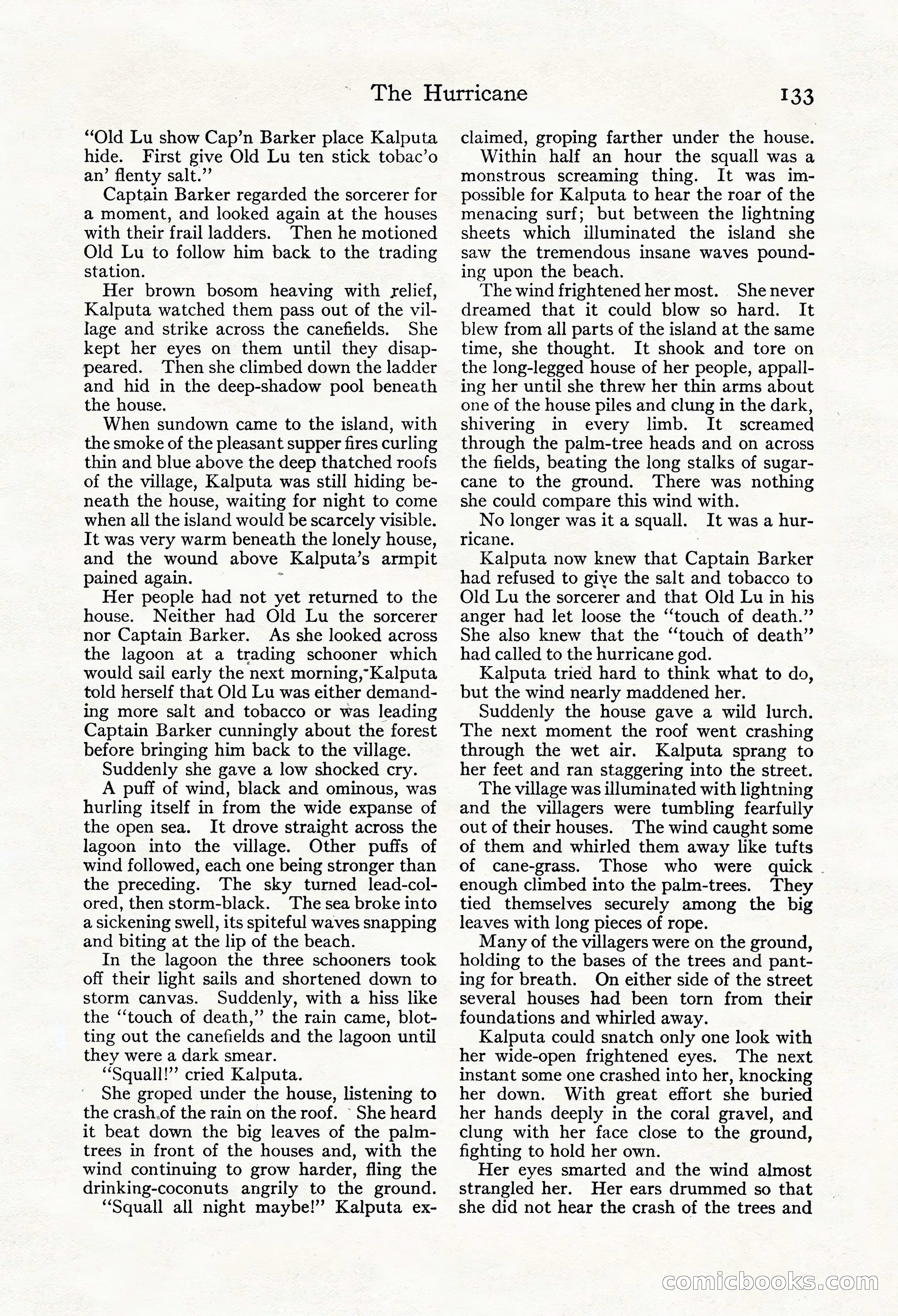
A restored page from Pulp Fiction, 1917. Page through the whole issue in the reader above.
📄 Transcribed text from this page (OCR, searchable)
Machine-transcribed from the original scan — historical spelling and the odd misread are preserved.
The Hurricane “Old Lu show Cap’n Barker place Kalputa hide. First give Old Lu ten stick tobac’o an’ flenty salt.” Captain Barker regarded the sorcerer for a moment, and looked again at the houses with their frail ladders. ‘Then he motioned Old Lu to follow him back to the trading station. Her brown bosom heaving with relief, Kalputa watched them pass out of the vil- lage and strike across the canefields. She kept her eyes on them until they disap- peared. Then she climbed down the ladder and hid in the deep-shadow pool beneath the house. When sundown came to the island, with the smoke of the pleasant supper fires curling thin and blue above the deep thatched roofs of the village, Kalputa was still hiding be- neath the house, waiting for night to come when all the island would be scarcely visible. It was very warm beneath the lonely house, and the wound above Kalputa’s armpit pained again. : Her people had not yet returned to the house. Neither had Old Lu the sorcerer nor Captain Barker. As she looked across the lagoon at a trading schooner which would sail early the next morning,-Kalputa told herself that Old Lu was either demand- ing more salt and tobacco or was leading Captain Barker cunningly about the forest before bringing him back to the village. Suddenly she gave a low shocked cry. A puff of wind, black and ominous, was hurling itself in from the wide expanse of the open sea. It drove straight across the lagoon into the village. Other pufis of wind followed, each one being stronger than the preceding. The sky turned lead-col- ored, then storm-black. The sea broke into a sickening swell, its spiteful waves snapping and biting at the lip of the beach. In the lagoon the three schooners took off their light sails and shortened down to storm canvas. Suddenly, with a hiss like the ‘“‘touch of death,” the rain came, blot- ting out the canefields and the lagoon until they were a dark smear. ‘“Squall!’”’ cried Kalputa. She groped under the house, listening to the crash.of the rain on the roof. - She heard it beat down the big leaves of the palm- trees in front of the houses and, with the wind continuing to grow harder, fling the drinking-coconuts angrily to the ground. “Squall all night maybe!”’ Kalputa ex- 133 claimed, groping farther under the house. Within half an hour the squall was a monstrous screaming thing. It was im- possible for Kalputa to hear the roar of the menacing surf; but between the lightning sheets which illuminated the island she saw the tremendous insane waves pound- ing upon the beach. The wind frightened her most. Shenever dreamed that it could blow so hard. It blew from all parts of the island at the same time, she thought. It shook and tore on the long-legged house of her people, appall- ing her until she threw her thin arms about one of the house piles and clung in the dark, shivering in every limb. It screamed through the palm-tree heads and on across the fields, beating the long stalks of sugar- cane to the ground. There was nothing she could compare this wind with. No longer was it a squall. It was a hur- ricane. ; Kalputa now knew that Captain Barker had refused to give the salt and tobacco to Old Lu the sorcerer and that Old Lu in his anger had let loose the “‘touch of death.” She also knew that the “‘touch of death’ had called to the hurricane god. Kalputa tried hard to think what to do, but the wind nearly maddened her. Suddenly the house gave a wild lurch. The next moment the roof went crashing through the wet air. Kalputa sprang to her feet and ran staggering into the street. The village was illuminated with lightning and the villagers were tumbling fearfully out of their houses. The wind caught some of them and whirled them away like tufts of cane-grass. enough climbed into the palm-trees. They tied themselves securely among the big leaves with long pieces of rope. Many of the villagers were on the ground, holding to the bases of the trees and pant- ing for breath. On either side of the street several houses had been torn from their foundations and whirled away. Kalputa could snatch only one look with her wide-open frightened eyes. The next instant some one crashed into her, knocking her down. With great effort she buried her hands deeply in the coral gravel, and clung with her face close to the ground, fighting to hold her own. Her eyes smarted and the wind almost strangled her. Her ears drummed so that she did not hear the crash of the trees and COmicloo Those who were quick - C©