
Pulp Fiction, 1917 · page 118 of 196
Adventure Magazine, Mid-September 1917 — page 118: what you’re looking at
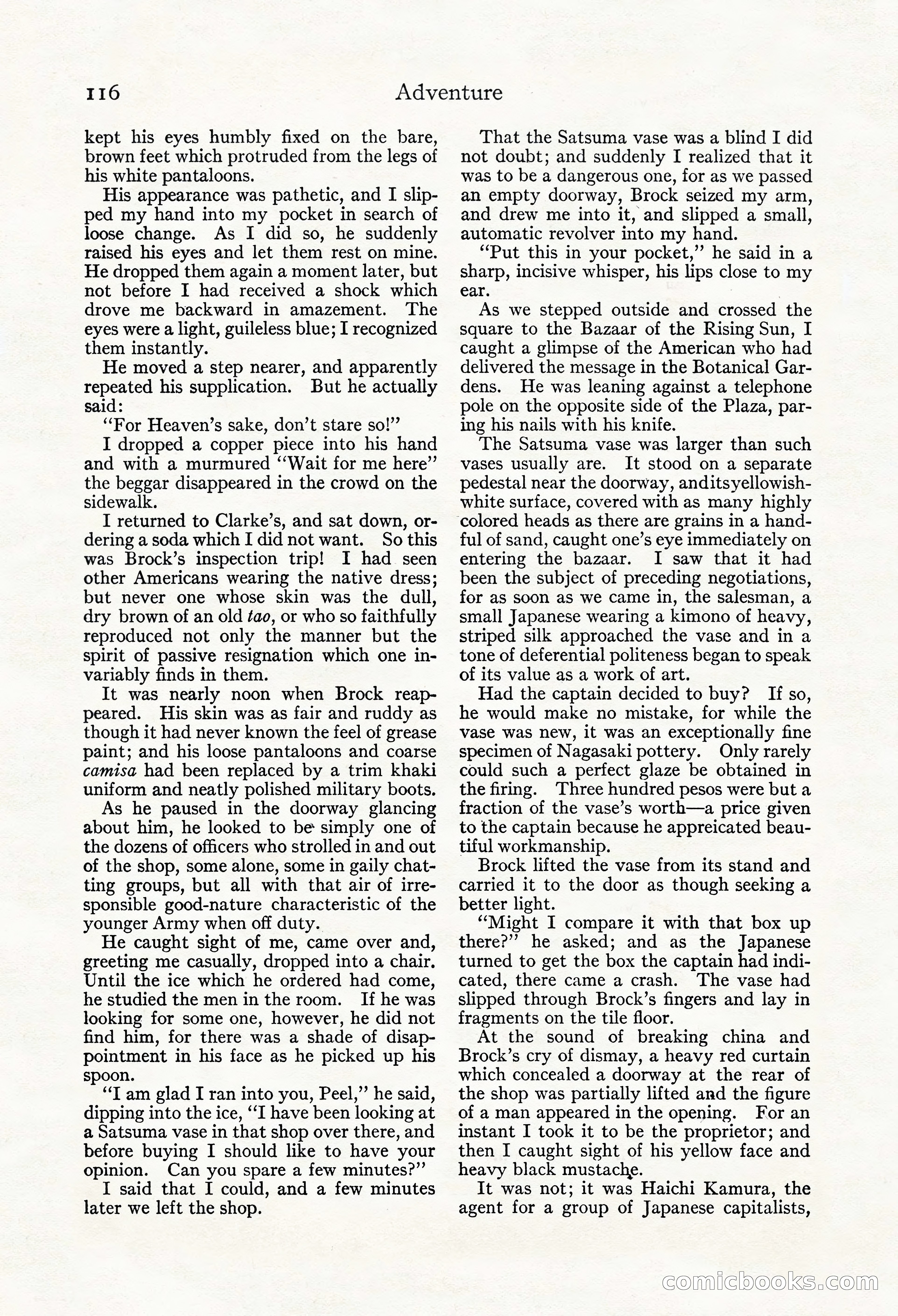
A restored page from Pulp Fiction, 1917. Page through the whole issue in the reader above.
📄 Transcribed text from this page (OCR, searchable)
Machine-transcribed from the original scan — historical spelling and the odd misread are preserved.
116 kept his eyes humbly fixed on the bare, brown feet which protruded from the legs of his white pantaloons. His appearance was pathetic, and I slip- ped my hand into my pocket in search of loose change. As I did so, he suddenly raised his eyes and let them rest on mine. He dropped them again a moment later, but not before I had received a shock which drove me backward in amazement. The eyes were a light, guileless blue; I recognized them instantly. He moved a step nearer, and apparently repeated his supplication. But he actually said: “For Heaven’s sake, don’t stare so!”’ I dropped a copper piece into his hand and with a murmured ‘‘Wait for me here”’ the beggar disappeared in the crowd on the sidewalk. I returned to Clarke’s, and sat down, or- dering a soda which I did not want. So this was Brock’s inspection trip! I had seen other Americans wearing the native dress; but never one whose skin was the dull, dry brown of an old éao, or who so faithfully reproduced not only the manner but the spirit of passive resignation which one in- variably finds in them. It was nearly noon when Brock reap- peared. His skin was as fair and ruddy as though it had never known the feel of grease paint; and his loose pantaloons and coarse camisa had been replaced by a trim khaki uniform and neatly polished military boots. As he paused in the doorway glancing about him, he looked to be simply one of the dozens of officers who strolled in and out of the shop, some alone, some in gaily chat- ting groups, but all with that air of irre- sponsible good-nature characteristic of the younger Army when off duty. He caught sight of me, came over and, greeting me casually, dropped into a chair. Until the ice which he ordered had come, he studied the men in the room. If he was looking for some one, however, he did not find him, for there was a shade of disap- pointment in his face as he picked up his spoon. “T am glad I ran into you, Peel,” he said, dipping into the ice, “‘I have been looking at a Satsuma vase in that shop over there, and before buying I should like to have your opinion. Can you spare a few minutes?” I said that I could, and a few minutes later we left the shop. Adventure That the Satsuma vase was a blind I did not doubt; and suddenly I realized that it was to be a dangerous one, for as we passed an empty doorway, Brock seized my arm, and drew me into it, and slipped a small, automatic revolver into my hand. “Put this in your pocket,” he said in a sharp, incisive whisper, his lips close to my ear. : As we stepped outside and crossed the square to the Bazaar of the Rising Sun, I caught a glimpse of the American who had delivered the message in the Botanical Gar- dens. He was leaning against a telephone pole on the opposite side of the Plaza, par- ing his nails with his knife. The Satsuma vase was larger than such vases usually are. It stood on a separate pedestal near the doorway, anditsyellowish- white surface, covered with as many highly ‘colored heads as there are grains in a hand- ful of sand, caught one’s eye immediately on entering the bazaar. I saw that it had been the subject of preceding negotiations, for as soon as we came in, the salesman, a small Japanese wearing a kimono of heavy, striped silk approached the vase and in a tone of deferential politeness began to speak of its value as a work of art. Had the captain decided to buy? If so, he would make no mistake, for while the vase was new, it was an exceptionally fine specimen of Nagasaki pottery. Only rarely could such a perfect glaze be obtained in the firing. Three hundred pesos were but a fraction of the vase’s worth—a price given to the captain because he appreicated beau- tiful workmanship. Brock lifted the vase from its stand and carried it to the door as though seeking a better light. “Might I compare it with that box up there?” he asked; and as the Japanese turned to get the box the captain had indi- cated, there came a crash. The vase had slipped through Brock’s fingers and lay in fragments on the tile floor. At the sound of breaking china and Brock’s cry of dismay, a heavy red curtain which concealed a doorway at the rear of the shop was partially lifted and the figure of a man appeared in the opening. For an instant I took it to be the proprietor; and then I caught sight of his yellow face and heavy black mustache. It was not; it was Haichi Kamura, the agent for a group of Japanese capitalists, CoOMmicsoo (©