
Pulp Fiction, 1917 · page 112 of 196
Adventure Magazine, Mid-September 1917 — page 112: what you’re looking at
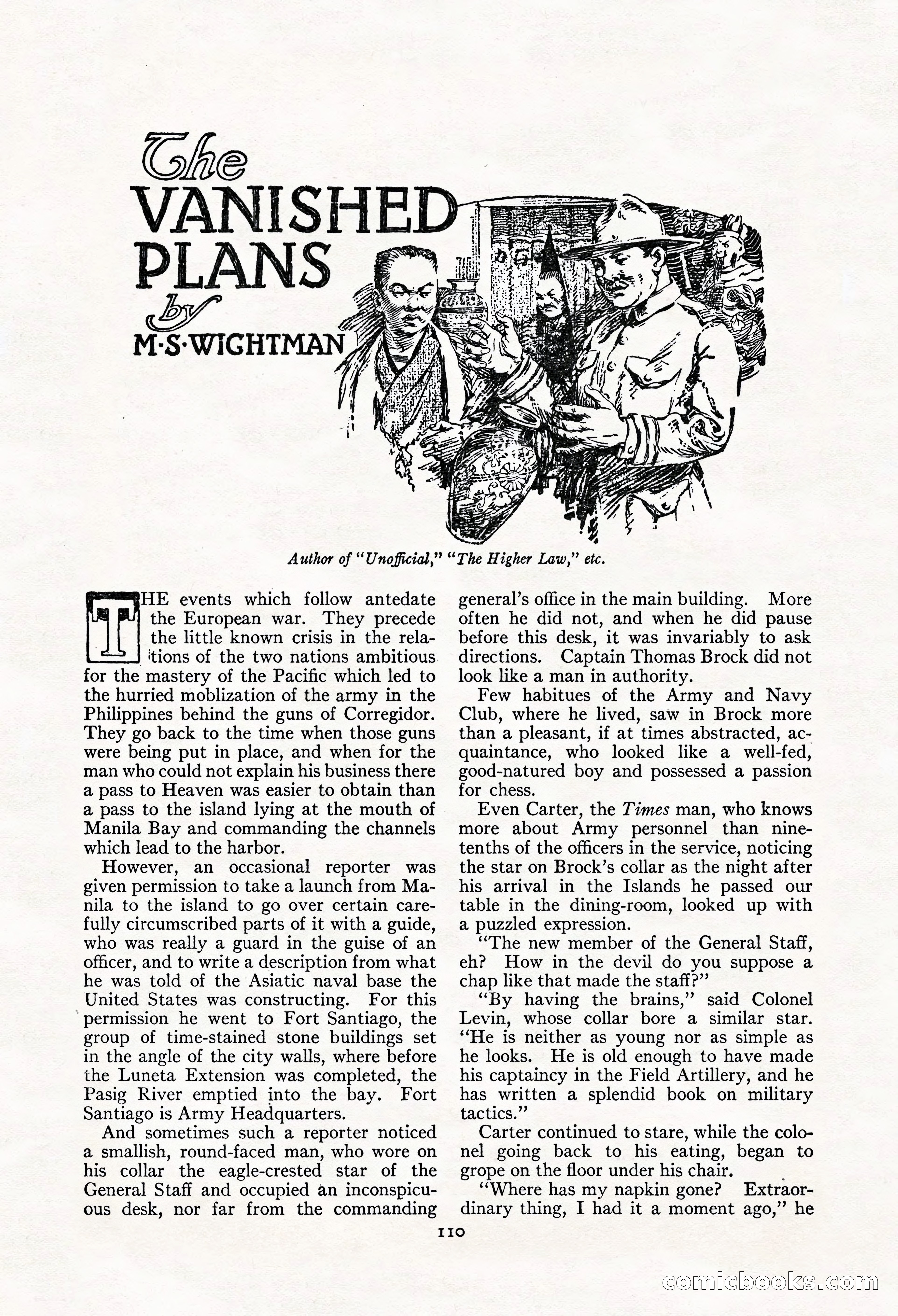
A restored page from Pulp Fiction, 1917. Page through the whole issue in the reader above.
📄 Transcribed text from this page (OCR, searchable)
Machine-transcribed from the original scan — historical spelling and the odd misread are preserved.
Ghe VANISH B D PLANS 4 M- 4 S WIGHTMAN Author of “Unofficial,” “The Higher Law,” etc RHE events which follow antedate the European war. They precede the little known crisis in the rela- | ‘tions of the two nations ambitious for the mastery of the Pacific which led to the hurried moblization of the army in the Philippines behind the guns of Corregidor. They go back to the time when those guns were being put in place, and when for the man who could not explain his business there a pass to Heaven was easier to obtain than a pass to the island lying at the mouth of Manila Bay and commanding the channels which lead to the harbor. However, an occasional reporter was given permission to take a launch from Ma- nila to the island to go over certain care- fully circumscribed parts of it with a guide, who was really a guard in the guise of an officer, and to write a description from what he was told of the Asiatic naval base the United States was constructing. For this ‘permission he went to Fort Santiago, the group of time-stained stone buildings set in the angle of the city walls, where before the Luneta Extension was completed, the Pasig River emptied into the bay. Fort Santiago is Army Headquarters. And sometimes such a reporter noticed a smallish, round-faced man, who wore on his collar the eagle-crested star of the General Staff and occupied an inconspicu- ous desk, nor far from the commanding general’s office in the main building. More often he did not, and when he did pause before this desk, it was invariably to ask directions. Captain Thomas Brock did not look like a man in authority. Few habitues of the Army and Navy Club, where he lived, saw in Brock more than a pleasant, if at times abstracted, ac- quaintance, who looked like a well- fed, good-natured boy and possessed a passion for chess. Even Carter, the Times man, who knows more about Army personnel than nine- tenths of the officers in the service, noticing the star on Brock’s collar as the night after his arrival in the Islands he passed our table in the dining-room, looked up with a puzzled expression. “The new member of the General Staff, eh? How in the devil do you suppose a chap like that made the staff?” “By having the brains,” said Colonel Levin, whose collar bore a similar star. ‘“‘He is neither as young nor as simple as he looks. He is old enough to have made his captaincy in the Field Artillery, and he has written a splendid book on military tactics.” Carter continued to stare, while the colo- nel going back to his eating, began to grope on the floor under his chair. ‘“Where has my napkin gone? __Extraor- dinary thing, I had it a moment ago,” he IIo Clo@@ 5}