
Pulp Fiction, 1917 · page 109 of 196
Adventure Magazine, Mid-September 1917 — page 109: what you’re looking at
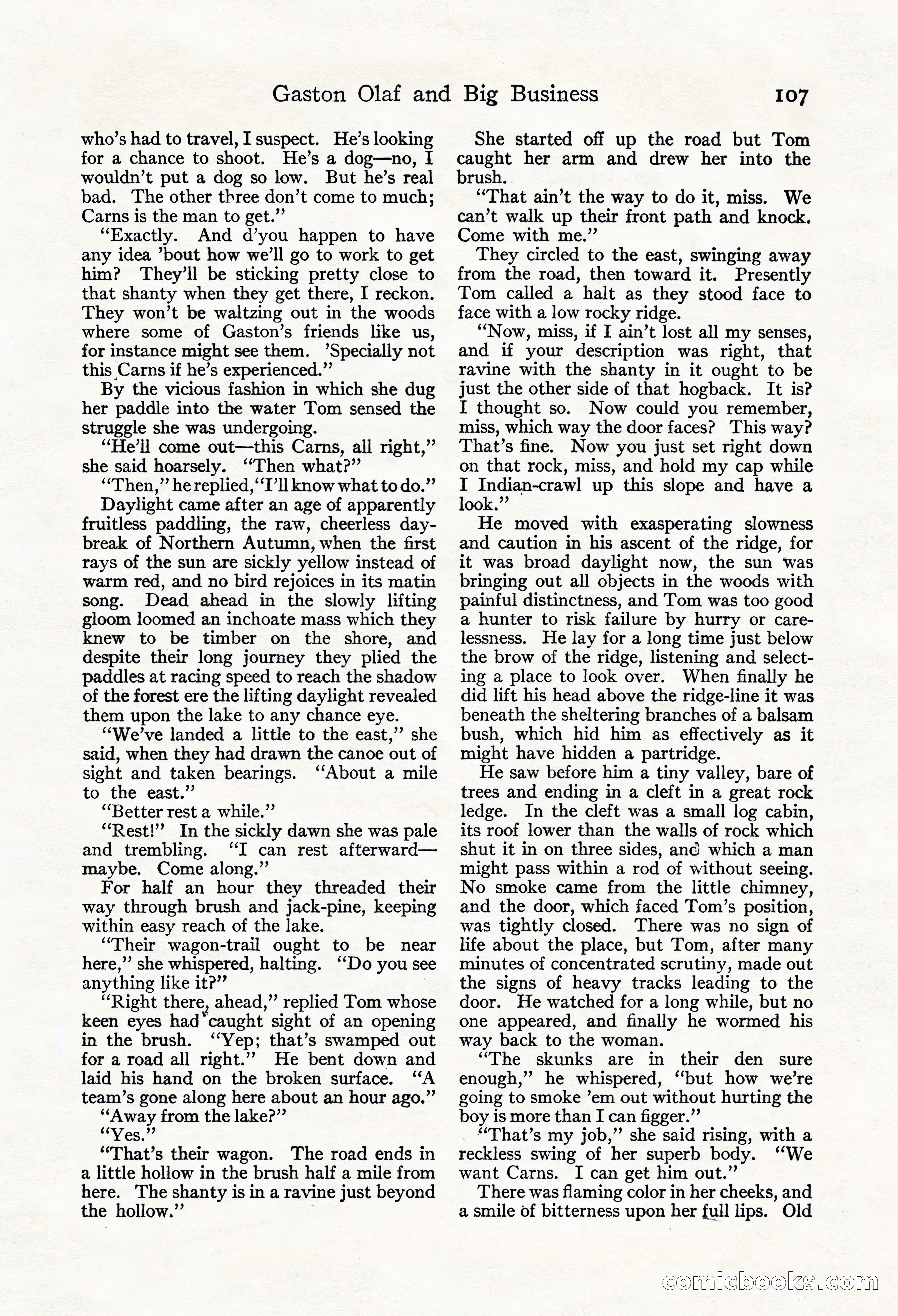
A restored page from Pulp Fiction, 1917. Page through the whole issue in the reader above.
📄 Transcribed text from this page (OCR, searchable)
Machine-transcribed from the original scan — historical spelling and the odd misread are preserved.
Gaston Olaf and Big Business who’s had to travel, I suspect. He’s looking for a chance to shoot. He’s a dog—no, I wouldn’t put a dog so low. But he’s real bad. The other three don’t come to much; Carns is the man to get.” “Exactly. And d’you happen to have any idea ’bout how we'll go to work to get him? They’ll be sticking pretty close to that shanty when they get there, I reckon. They won’t be waltzing out in the woods where some of Gaston’s friends like us, for instance might see them. ‘Specially not this Carns if he’s experienced.” By the vicious fashion in which she dug her paddle into the water Tom sensed the struggle she was undergoing. ““He’ll come out—this Carns, all right,” she said hoarsely. ‘“Then what?” ‘“‘Then,” he replied, ‘‘I’ll know what to do.” Daylight came after an age of apparently fruitless paddling, the raw, cheerless day- break of Northern Autumn, when the first rays of the sun are sickly yellow instead of warm red, and no bird rejoices in its matin song. Dead ahead in the slowly lifting gloom loomed an inchoate mass which they knew to be timber on the shore, and despite their long journey they plied the paddles at racing speed to reach the shadow of the forest ere the lifting daylight revealed them upon the lake to any chance eye. ‘“We’ve landed a little to the east,’’ she said, when they had drawn the canoe out of sight and taken bearings. ‘‘About a mile to the east.” “Better rest a while.” ‘‘Rest!”’? In the sickly dawn she was pale and trembling. ‘I can rest afterward— maybe. Come along.”’ For half an hour they threaded their way through brush and jack-pine, keeping within easy reach of the lake. “Their wagon-trail ought to be near here,”’ she whispered, halting. ‘‘Do you see anything like itP”’ “Right there, ahead,” replied Tom whose keen eyes had caught sight of an opening in the brush. ‘“‘Yep; that’s swamped out for a road all right.”” He bent down and laid his hand on the broken surface. ‘A team’s gone along here about an hour ago.”’ ‘Away from the lake?”’ ¢ ‘Yes,”’ “That’s their wagon. The road ends in a little hollow in the brush half a mile from here. The shanty is in a ravine just beyond the hollow.” 107 She started off up the road but Tom caught her arm and drew her into the brush. | “That ain’t the way to do it, miss. We can’t walk up their front path and knock. Come with me.” They circled to the east, swinging away from the road, then toward it. Presently Tom called a halt as they stood face to face with a low rocky ridge. “‘Now, miss, if I ain’t lost all my senses, and if your description was right, that ravine with the shanty in it ought to be just the other side of that hogback. It is? I thought so. Now could you remember, miss, which way the door faces? This way? That’s fine. Now you just set right down on that rock, miss, and hold my cap while I Indian-crawl up this slope and have a look.” He moved with exasperating slowness and caution in his ascent of the ridge, for it was broad daylight now, the sun was bringing out all objects in the woods with painful distinctness, and Tom was too good a hunter to risk failure by hurry or care- lessness. He lay for a long time just below the brow of the ridge, listening and select- ing a place to look over. When finally he did lift his head above the ridge-line it was beneath the sheltering branches of a balsam bush, which hid him as effectively as it might have hidden a partridge. He saw before him a tiny valley, bare of trees and ending in a cleft in a great rock ledge. In the cleft was a small log cabin, its roof lower than the walls of rock which shut it in on three sides, and which a man might pass within a rod of without seeing. No smoke came from the little chimney, and the door, which faced Tom’s position, was tightly closed. There was no sign of life about the place, but Tom, after many minutes of concentrated scrutiny, made out the signs of heavy tracks leading to the door. He watched for a long while, but no one appeared, and finally he wormed his way back to the woman. “The skunks are in their den sure enough,” he whispered, “but how we’re going to smoke ’em out without hurting the boy is more than I can figger.”’ _ “That’s my job,” she said rising, with a reckless swing of her superb body. ‘‘We want Carns. I can get him out.” There was flaming color in her cheeks, and a smile of bitterness upon her full lips. Old oO COMmicloo S C©