
Pulp Fiction, 1917 · page 105 of 196
Adventure Magazine, Mid-September 1917 — page 105: what you’re looking at
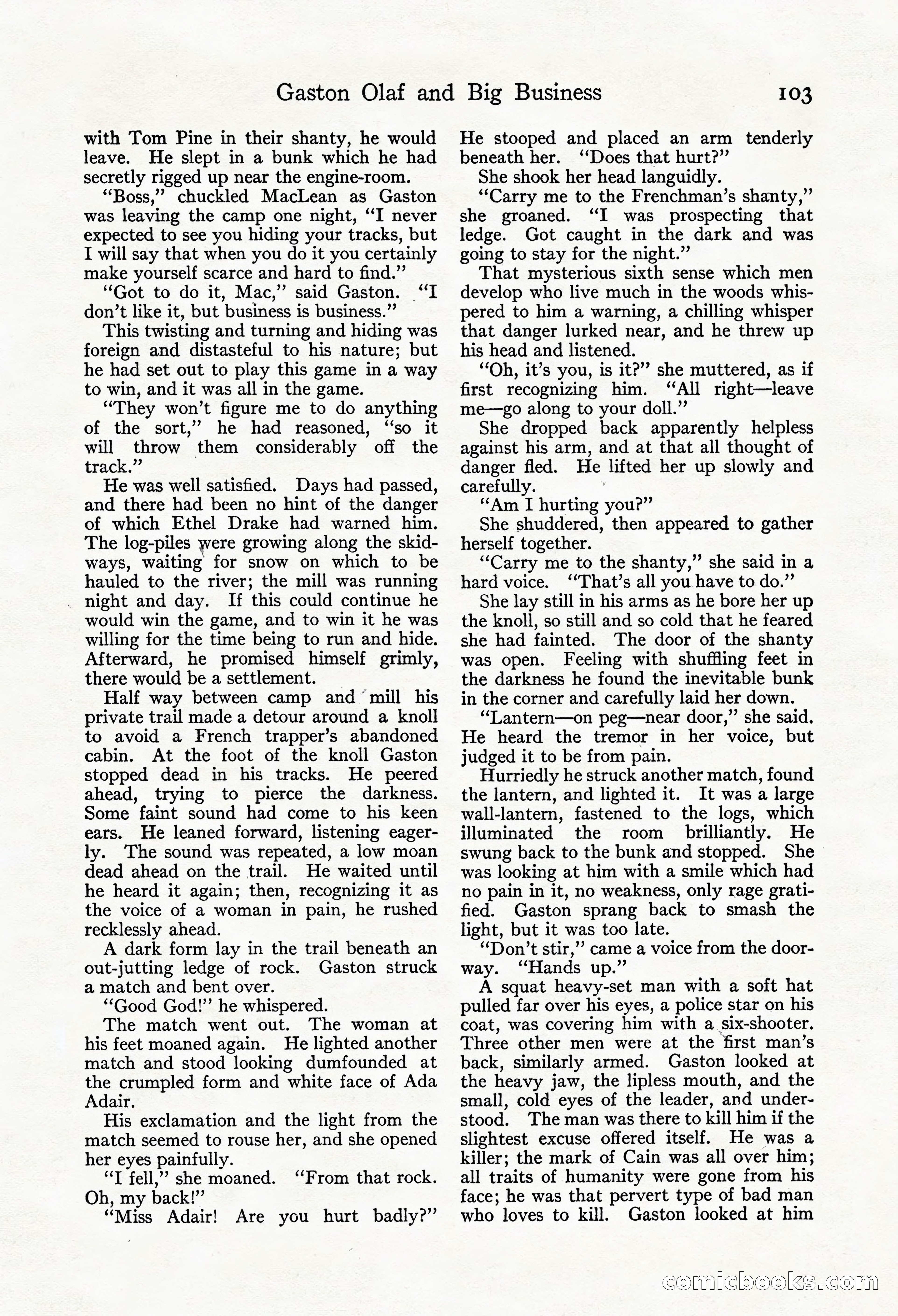
A restored page from Pulp Fiction, 1917. Page through the whole issue in the reader above.
📄 Transcribed text from this page (OCR, searchable)
Machine-transcribed from the original scan — historical spelling and the odd misread are preserved.
Gaston Olaf and Big Business with Tom Pine in their shanty, he would leave. He slept in a bunk which he had secretly rigged up near the engine-room. “Boss,” chuckled MacLean as Gaston was leaving the camp one night, “TI never expected to see you hiding your tracks, but I will say that when you do it you certainly make yourself scarce and hard to find.” “Got to do it, Mac,” said Gaston. don’t like it, but business is business.”’ This twisting and turning and hiding was foreign and distasteful to his nature; but he had set out to play this game in a way to win, and it was all in the game. “They won’t figure me to do anything Sh 5 of the sort,” he had reasoned, “‘so it will throw them considerably off the track.” He was well satisfied. Days had passed, and there had been no hint of the danger of which Ethel Drake had warned him. The log-piles were growing along the skid- ways, waiting for snow on which to be hauled to the river; the mill was running . night and day. If this could continue he would win the game, and to win it he was willing for the time being to run and hide. Afterward, he promised himself grimly, there would be a settlement. _ Half way between camp and mill his private trail made a detour around a knoll to avoid a French trapper’s abandoned cabin. At the foot of the knoll Gaston stopped dead in his tracks. He peered ahead, trying to pierce the darkness. Some faint sound had come to his keen ears. He leaned forward, listening eager- ly. The sound was repeated, a low moan dead ahead on the trail. He waited until he heard it again; then, recognizing it as the voice of a woman in pain, he rushed recklessly ahead. A dark form lay in the trail beneath an out-jutting ledge of rock. Gaston struck a match and bent over. ““Good God!”’ he whispered. The match went out. The woman at his feet moaned again. He lighted another match and stood looking dumfounded at the crumpled form and white face of Ada Adair. His exclamation and the light from the match seemed to rouse her, and she opened her eyes painfully. “T fell,’ she moaned. Oh, my back!’’ “Miss Adair! “From that rock. Are you hurt badly?” 103 He stooped and placed an arm tenderly beneath her. ‘‘Does that hurt?” She shook her head languidly. ‘“‘Carry me to the Frenchman’s shanty,” she groaned. ‘I was prospecting that ledge. Got caught in the dark and was going to stay for the night.” That mysterious sixth sense which men develop who live much in the woods whis- pered to him a warning, a chilling whisper that danger lurked near, and he threw up his head and listened. “Oh, it’s you, is it?” she muttered, as if first recognizing him. “All right—leave me—go along to your doll.” She dropped back apparently helpless against his arm, and at that all thought of danger fled. He lifted her up slowly and carefully. ‘Am I hurting you?” She shuddered, then appeared to gather herself together. ‘“‘Carry me to the shanty,” she said in a hard voice. ‘‘That’s all you have to do.” She lay still in his arms as he bore her up the knoll, so still and so cold that he feared she had fainted. The door of the shanty was open. Feeling with shuffling feet in the darkness he found the inevitable bunk in the corner and carefully laid her down. “Lantern—on peg—near door,” she said. He heard the tremor in her voice, but judged it to be from pain. Hurriedly he struck another match, found the lantern, and lighted it. It was a large wall-lantern, fastened to the logs, which illuminated the room brilliantly. He swung back to the bunk and stopped. She was looking at him with a smile which had no pain in it, no weakness, only rage grati- fied. Gaston sprang back to smash the light, but it was too late. “Don’t stir,” came a voice from the door- way. “Hands up.” A squat heavy-set man with a soft hat pulled far over his eyes, a police star on his coat, was covering him with a six-shooter. Three other men were at the first man’s back, similarly armed. Gaston looked at the heavy jaw, the lipless mouth, and the small, cold eyes of the leader, and under- stood. The man was there to kill him if the slightest excuse offered itself. He was a killer; the mark of Cain was all over him; all traits of humanity were gone from his face; he was that pervert type of bad man who loves to kill. Gaston looked at him COmicloo S C©