
Pulp Fiction, 1917 · page 101 of 196
Adventure Magazine, Mid-September 1917 — page 101: what you’re looking at
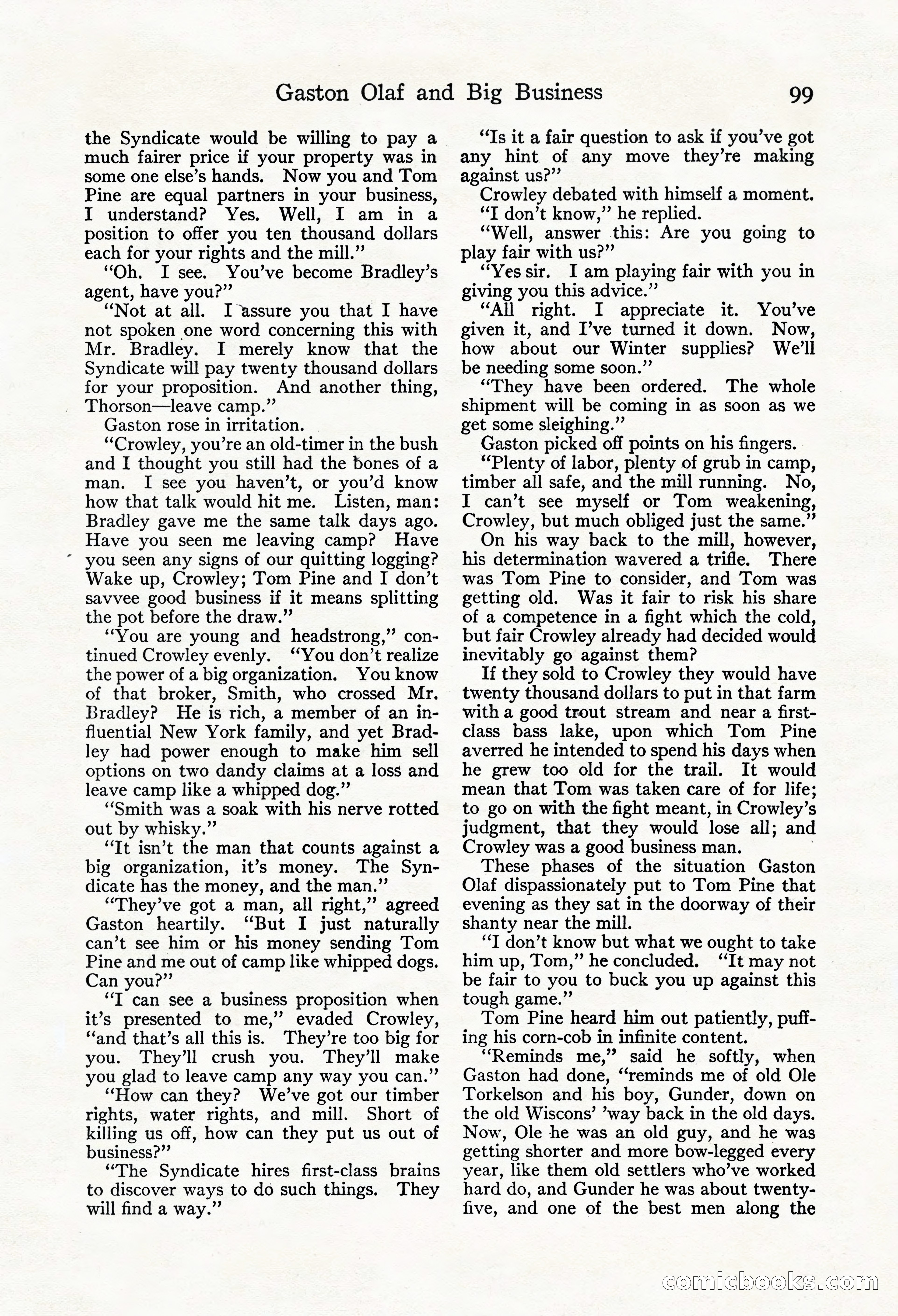
A restored page from Pulp Fiction, 1917. Page through the whole issue in the reader above.
📄 Transcribed text from this page (OCR, searchable)
Machine-transcribed from the original scan — historical spelling and the odd misread are preserved.
Gaston Olaf and Big Business the Syndicate would be willing to pay a much fairer price if your property was in some one else’s hands. Now you and Tom Pine are equal partners in your business, I understand? Yes. Well, I am in a position to offer you ten thousand dollars each for your rights and the mill.” “Oh. I see. You’ve become Bradley’s agent, have you?” “Not at all. I assure you that I have not spoken one word concerning this with Mr. Bradley. I merely know that the Syndicate will pay twenty thousand dollars for your proposition. And another thing, Thorson—leave camp.” Gaston rose in Irritation. “‘Crowley, you’re an old-timer in the bush and I thought you still had the bones of a man. I see you haven’t, or you’d know how that talk would hit me. Listen, man: Bradley gave me the same talk days ago. Have you seen me leaving camp? Have “ you seen any signs of our quitting logging? Wake up, Crowley; Tom Pine and I don’t savvee good business if it means splitting the pot before the draw.” ‘‘You are young and headstrong,” con- tinued Crowley evenly. ‘You don’t realize the power of a big organization. You know of that broker, Smith, who crossed Mr. | Bradley? He is rich, a member of an in- fluential New York family, and yet Brad- ley had power enough to make him sell options on two dandy claims at a loss and leave camp like a whipped dog.”’ “‘Smith was a soak with his nerve rotted out by whisky.” “Tt isn’t the man that counts against a big organization, it’s money. The Syn- dicate has the money, and the man.” “They’ve got a man, all right,” agreed Gaston heartily. ‘But I just naturally can’t see him or his money sending Tom Pine and me out of camp like whipped dogs. Can your” “T can see a business proposition when it’s presented to me,” evaded Crowley, ‘‘and that’s all this is. They’re too big for you. They’ll crush you. They’ll make you glad to leave camp any way you can.” ‘How can they? We’ve got our timber rights, water rights, and mill. Short of killing us off, how can they put us out of business?” “The Syndicate hires first-class brains to discover ways to do such things. They will find a way.” 99 “Ts it a fair question to ask if you’ve got any hint of any move they’re making against us?” Crowley debated with himself a moment. “T don’t know,” he replied. ‘“‘Well, answer this: Are you going to play fair with us?” “Yessir. Iam playing fair with you in giving you this advice.” “All right. I appreciate it. You’ve given it, and I’ve turned it down. Now, how about our Winter supplies? We'll be needing some soon.” “They have been ordered. The whole shipment will be coming in as soon as we get some sleighing.”’ Gaston picked off points on his fingers. “Plenty of labor, plenty of grub in camp, timber all safe, and the mill running. No, I can’t see myself or Tom weakening, Crowley, but much obliged just the same.” On his way back to the mill, however, his determination wavered a trifle. There was Tom Pine to consider, and Tom was getting old. Was it fair to risk his share of a competence in a fight which the cold, but fair Crowley already had decided would inevitably go against them? If they sold to Crowley they would have twenty thousand dollars to put in that farm with a good trout stream and near a first- class bass lake, upon which Tom Pine averred he intended to spend his days when he grew too old for the trail. It would mean that Tom was taken care of for life; to go on with the fight meant, in Crowley’s judgment, that they would lose all; and Crowley was a good business man. These phases of the situation Gaston Olaf dispassionately put to Tom Pine that evening as they sat in the doorway of their shanty near the mill. “T don’t know but what we ought to take him up, Tom,” he concluded. ‘It may not be fair to you to buck you up against this tough game.” Tom Pine heard him out patiently, puff- ing his corn-cob in infinite content. “Reminds me,” said he softly, when Gaston had done, ‘‘reminds me of old Ole Torkelson and his boy, Gunder, down on the old Wiscons’ ’way back in the old days. Now, Ole he was an old guy, and he was getting shorter and more bow-legged every year, like them old settlers who’ve worked hard do, and Gunder he was about twenty- five, and one of the best men along the COmiclboo C©