
Pulp Fiction, 1917 · page 93 of 196
Adventure, August 1917 — page 93: what you’re looking at
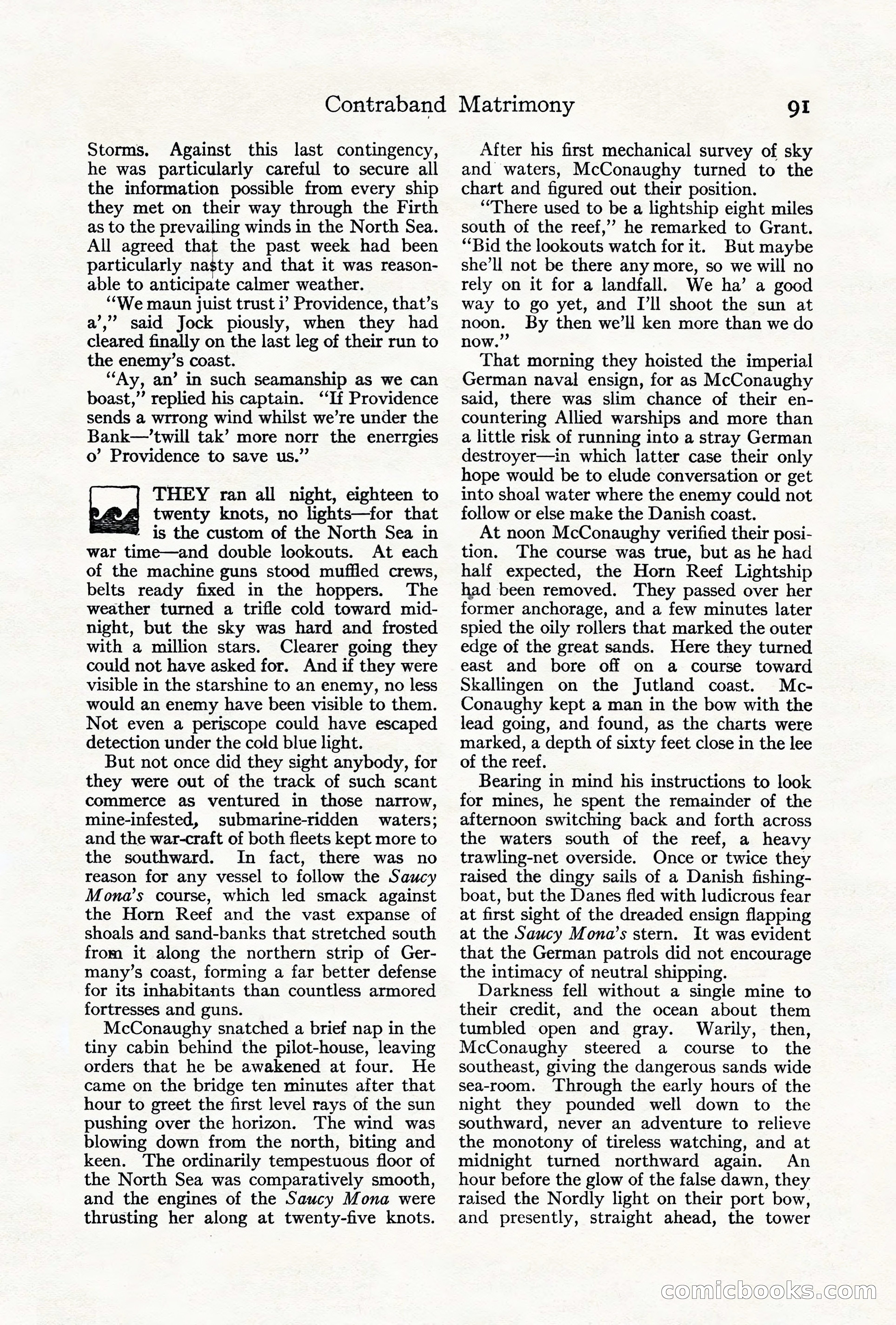
A restored page from Pulp Fiction, 1917. Page through the whole issue in the reader above.
📄 Transcribed text from this page (OCR, searchable)
Machine-transcribed from the original scan — historical spelling and the odd misread are preserved.
Contraband Matrimony Storms. Against this last contingency, he was particularly careful to secure all the information possible from every ship they met on their way through the Firth as to the prevailing winds in the North Sea. All agreed that the past week had been particularly nasty and that it was reason- able to anticipate calmer weather. ‘“‘We maun juist trust i’ Providence, that’s a’,” said Jock piously, when they had cleared finally on the last leg of their run to the enemy’s coast. ‘“‘Ay, an’ in such seamanship as we can boast,” replied his captain. ‘If Providence sends a wrrong wind whilst we’re under the Bank—’twill tak’ more norr the enerrgies o’ Providence to save us.” THEY ran all night, eighteen to 8 twenty knots, no lights—for that * is the custom of the North Sea in war time—and double lookouts. At each of the machine guns stood muffled crews, belts ready fixed in the hoppers. The weather turned a trifle cold toward mid- night, but the sky was hard and frosted with a million stars. Clearer going they could not have asked for. And if they were visible in the starshine to an enemy, no less would an enemy have been visible to them. Not even a periscope could have escaped detection under the cold blue light. But not once did they sight anybody, for they were out of the track of such scant commerce as ventured in those narrow, mine-infested, submarine-ridden waters; and the war-craft of both fleets kept more to the southward. In fact, there was no reason for any vessel to follow the Saucy Mona’s course, which led smack against the Horn Reef and the vast expanse of shoals and sand-banks that stretched south from it along the northern strip of Ger- many’s coast, forming a far better defense for its inhabitants than countless armored fortresses and guns. McConaughy snatched a brief nap in the tiny cabin behind the pilot-house, leaving orders that he be awakened at four. He came on the bridge ten minutes after that hour to greet the first level rays of the sun pushing over the horizon. The wind was blowing down from the north, biting and keen. The ordinarily tempestuous floor of the North Sea was comparatively smooth, and the engines of the Saucy Mona were thrusting her along at twenty-five knots. OI After his first mechanical survey of sky and waters, McConaughy turned to the chart and figured out their position. ‘‘There used to be a lightship eight miles south of the reef,” he remarked to Grant. ‘Bid the lookouts watch for it. But maybe she’ll not be there any more, so we will no rely on it for a landfall. We ha’ a good way to go yet, and I’ll shoot the sun at noon. By then we'll ken more than we do now.” That morning they hoisted the imperial German naval ensign, for as McConaughy said, there was slim chance of their en- countering Allied warships and more than a little risk of running into a stray German destroyer—in which latter case their only hope would be to elude conversation or get into shoal water where the enemy could not follow or else make the Danish coast. At noon McConaughy verified their posi- tion. The course was true, but as he had half expected, the Horn Reef Lightship had been removed. They passed over her former anchorage, and a few minutes later spied the oily rollers that marked the outer edge of the great sands. Here they turned east and bore off on a course toward Skallingen on the Jutland coast. Mc- Conaughy kept a man in the bow with the lead going, and found, as the charts were marked, a depth of sixty feet close in the lee of the reef. Bearing in mind his instructions to look for mines, he spent the remainder of the afternoon switching back and forth across the waters south of the reef, a heavy trawling-net overside. Once or twice they raised the dingy sails of a Danish fishing- boat, but the Danes fled with ludicrous fear at first sight of the dreaded ensign flapping at the Saucy Mona’s stern. It was evident that the German patrols did not encourage the intimacy of neutral shipping. Darkness fell without a single mine to their credit, and the ocean about them tumbled open and gray. Warily, then, McConaughy steered a course to the southeast, giving the dangerous sands wide sea-room. Through the early hours of the night they pounded well down to the southward, never an adventure to relieve the monotony of tireless watching, and at midnight turned northward again. An hour before the glow of the false dawn, they raised the Nordly light on their port bow, and presently, straight ahead, the tower cCoOMmiclsoo CO 5}