
Pulp Fiction, 1917 · page 92 of 196
Adventure, August 1917 — page 92: what you’re looking at
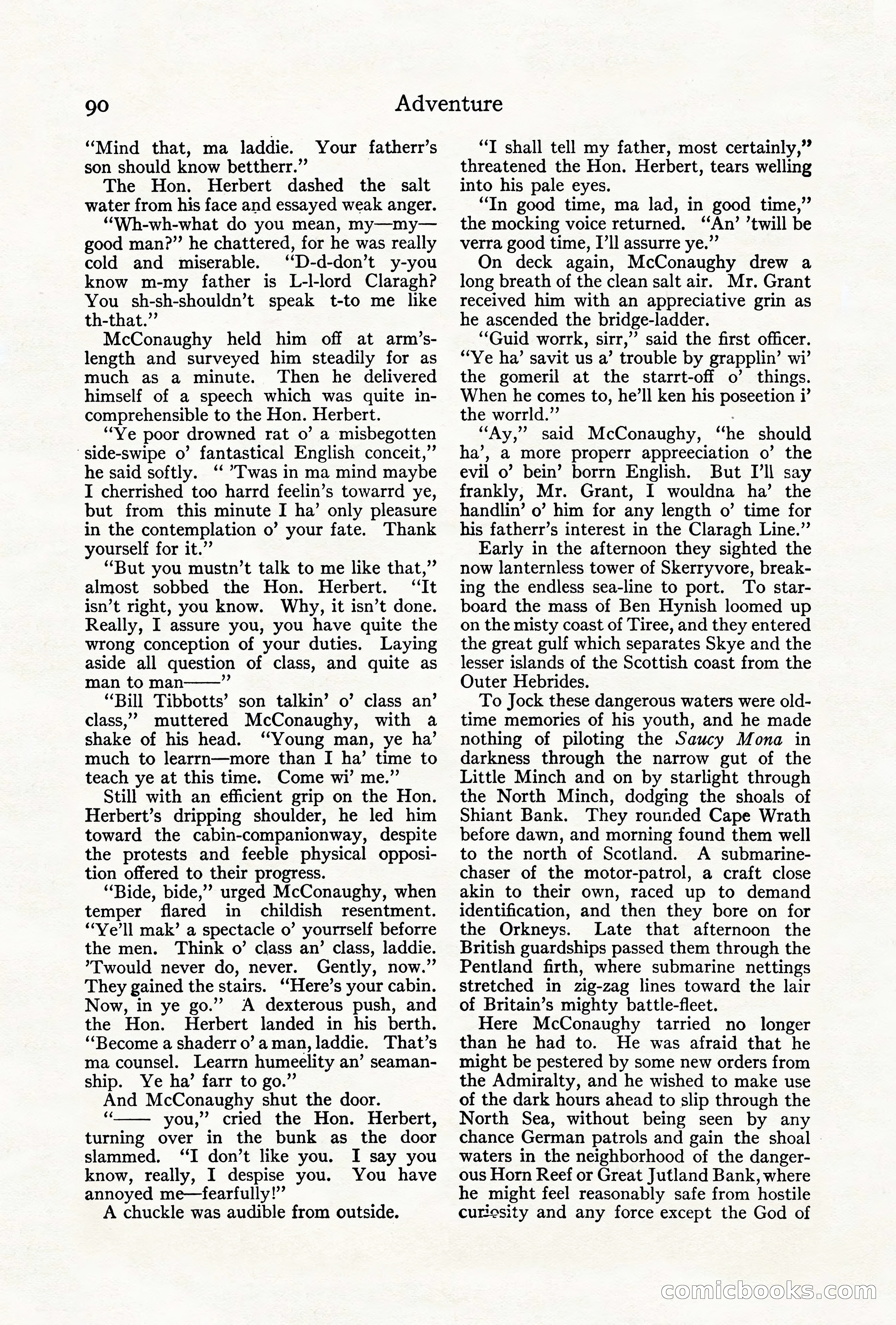
A restored page from Pulp Fiction, 1917. Page through the whole issue in the reader above.
📄 Transcribed text from this page (OCR, searchable)
Machine-transcribed from the original scan — historical spelling and the odd misread are preserved.
90 “Mind that, ma laddie. son should know bettherr.” The Hon. Herbert dashed the salt water from his face and essayed weak anger. “Wh-wh-what do you mean, my—my— good man?” he chattered, for he was really cold and miserable. ‘‘D-d-don’t y-you know m-my father is L-l-lord Claragh? You sh-sh-shouldn’t speak t-to me like th-that.” McConaughy held him off at arm’s- length and surveyed him steadily for as much as a minute. Then he delivered himself of a speech which was quite in- comprehensible to the Hon. Herbert. ‘Ye poor drowned rat o’ a misbegotten side-swipe o’ fantastical English conceit,” he said softly. ‘‘ "T'was in ma mind maybe I cherrished too harrd feelin’s towarrd ye, but from this minute I ha’ only pleasure in the contemplation o’ your fate. Thank yourself for it.” “But you mustn’t talk to me like that,” almost sobbed the Hon. Herbert. “It isn’t right, you know. Why, it isn’t done. Really, I assure you, you have quite the wrong conception of your duties. Laying aside all question of class, and quite as man to man i “Bill Tibbotts’ son talkin’ o’ class an’ class,” muttered McConaughy, with a shake of his head. “Young man, ye ha’ much to learrn—more than I ha’ time to teach ye at this time. Come wi’ me.” Still with an efficient grip on the Hon. Herbert’s dripping shoulder, he led him toward the cabin-companionway, despite the protests and feeble physical opposi- tion offered to their progress. ‘Bide, bide,’”’ urged McConaughy, when temper flared in childish resentment. ‘““Ye’ll mak’ a spectacle o’ yourrself beforre the men. Think o’ class an’ class, laddie. ’Twould never do, never. Gently, now.” They gained the stairs. “Here’s your cabin. Now, in ye go.” A dexterous push, and the Hon. Herbert landed in his berth. ‘‘Become a shaderr 0’ aman, laddie. That’s ma counsel. Learrn humeelity an’ seaman- ship. Ye ha’ farr to go.” And McConaughy shut the door. es you,” cried the Hon. Herbert, turning over in the bunk as the door slammed. “I don’t like you. I say you know, really, I despise you. You have annoyed me—fearfully!”’ A chuckle was audible from outside. Your fatherr’s Adventure “T shall tell my father, most certainly,” threatened the Hon. Herbert, tears welling into his pale eyes. “In good time, ma lad, in good time,” the mocking voice returned. ‘An’ ’twill be verra good time, I’ll assurre ye.” On deck again, McConaughy drew a long breath of the clean salt air. Mr. Grant received him with an appreciative grin as he ascended the bridge-ladder. “Guid worrk, sirr,” said the first officer. “Ye ha’ savit us a’ trouble by grapplin’ wi’ the gomeril at the starrt-off o’ things. When he comes to, he’ll ken his poseetion i’ the worrld.” “Ay,” said McConaughy, “he should ha’, a more properr appreeciation o’ the evil o’ bein’ borrn English. But I’ll say frankly, Mr. Grant, 1 wouldna ha’ the handlin’ o’ him for any length o’ time for his fatherr’s interest in the Claragh Line.” Early in the afternoon they sighted the now lanternless tower of Skerryvore, break- ing the endless sea-line to port. To star- board the mass of Ben Hynish loomed up on the misty coast of Tiree, and they entered the great gulf which separates Skye and the lesser islands of the Scottish coast from the Outer Hebrides. To Jock these dangerous waters were old- time memories of his youth, and he made nothing of piloting the Saucy Mona in darkness through the narrow gut of the Little Minch and on by starlight through the North Minch, dodging the shoals of Shiant Bank. They rounded Cape Wrath before dawn, and morning found them well to the north of Scotland. A submarine- chaser of the motor-patrol, a craft close akin to their own, raced up to demand identification, and then they bore on for the Orkneys. Late that afternoon the British guardships passed them through the Pentland firth, where submarine nettings stretched in zig-zag lines toward the lair of Britain’s mighty battle-fleet. Here McConaughy tarried no longer than he had to. He was afraid that he might be pestered by some new orders from the Admiralty, and he wished to make use of the dark hours ahead to slip through the North Sea, without being seen by any chance German patrols and gain the shoal - waters in the neighborhood of the danger- ous Horn Reef or Great Jutland Bank, where he might feel reasonably safe from hostile curiosity and any force except the God of CoOMmiclsoo (©