
Pulp Fiction, 1917 · page 65 of 196
Adventure, August 1917 — page 65: what you’re looking at
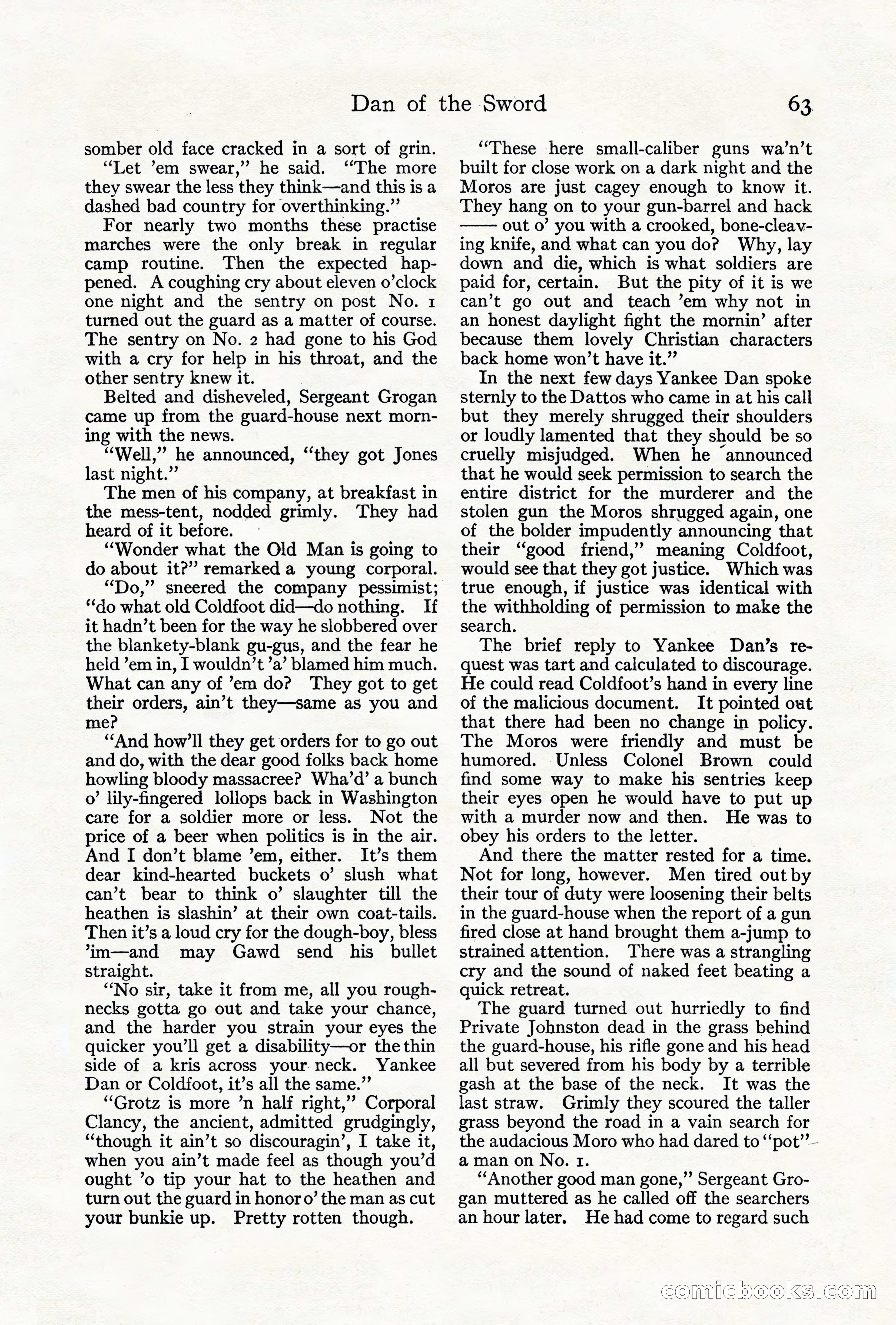
A restored page from Pulp Fiction, 1917. Page through the whole issue in the reader above.
📄 Transcribed text from this page (OCR, searchable)
Machine-transcribed from the original scan — historical spelling and the odd misread are preserved.
Dan of the Sword somber old face cracked in a sort of grin. “Let ’em swear,” he said. ‘“The more they swear the less they think—and this is a dashed bad country for overthinking.”’ For nearly two months these practise marches were the only break in regular camp routine. Then the expected hap- pened. A coughing cry about eleven o’clock one night and the sentry on post No. 1 turned out the guard as a matter of course. The sentry on No. 2 had gone to his God with a cry for help in his throat, and the other sentry knew it. Belted and disheveled, Sergeant Grogan came up from the guard-house next morn- ing with the news. “Well,” he announced, ‘‘they got Jones last night.” The men of his company, at breakfast in the mess-tent, nodded grimly. They had heard of it before. ‘‘Wonder what the Old Man is going to do about it?” remarked a young corporal. “Do,” sneered the company pessimist; “do what old Coldfoot did—do nothing. If it hadn’t been for the way he slobbered over the blankety-blank gu-gus, and the fear he held ’em in, I wouldn’t ’a’ blamed him much. What can any of ’em do? They got to get their orders, ain’t they—same as you and me? ‘“‘And how’ll they get orders for to go out and do, with the dear good folks back home howling bloody massacree? Wha’d’ a bunch o’ lily-fingered loliops back in Washington care for a soldier more or less. Not the price of a beer when politics is in the air. And I don’t blame ’em, either. It’s them dear kind-hearted buckets o’ slush what can’t bear to think o’ slaughter till the heathen is slashin’ at their own coat-tails. Then it’s a loud cry for the dough-boy, bless "im—and may Gawd send his bullet straight. ‘“‘No sir, take it from me, all you rough- necks gotta go out and take your chance, and the harder you strain your eyes the quicker you'll get a disability—or the thin side of a kris across your. neck. Yankee Dan or Coldfoot, it’s all the same.”’ “Grotz is more ’n half right,” Corporal Clancy, the ancient, admitted grudgingly, “though it ain’t so discouragin’, I take it, when you ain’t made feel as though you’d ought ’o tip your hat to the heathen and turn out the guard in honoro’ the man as cut your bunkie up. Pretty rotten though. 63 “These here small-caliber guns wa’n’t built for close work on a dark night and the Moros are just cagey enough to know it. They hang on to your gun-barrel and hack out o’ you with a crooked, bone-cleav- ing knife, and what can you do? Why, lay down and die, which is what soldiers are paid for, certain. But the pity of it is we can’t go out and teach ’em why not in an honest daylight fight the mornin’ after because them lovely Christian characters back home won’t have it.” In the next few days Yankee Dan spoke sternly to the Dattos who came in at his call but they merely shrugged their shoulders or loudly lamented that they should be so cruelly misjudged. When he ‘announced that he would seek permission to search the entire district for the murderer and the stolen gun the Moros shrugged again, one of the bolder impudently announcing that their ‘“‘good friend,’’ meaning Coldfoot, would see that they got justice. Which was true enough, if justice was identical with the withholding of permission to make the search. The brief reply to Yankee Dan’s re- quest was tart and calculated to discourage. He could read Coldfoot’s hand in every line of the malicious document. It pointed out that there had been no change in policy. The Moros were friendly and must be humored. Unless Colonel Brown could find some way to make his sentries keep their eyes open he would have to put up with a murder now and then. He was to obey his orders to the letter. And there the matter rested for a time. Not for long, however. Men tired out by their tour of duty were loosening their belts in the guard-house when the report of a gun fired close at hand brought them a-jump to strained attention. There was a strangling cry and the sound of naked feet beating a quick retreat. The guard turned out hurriedly to find Private Johnston dead in the grass behind the guard-house, his rifle gone and his head all but severed from his body by a terrible gash at the base of the neck. It was the last straw. Grimly they scoured the taller grass beyond the road in a vain search for the audacious Moro who had dared to “‘pot’’- aman on No. tf. ‘Another good man gone,” Sergeant Gro- gan muttered as he called off the searchers an hour later. He had come to regard such CoOMmiclsoo CO =