
Pulp Fiction, 1917 · page 64 of 196
Adventure, August 1917 — page 64: what you’re looking at
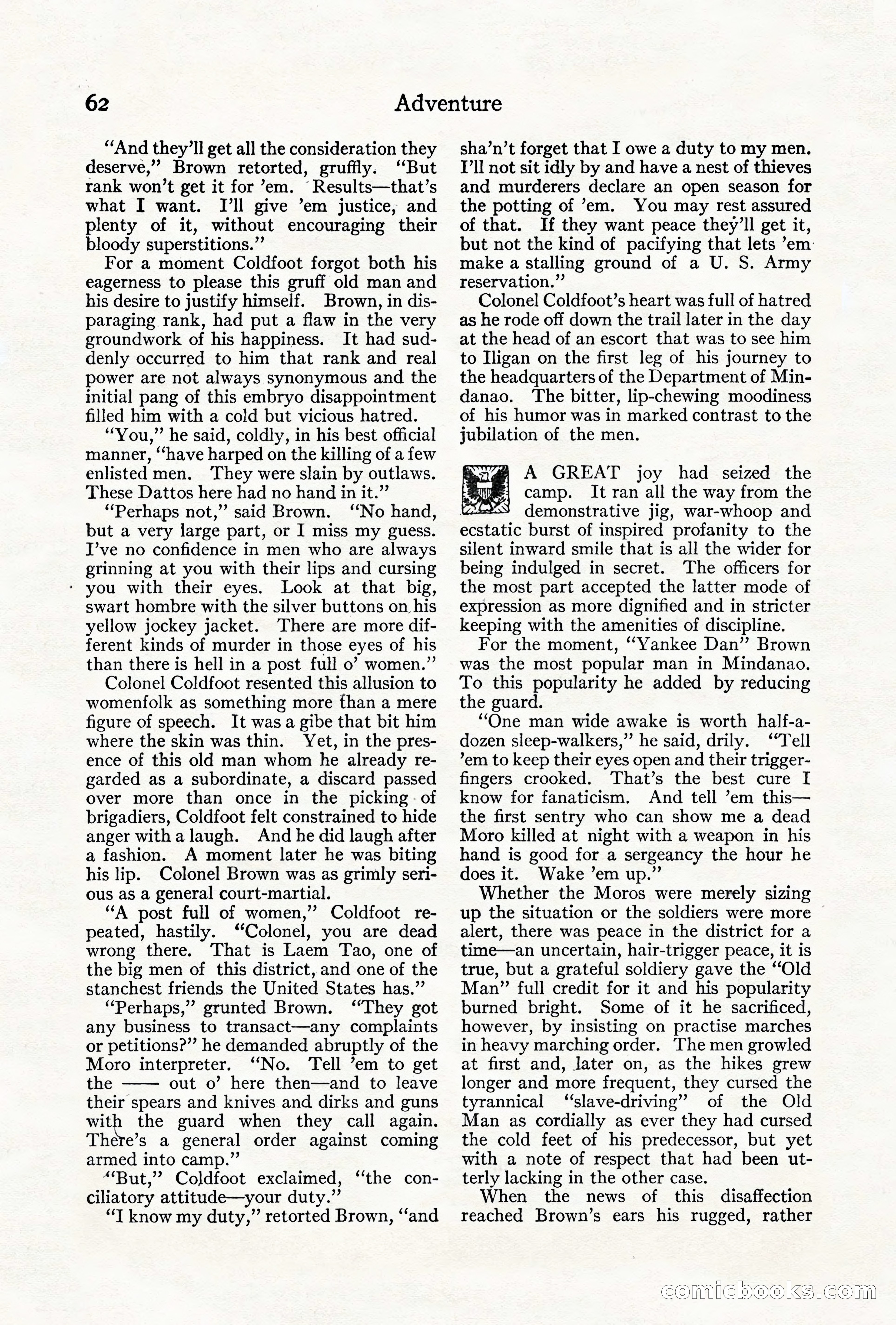
A restored page from Pulp Fiction, 1917. Page through the whole issue in the reader above.
📄 Transcribed text from this page (OCR, searchable)
Machine-transcribed from the original scan — historical spelling and the odd misread are preserved.
62 “And they’! get all the consideration they deserve,” Brown retorted, gruffly. “But rank won’t get it for ’°em. Results—that’s what I want. I'll give ’em justice; and plenty of it, without encouraging their bloody superstitions.” For a moment Coldfoot forgot both his eagerness to please this gruff old man and his desire to justify himself. Brown, in dis- paraging rank, had put a flaw in the very groundwork of his happiness. It had sud- denly occurred to him that rank and real power are not always synonymous and the initial pang of this embryo disappointment filled him with a cold but vicious hatred. “You,” he said, coldly, in his best official manner, “have harped on the killing of a few enlisted men. ‘They were slain by outlaws. These Dattos here had no hand in it.” “Perhaps not,” said Brown. “No hand, but a very large part, or I miss my guess. I’ve no confidence in men who are always grinning at you with their lips and cursing ‘ you with their eyes. Look at that big, swart hombre with the silver buttons on his yellow jockey jacket. There are more dif- ferent kinds of murder in those eyes of his than there is hell in a post full o’ women.” Colonel Coldfoot resented this allusion to womenfolk as something more than a mere figure of speech. It was a gibe that bit him where the skin was thin. Yet, in the pres- ence of this old man whom he already re- garded as a subordinate, a discard passed over more than once in the picking - of brigadiers, Coldfoot felt constrained to hide anger witha laugh. And he did laugh after a fashion. A moment later he was biting his lip. Colonel Brown was as grimly seri- ous as a general court-martial. ‘“‘A post full of women,” Coldfoot re- peated, hastily. ‘‘Colonel, you are dead wrong there. That is Laem Tao, one of the big men of this district, and one of the stanchest friends the United States has.”’ “Perhaps,” grunted Brown. “They got any business to transact—any complaints or petitions?” he demanded abruptly of the Moro interpreter. “No. Tell ’em to get the out o’ here then—and to leave their spears and knives and dirks and guns with the guard when they call again. There’s a general order against coming armed into camp.” “But,” Coldfoot exclaimed, ciliatory attitude—your duty.” “T know my duty,” retorted Brown, “‘and “the con- Adventure sha’n’t forget that I owe a duty to my men. I’ll not sit idly by and have a nest of thieves and murderers declare an open season for the potting of ’°em. You may rest assured of that. If they want peace they’ll get it, but not the kind of pacifying that lets ’em-: make a stalling ground of a U. S. Army reservation.” Colonel Coldfoot’s heart was full of hatred as he rode off down the trail later in the day at the head of an escort that was to see him to Iligan on the first leg of his journey to the headquarters of the Department of Min- danao. The bitter, lip-chewing moodiness of his humor was in marked contrast to the jubilation of the men. A GREAT joy had seized the camp. It ran all the way from the demonstrative jig, war-whoop and ecstatic burst of inspired profanity to the silent inward smile that is all the wider for being indulged in secret. The officers for the most part accepted the latter mode of expression as more dignified and in stricter keeping with the amenities of discipline. For the moment, ‘“‘Yankee Dan” Brown was the most popular man in Mindanao. To this popularity he added by reducing the guard. “One man wide awake is worth half-a- dozen sleep-walkers,”’ he said, drily. ‘Tell em to keep their eyes open and their trigger- fingers crooked. That’s the best cure I know for fanaticism. And tell ’em this— the first sentry who can show me a dead Moro killed at night with a weapon in his hand is good for a sergeancy the hour he does it. Wake ’em up.” Whether the Moros were merely sizing up the situation or the soldiers were more ~ alert, there was peace in the district for a time—an uncertain, hair-trigger peace, it is true, but a grateful soldiery gave the “Old Man” full credit for it and his popularity burned bright. Some of it he sacrificed, however, by insisting on practise marches in heavy marching order. The men growled at first and, later on, as the hikes grew longer and more frequent, they cursed the tyrannical “‘slave-driving”’ of the Old Man as cordially as ever they had cursed the cold feet of his predecessor, but yet with a note of respect that had been ut- terly lacking in the other case. When the news of this disaffection reached Brown’s ears his rugged, rather cComiclsook CO 5}