
Pulp Fiction, 1917 · page 61 of 196
Adventure, August 1917 — page 61: what you’re looking at
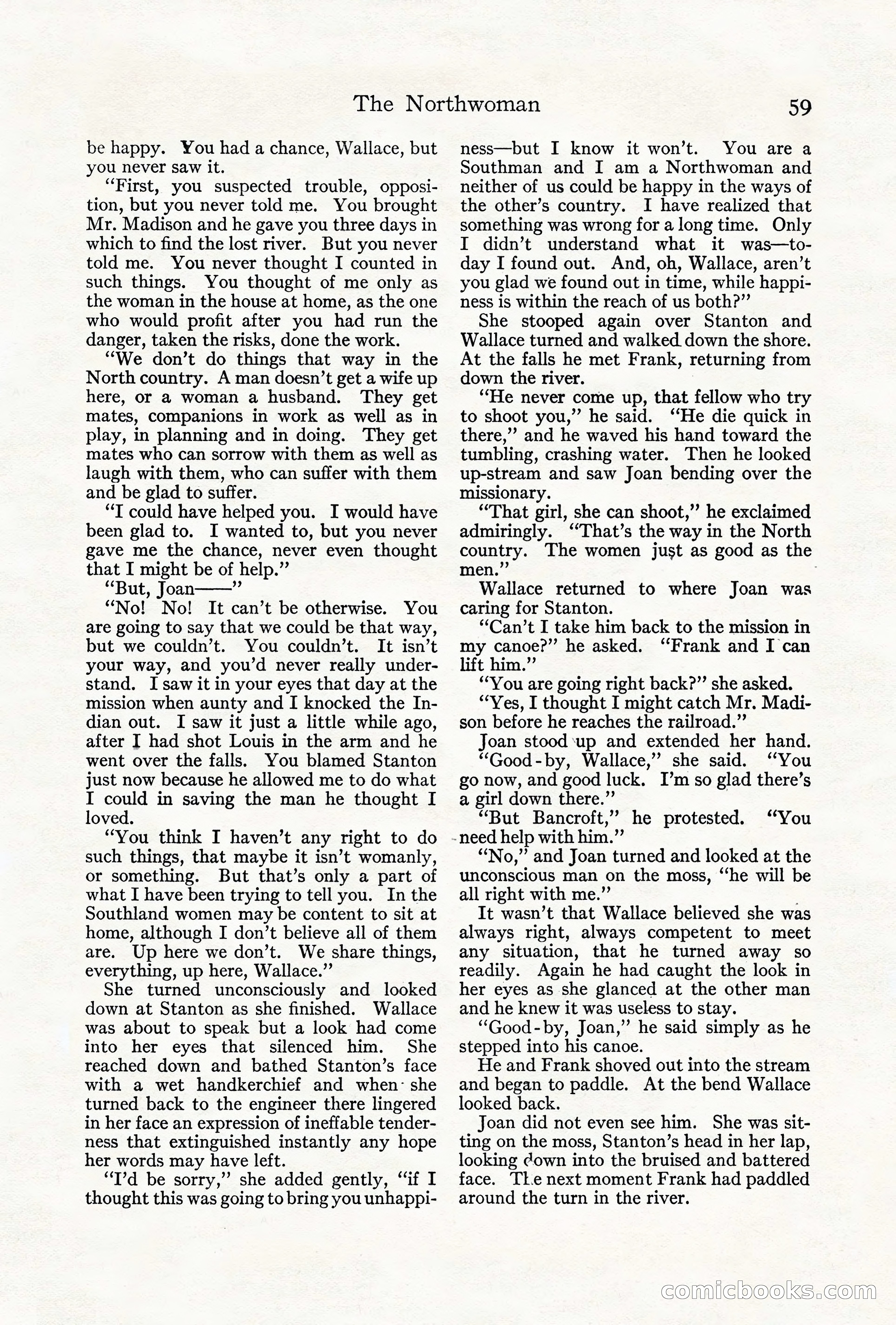
A restored page from Pulp Fiction, 1917. Page through the whole issue in the reader above.
📄 Transcribed text from this page (OCR, searchable)
Machine-transcribed from the original scan — historical spelling and the odd misread are preserved.
The Northwoman be happy. You had a chance, Wallace, but you never saw it. “First, you suspected trouble, opposi- tion, but you never told me. You brought Mr. Madison and he gave you three days in which to find the lost river. But you never told me. You never thought I counted in such things. You thought of me only as the woman in the house at home, as the one who would profit after you had run the danger, taken the risks, done the work. “We don’t do things that way in the North country. A man doesn’t get a wife up here, or a2 woman a husband. They get mates, companions in work as well as in play, in planning and in doing. They get mates who can sorrow with them as well as laugh with them, who can suffer with them and be glad to suffer. “TI could have helped you. I would have been glad to. I wanted to, but you never gave me the chance, never even thought that I might be of help.” “But, Joan——”’ “No! No! It can’t be otherwise. You are going to say that we could be that way, but we couldn’t. You couldn’t. It isn’t your way, and you’d never really under- stand. I saw it in your eyes that day at the mission when aunty and I knocked the In- dian out. I saw it just a little while ago, after I had shot Louis in the arm and he went over the falls. You blamed Stanton just now because he allowed me to do what I could in saving the man he thought I loved. “You think I haven’t any right to do such things, that maybe it isn’t womanly, or something. But that’s only a part of what I have been trying to tell you. In the Southland women may be content to sit at home, although I don’t believe all of them are. Up here we don’t. We share things, everything, up here, Wallace.” She turned unconsciously and looked down at Stanton as she finished. Wallace was about to speak but a look had come into her eyes that silenced him. She reached down and bathed Stanton’s face with a wet handkerchief and when- she turned back to the engineer there lingered in her face an expression of ineffable tender- ness that extinguished instantly any hope her words may have left. “T’d be sorry,” she added gently, “‘if I thought this was going to bring you unhappi- 99 ness—but I know it won’t. You are a Southman and I am a Northwoman and neither of us could be happy in the ways of the other’s country. I have realized that something was wrong for along time. Only I didn’t understand what it was—to- day I found out. And, oh, Wallace, aren’t you glad we found out in time, while happi- ness is within the reach of us both?” She stooped again over Stanton and Wallace turned and walked down the shore. At the falls he met Frank, returning from down the river. : ‘“‘“Hle never come up, that fellow who try to shoot you,” he said. ‘‘He die quick in there,”’ and he waved his hand toward the tumbling, crashing water. Then he looked up-stream and saw Joan bending over the missionary. “That girl, she can shoot,” he exclaimed admiringly. ‘“That’s the way in the North country. The women just as good as the men.” Wallace returned to where Joan was caring for Stanton. “‘Can’t I take him back to the mission in my canoe?” he asked. ‘‘Frank and I can lift him.”’ “You are going right back?” she asked. “Ves, I thought I might catch Mr. Madi- son before he reaches the railroad.”’ Joan stood ‘up and extended her hand. ““Good-by, Wallace,” she said. ‘‘You go now, and good luck. I’m so glad there’s a girl down there.”’ “But Bancroft,” he protested. ‘You -need help with him.”’ “No,” and Joan turned and looked at the unconscious man on the moss, “he will be all right with me.”’ It wasn’t that Wallace believed she was always right, always competent to meet any situation, that he turned away so readily. Again he had caught the look in her eyes as she glanced at the other man and he knew it was useless to stay. “Good-by, Joan,” he said simply as he stepped into his canoe. He and Frank shoved out into the stream and began to paddle. At the bend Wallace looked back. Joan did not even see him. She was sit- ting on the moss, Stanton’s head in her lap, looking down into the bruised and battered face. Tk.e next moment Frank had paddled around the turn in the river. COMmiclsoo C© 5}