
Pulp Fiction, 1917 · page 192 of 196
Adventure, August 1917 — page 192: what you’re looking at
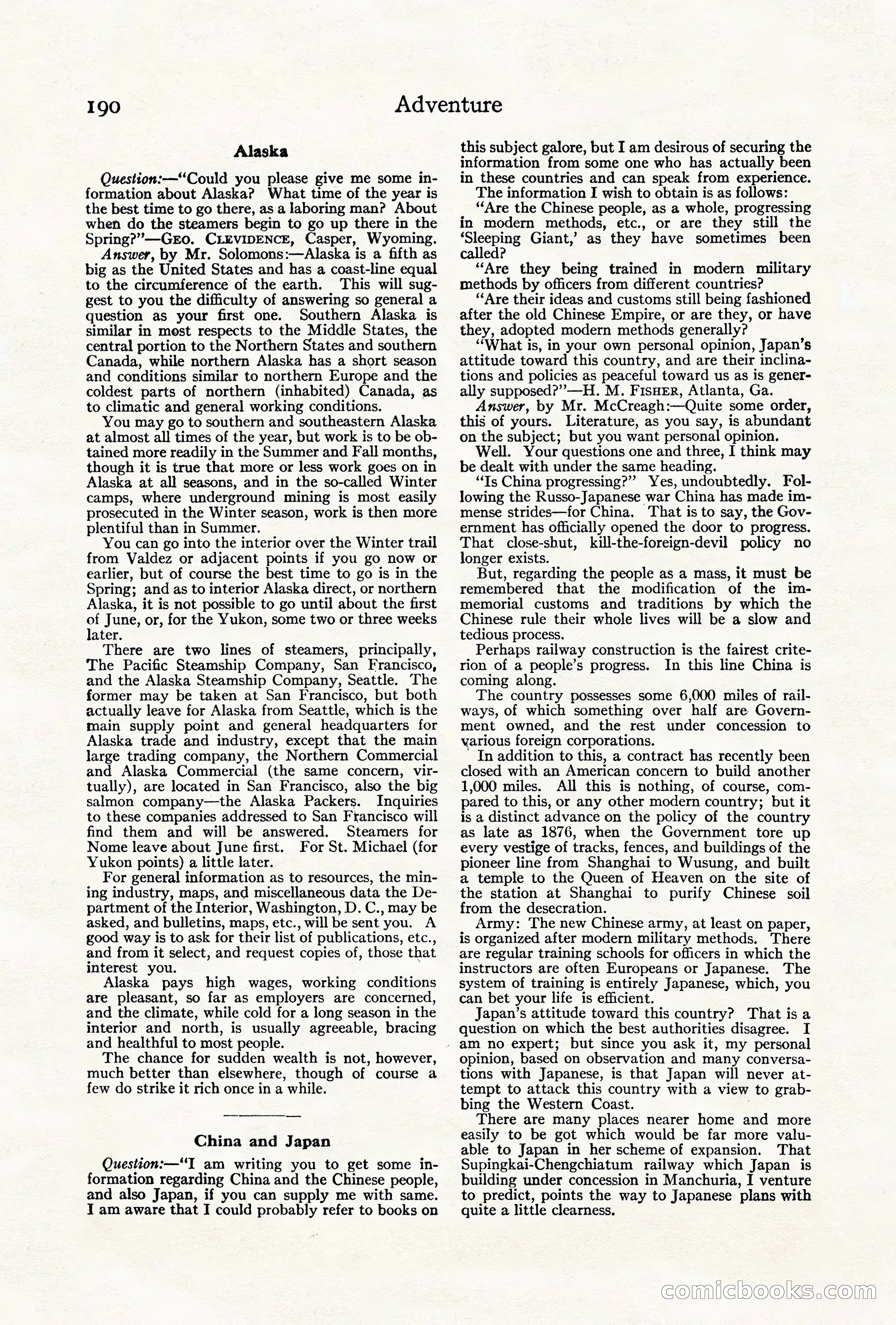
A restored page from Pulp Fiction, 1917. Page through the whole issue in the reader above.
📄 Transcribed text from this page (OCR, searchable)
Machine-transcribed from the original scan — historical spelling and the odd misread are preserved.
190 Alaska Question: —“Could you please give me some in- formation about Alaska? What time of the year is the best time to go there, as a laboring man? About when do the steamers begin to go up there in the Spring?’”’—GEo. CLEVIDENCE, Casper, Wyoming. Answer, by Mr. Solomons:—Alaska is a fifth as big as the United States and has a coast-line equal to the circumference of the earth. This will sug- gest to you the difficulty of answering so general a question as your first one. Southern Alaska is similar in most respects to the Middle States, the central portion to the Northern States and southern Canada, while northern Alaska has a short season and conditions similar to northern Europe and the coldest parts of northern (inhabited) Canada, as to climatic and general working conditions. You may go to southern and southeastern Alaska at almost all times of the year, but work is to be ob- tained more readily in the Summer and Fall months, though it is true that more or less work goes on in Alaska at all seasons, and in the so-called Winter camps, where underground mining is most easily prosecuted in the Winter season, work is then more plentiful than in Summer. You can go into the interior over the Winter trail from Valdez or adjacent points if you go now or earlier, but of course the best time to go is in the Spring; and as to interior Alaska direct, or northern Alaska, it is not possible to go until about the first of June, or, for the Yukon, some two or three weeks later. There are two lines of steamers, principally, The Pacific Steamship Company, San Francisco, and the Alaska Steamship Company, Seattle. The former may be taken at San Francisco, but both actually leave for Alaska from Seattle, which is the main supply point and general headquarters for Alaska trade and industry, except that the main large trading company, the Northern Commercial and Alaska Commercial (the same concern, vir- tually), are located in San Francisco, also the big salmon company—the Alaska Packers. Inquiries to these companies addressed to San Francisco will find them and will be answered. Steamers for Nome leave about June first. For St. Michael (for Yukon points) a little later. For general information as to resources, the min- ing industry, maps, and miscellaneous data the De- partment of the Interior, Washington, D. C., may be asked, and bulletins, maps, etc., will be sent you. A good way is to ask for their list of publications, etc., and from it select, and request copies of, those that interest you. Alaska pays high wages, working conditions are pleasant, so far as employers are concerned, and the climate, while cold for a long season in the interior and north, is usually agreeable, bracing and healthful to most people. The chance for sudden wealth is not, however, much better than elsewhere, though of course a few do strike it rich once in a while. China and Japan Question: —“T am writing you to get some in- formation regarding China and the Chinese people, and also Japan, if you can supply me with same. {J am aware that I could probably refer to books on Adventure this subject galore, but I am desirous of securing the information from some one who has actually been in these countries and can speak from experience. The information I wish to obtain is as follows: “Are the Chinese people, as a whole, progressing in modern methods, etc., or are they still the ‘Sleeping Giant,’ as they have sometimes been called? ‘“‘Are they being trained in modern military methods by officers from different countries? ‘Are their ideas and customs still being fashioned after the old Chinese Empire, or are they, or have they, adopted modern methods generally? ‘‘What is, in your own personal opinion, Japan’s attitude toward this country, and are their inclina- tions and policies as peaceful toward us as is gener- ally supposed?”—H. M. FisuHer, Atlanta, Ga. Answer, by Mr. McCreagh:—Quite some order, this of yours. Literature, as you say, is abundant on the subject; but you want personal opinion. Well. Your questions one and three, I think may be dealt with under the same heading. “Is China progressing?”’ Yes, undoubtedly. Fol- lowing the Russo-Japanese war China has made im- mense strides—for China. That is to say, the Gov- ernment has officially opened the door to progress. That close-sbut, kill-the-foreign-devil policy no longer exists. But, regarding the people as a mass, it must be remembered that the modification of the im- memorial customs and traditions by which the Chinese rule their whole lives will be a slow and tedious process. Perhaps railway construction is the fairest crite- rion of a people’s progress. In this line China is coming along. The country possesses some 6,000 miles of rail- ways, of which something over half are Govern- ment owned, and the rest under concession to various foreign corporations. In addition to this, a contract has recently been closed with an American concern to build another 1,000 miles. All this is nothing, of course, com- pared to this, or any other modern country; but it is a distinct advance on the policy of the country as late as 1876, when the Government tore up every vestige of tracks, fences, and buildings of the pioneer line from Shanghai to Wusung, and built a temple to the Queen of Heaven on the site of the station at Shanghai to purify Chinese soil from the desecration. Army: The new Chinese army, at least on paper, is organized after modern military methods. There are regular training schools for officers in which the instructors are often Europeans or Japanese. The system of training is entirely Japanese, which, you can bet your life is efficient. Japan’s attitude toward this country? That is a question on which the best authorities disagree. I am no expert; but since you ask it, my personal opinion, based on observation and many conversa- tions with Japanese, is that Japan will never at- tempt to attack this country with a view to grab- bing the Western Coast. There are many places nearer home and more easily to be got which would be far more valu- able to Japan in her scheme of expansion. That Supingkai-Chengchiatum railway which Japan is building under concession in Manchuria, I venture to predict, points the way to Japanese plans with quite a little clearness. Comicloook (© S|