
Pulp Fiction, 1917 · page 191 of 196
Adventure, August 1917 — page 191: what you’re looking at
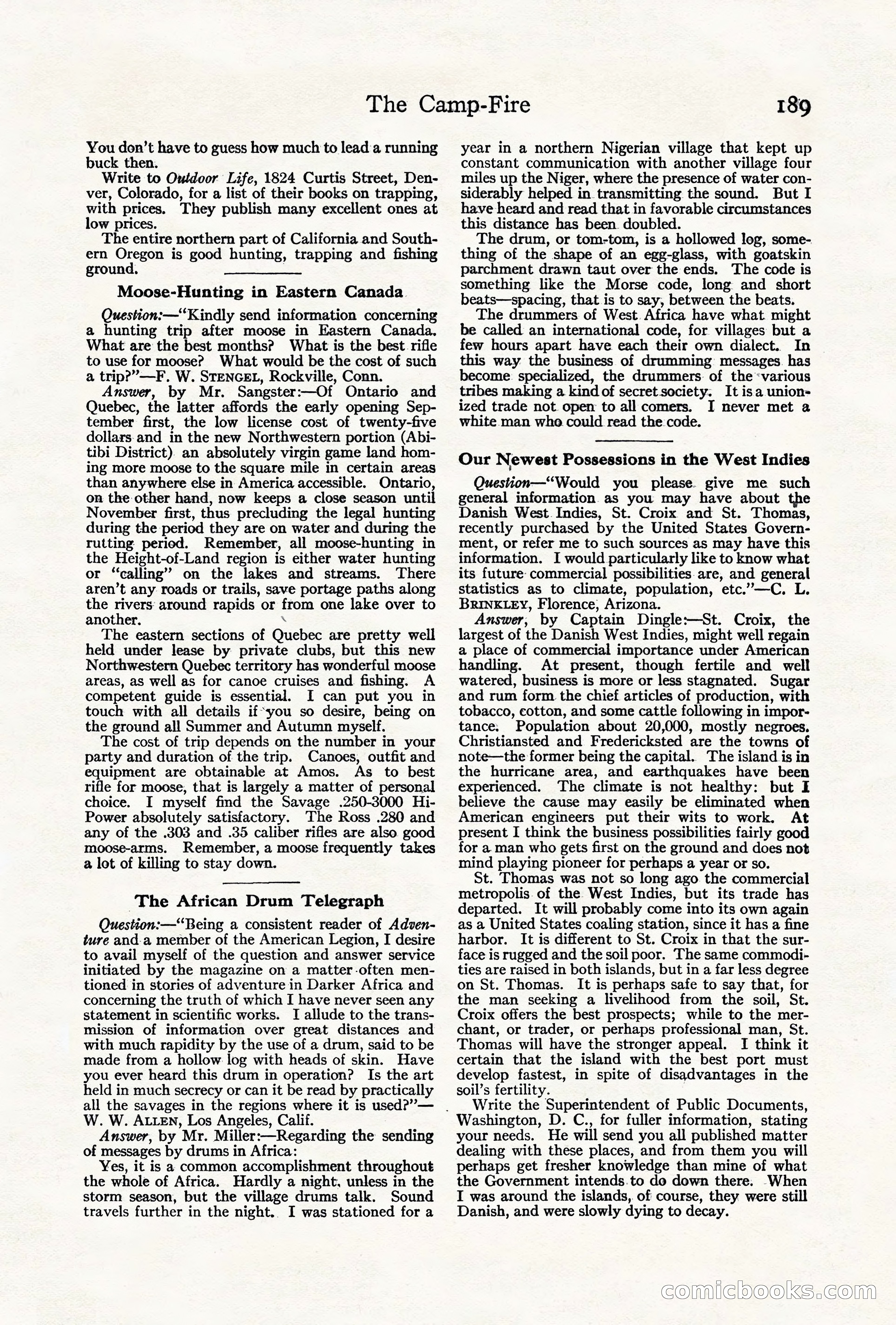
A restored page from Pulp Fiction, 1917. Page through the whole issue in the reader above.
📄 Transcribed text from this page (OCR, searchable)
Machine-transcribed from the original scan — historical spelling and the odd misread are preserved.
The Camp-Fire You don’t have to guess how much to lead a running buck then. Write to Outdoor Life, 1824 Curtis Street, Den- ver, Colorado, for a list of their books on trapping, with prices. They publish many excellent ones at low prices. The entire northern part of California and South- ern Oregon is good hunting, trapping and fishing ground, Moose-Hunting in Eastern Canada. Question: —‘‘Kindly send information concerning a hunting trip after moose in Eastern Canada, What are the best months? What is the best rifle to use for moose? What would be the cost of such a trip?”—F. W. STENGEL, Rockville, Conn. Answer, by Mr. Sangster:—Of Ontario and Quebec, the latter affords the early opening Sep- tember first, the low license cost of twenty-five dollars and in the new Northwestern portion (Abi- tibi District) an absolutely virgin game land hom- ing more moose to the square mile in certain areas than anywhere else in America accessible. Ontario, on the other hand, now keeps a close season until November first, thus precluding the legal hunting during the period they are on water and during the rutting period. Remember, all moose-hunting in the Height-of-Land region is either water hunting or ‘‘calling’’ on the lakes and streams. There aren’t any roads or trails, save portage paths along the rivers around rapids or from one lake over to another. \ The eastern sections of Quebec are pretty well held under lease by private clubs, but this new Northwestern Quebec territory has wonderful moose areas, as well as for canoe cruises and fishing. A competent guide is essential. I can put you in touch with all details if*you so desire, being on the ground all Summer and Autumn myself. The cost of trip depends on the number in your party and duration of the trip. Canoes, outfit and equipment are obtainable at Amos. As to best rifle for moose, that is largely a matter of personal choice. I myself find the Savage .250-3000 Hi- Power absolutely satisfactory. The Ross .280 and any of the .303 and .35 caliber rifles are also good moose-arms. Remember, a moose frequently takes a lot of killing to stay down. The African Drum Telegraph Question: —“Being a consistent reader of Adven- ture and-a member of the American Legion, I desire to avail myself of the question and answer service initiated by the magazine on a matter-often men- tioned in stories of adventure in Darker Africa and concerning the truth of which I have never seen any statement in scientific works. I allude to the trans- mission of information over great distances and with much rapidity by the use of a drum, said to be made from a hollow log with heads of skin. Have you ever heard this drum in operation? Is the art held in much secrecy or can it be read by practically all the savages in the regions where it is used?”?— W. W. ALLEN, Los Angeles, Calif. Answer, by Mr. Miller:—Regarding the sending of messages by drums in Africa: ¥es, it is a common accomplishment throughout the whole of Africa. Hardly a night, unless in the storm season, but the village drums talk. Sound travels further in the night.. I was stationed for a 189 year in a northern Nigerian village that kept up constant communication with another village four miles up the Niger, where the presence of water con- siderably helped in transmitting the sound. But I have heard and read that in favorable circumstances this distance has been doubled. The drum, or tom-tom, is a hollowed log, some- thing of the shape of an egg-glass, with goatskin parchment drawn taut over the ends. The code is something like the Morse code, long and short beats—spacing, that. is to say, between the beats. The drummers of West. Africa have what might be called an international code, for villages but a few hours apart have each their own dialect. In this way the business of drumming messages. has become specialized, the drummers of the «various tribes making a kind of secret society. It isa union- ized trade not open to all comers. I never met a white man who could read the code. Our Newest Possessions in the West Indies Question—“Would you please. give me such general information. as you may have about the Danish West. Indies, St. Croix and St. Thomas, recently purchased by the United States Govern- ment, or refer me to such sources as may have this information. I would particularly like to know what its future commercial possibilities. are, and general statistics as to climate, population, etc.”—C. L. BRINKLEY, Florence, Arizona. Answer, by Captain Dingle:—St. Croix, the largest of the Danish West Indies, might well regain a place of commercial importance under American handling. At present, though fertile and well watered, business is more or less stagnated. Sugar and rum form the chief articles of production, with tobacco, cotton, and some cattle following in impor- tance. Population about 20,000, mostly negroes. Christiansted and Fredericksted are the towns of note—the former being the capital. The island is in the hurricane area, and earthquakes have been experienced. The climate is not healthy: but I believe the cause may easily be eliminated when American engineers put their wits to work. At present I think the business possibilities fairly good for a man who gets first on the ground and does not mind playing pioneer for perhaps a year or so. St. Thomas was not so long ago the commercial metropolis. of the West Indies, but its trade has departed. It will probably come into its own again as a United States coaling station, since it has a fine harbor. It is different to St. Croix in that the sur- face is rugged and the soil poor. The same commodi- ties are raised in both islands, but in a far less degree on St. Thomas. It is perhaps safe to say that, for the man seeking a livelihood from the soil, St. Croix offers the best prospects; while to the mer- chant, or trader, or perhaps professional man, St. Thomas will have the stronger appeal. I think it certain that the island with the best port must develop fastest, in spite of disadvantages in the soil’s fertility. Write the Superintendent of Public Documents, Washington, D. C., for fuller information, stating your needs. He will send you all published matter dealing with these places, and from them you will perhaps get fresher knowledge than mine of what the Government intends.to do down there. When I was around the islands, of course, they were still Danish, and were slowly dying to decay. COmicloo 5}