
Pulp Fiction, 1917 · page 185 of 196
Adventure, August 1917 — page 185: what you’re looking at
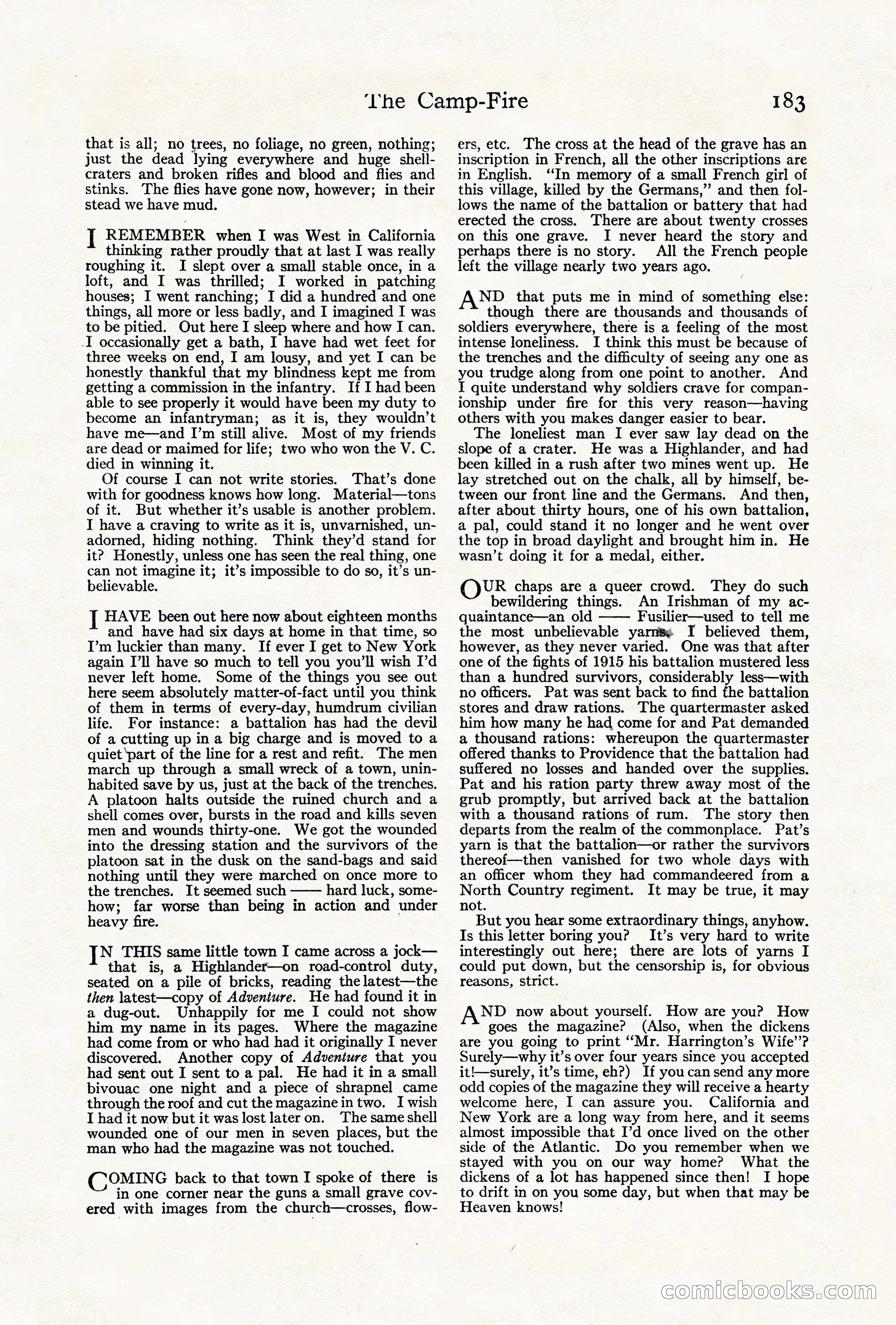
A restored page from Pulp Fiction, 1917. Page through the whole issue in the reader above.
📄 Transcribed text from this page (OCR, searchable)
Machine-transcribed from the original scan — historical spelling and the odd misread are preserved.
‘he Camp-Fire that is all; no trees, no foliage, no green, nothing; just the dead lying everywhere and huge shell- craters and broken rifles and blood and flies and stinks. The flies have gone now, however; in their stead we have mud. I REMEMBER when I was West in California thinking rather proudly that at last I was really roughing it. I slept over a small stable once, in a loft, and I was thrilled; I worked in patching houses; I went ranching; I did a hundred and one things, all more or less badly, and I imagined I was to be pitied. Out here I sleep where and how I can. I occasionally get a bath, I have had wet feet for three weeks on end, I am lousy, and yet I can be honestly thankful that my blindness kept me from getting a commission in the infantry. If I had been able to see properly it would have been my duty to become an infantryman; as it is, they wouldn’t have me—and I’m still alive. Most of my friends are dead or maimed for life; two who won the V. C. died in winning it. Of course I can not write stories. That’s done with for goodness knows how long. Material—tons of it. But whether it’s usable is another problem. I have a craving to write as it is, unvarnished, un- adorned, hiding nothing. Think they’d stand for it? Honestly, unless one has seen the real thing, one can not imagine it; it’s impossible to do so, it’s un- believable. I HAVE been out here now about eighteen months and have had six days at home in that time, so I’m luckier than many. If ever I get to New York again I’ll have so much to tell you you’ll wish I’d never left home. Some of the things you see out here seem absolutely matter-of-fact until you think of them in terms of every-day, humdrum civilian life. For instance: a battalion has had the devil of a cutting up in a big charge and is moved to a quiet ‘part of the line for a rest and refit. —The men march up through a small wreck of a town, unin- habited save by us, just at the back of the trenches. A platoon halts outside the ruined church and a shell comes over, bursts in the road and kills seven men and wounds thirty-one. We got the wounded into the dressing station and the survivors of the platoon sat in the dusk on the sand-bags and said nothing until they were marched on once more to the trenches. It seemed such hard luck, some- how; far worse than being in action and under heavy fire. 1 N THIS same little town I came across a jock— that is, a Highlander—on road-control duty, seated on a pile of bricks, reading the latest—the then latest—copy of Adveniure. He had found it in a dug-out. Unhappily for me I could not show him my name in its pages. Where the magazine had come from or who had had it originally I never discovered. Another copy of Adventure that you had sent out I sent to a pal. He had it in a small bivouac one night and a piece of shrapnel came through the roof and cut the magazine in two. I wish I had it now but it was lost lateron. The same shell wounded one of our men in seven places, but the man who had the magazine was not touched. (COMIN G back to that town I spoke of there is in one corner near the guns a small grave cov- ered with images from the church—crosses, flow- 183 ers, etc. The cross at the head of the grave has an inscription in French, all the other inscriptions are in English. ‘In memory of a small French girl of this village, killed by the Germans,” and then fol- lows the name of the battalion or battery that had erected the cross. There are about twenty crosses on this one grave. I never heard the story and perhaps there is no story. All the French people left the village nearly two years ago. AND that puts me in mind of something else: though there are thousands and thousands of soldiers everywhere, there is a feeling of the most intense loneliness. I think this must be because of the trenches and the difficulty of seeing any one as you trudge along from one point to another. And I quite understand why soldiers crave for compan- ionship under fire for this very reason—having others with you makes danger easier to bear. The loneliest man I ever saw lay dead on the slope of a crater. He was a Highlander, and had been killed in a rush after two mines went up. He lay stretched out on the chalk, all by himself, be- tween our front line and the Germans. And then, after about thirty hours, one of his own battalion, a pal, could stand it no longer and he went over the top in broad daylight and brought him in. He wasn’t doing it for a medal, either. ()UR chaps are a queer crowd. They do such bewildering things. An Irishman of my ac- quaintance—an old Fusilier—used to tell me the most unbelievable yarnse I believed them, however, as they never varied. One was that after one of the fights of 1915 his battalion mustered less than a hundred survivors, considerably less—with no officers. Pat was sent back to find the battalion stores and draw rations. The quartermaster asked him how many he had come for and Pat demanded a thousand rations: whereupon the quartermaster offered thanks to Providence that the battalion had suffered no losses and handed over the supplies. Pat and his ration party threw away most of the grub promptly, but arrived back at the battalion with a thousand rations of rum. The story then departs from the realm of the commonplace. Pat’s yarn is that the battalion—or rather the survivors thereof—then vanished for two whole days with an officer whom they had commandeered from a North Country regiment. It may be true, it may not. But you hear some extraordinary things, anyhow. Is this letter boring your It’s very hard to write interestingly out here; there are lots of yarns I could put down, but the censorship is, for obvious reasons, strict. AND now about yourself. How are your How goes the magazine? (Also, when the dickens are you going to print “Mr. Harrington’s Wife’’? Surely—why it’s over four years since you accepted it!—surely, it’s time, eh?) If youcan send any more odd copies of the magazine they will receive a hearty welcome here, I can assure you. California and New York are a long way from here, and it seems almost impossible that I’d once lived on the other side of the Atlantic. Do you remember when we stayed with you on our way home? What the dickens of a lot has happened since then! I hope to drift in on you some day, but when that may be Heaven knows! Goo 5}