
Pulp Fiction, 1917 · page 184 of 196
Adventure, August 1917 — page 184: what you’re looking at
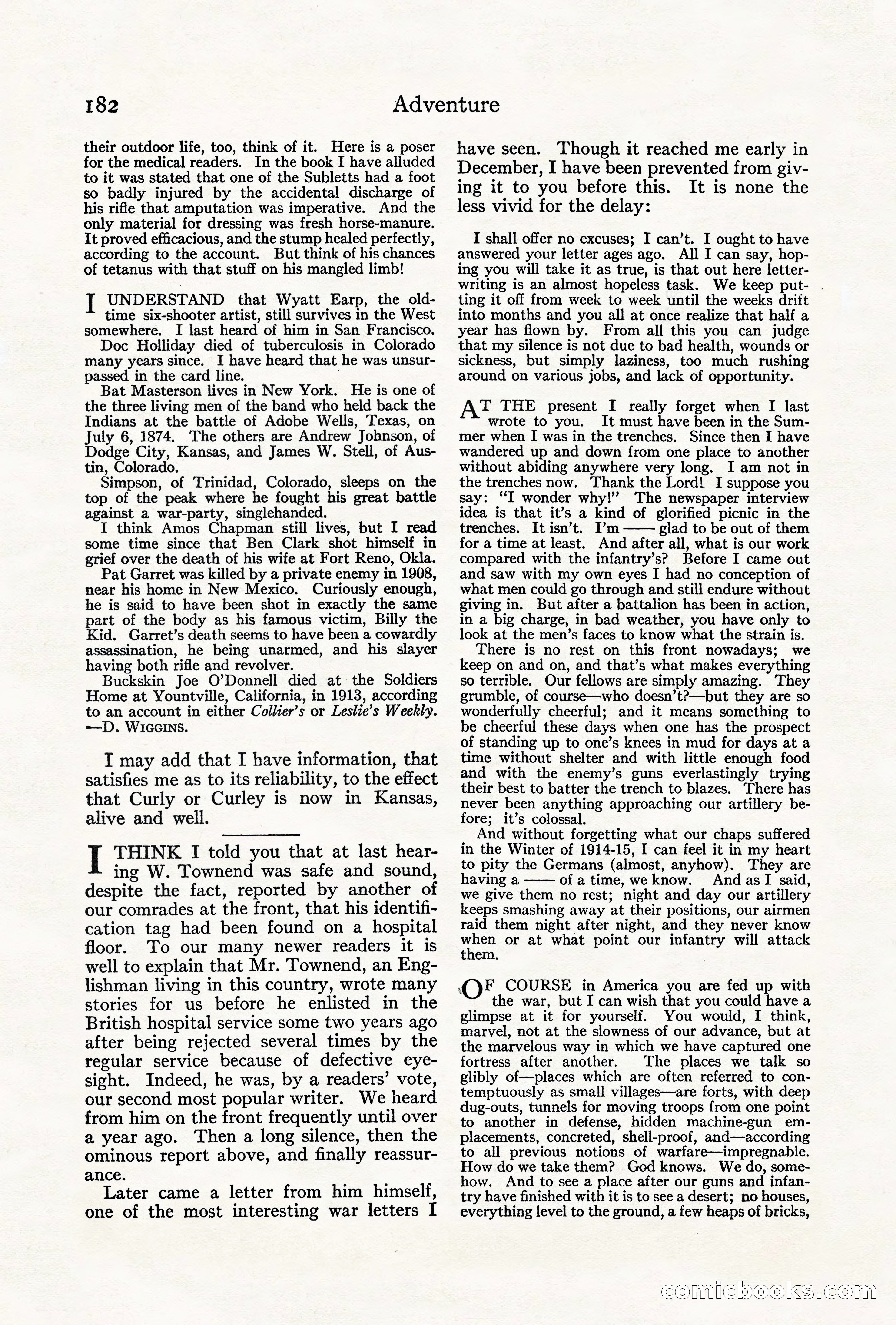
A restored page from Pulp Fiction, 1917. Page through the whole issue in the reader above.
📄 Transcribed text from this page (OCR, searchable)
Machine-transcribed from the original scan — historical spelling and the odd misread are preserved.
182 their outdoor life, too, think of it. Here is a poser for the medical readers. In the book I have alluded to it was stated that one of the Subletts had a foot so badly injured by the accidental discharge of his rifle that amputation was imperative. And the only material for dressing was fresh horse-manure. It proved efficacious, and the stump healed perfectly, according to the account. But think of his chances of tetanus with that stuff on his mangled limb! J UNDERSTAND that Wyatt Earp, the old- time six-shooter artist, still survives in the West somewhere. I last heard of him in San Francisco. Doc Holliday died of tuberculosis in Colorado many years since. I have heard that he was unsur- passed in the card line. 7 Bat Masterson lives in New York. He is one of the three living men of the band who held back the Indians at the battle of Adobe Wells, Texas, on July 6, 1874. The others are Andrew Johnson, of Dodge City, Kansas, and James W. Stell, of Aus- tin, Colorado. Simpson, of Trinidad, Colorado, sleeps on the top of the peak where he fought his great battle against a war-party, singlehanded. I think Amos Chapman still lives, but I read some time since that Ben Clark shot himself in grief over the death of his wife at Fort Reno, Okla. Pat Garret was killed by a private enemy in 1908, near his home in New Mexico. Curiously enough, he is said to have been shot in exactly the same part of the body as his famous victim, Billy the Kid. Garret’s death seems to have been a cowardly assassination, he being unarmed, and his slayer having both rifle and revolver. Buckskin Joe O’Donnell died at the Soldiers Home at Yountville, California, in 1913, according to an account in either Collier’s or Lesiie’s Weekly. —D. WIGGINS. T may add that I have information, that satisfies me as to its reliability, to the effect that Curly or Curley is now in Kansas, alive and well. THINK I told you that at last hear- ing W. Townend was safe and sound, despite the fact, reported by another of our comrades at the front, that his identifi- cation tag had been found on a hospital floor. To our many newer readers it is well to explain that Mr. Townend, an Eng- lishman living in this country, wrote many stories for us before he enlisted in the British hospital service some two years ago after being rejected several times by the regular service because of defective eye- sight. Indeed, he was, by a readers’ vote, our second most popular writer. We heard from him on the front frequently until over a year ago. Then a long silence, then the ominous report above, and finally reassur- ance. Later came a letter from him himself, one of the most interesting war letters I Adventure have seen. Though it reached me early in December, I have been prevented from giv- ing it to you before this. It is none the less vivid for the delay: I shall offer no excuses; I can’t. I ought to have answered your letter ages ago. All I can say, hop- ing you will take it as true, is that out here letter- writing is an almost hopeless task. We keep put- . ting it off from week to week until the weeks drift into months and you all at once realize that half a year has flown by. From all this you can judge that my silence is not due to bad health, wounds or sickness, but simply laziness, too much rushing around on various jobs, and lack of opportunity. T THE present I really forget when I last wrote to you. It must have been in the Sum- mer when I was in the trenches. Since then I have wandered up and down from one place to another without abiding anywhere very long. I am not in the trenches now. Thank the Lord! I suppose you say: “I wonder why!” The newspaper interview idea is that it’s a kind of glorified picnic in the trenches. Itisn’t. I’m ——- glad to be out of them for a time at least. And after all, what is our work compared with the infantry’s? Before I came out and saw with my own eyes I had no conception of what men could go through and still endure without giving in. But after a battalion has been in action, in a big charge, in bad weather, you have only to look at the men’s faces to know what the strain is. There is no rest on this front nowadays; we keep on and on, and that’s what makes everything so terrible. Our fellows are simply amazing. They grumble, of course—who doesn’t?—but they are so wonderfully cheerful; and it means something to be cheerful these days when one has the prospect of standing up to one’s knees in mud for days at a time without shelter and with little enough food and with the enemy’s guns everlastingly trying their best to batter the trench to blazes. There has never been anything approaching our artillery be- fore; it’s colossal. And without forgetting what our chaps suffered in the Winter of 1914-15, I can feel it in my heart to pity the Germans (almost, anyhow). They are having a of a time, we know. And asI said, we give them no rest; night and day our artillery keeps smashing away at their positions, our airmen raid them night after night, and they never know ae or at what point our infantry will attack them. OF COURSE in America you are fed up with the war, but I can wish that you could have a glimpse at it for yourself. You would, I think, marvel, not at the slowness of our advance, but at the marvelous way in which we have captured one fortress after another. The places we talk so glibly of—places which are often referred to con- temptuously as small villages—are forts, with deep dug-outs, tunnels for moving troops from one point to another in defense, hidden machine-gun em- placements, concreted, shell-proof, and—according to all previous notions of warfare—impregnable. How do we take them? God knows. We do, some- how. And to see a place after our guns and infan- try have finished with it is to see a desert; no houses, everything level to the ground, a few heaps of bricks, CoOmiclsoo 5}