
Pulp Fiction, 1917 · page 182 of 196
Adventure, August 1917 — page 182: what you’re looking at
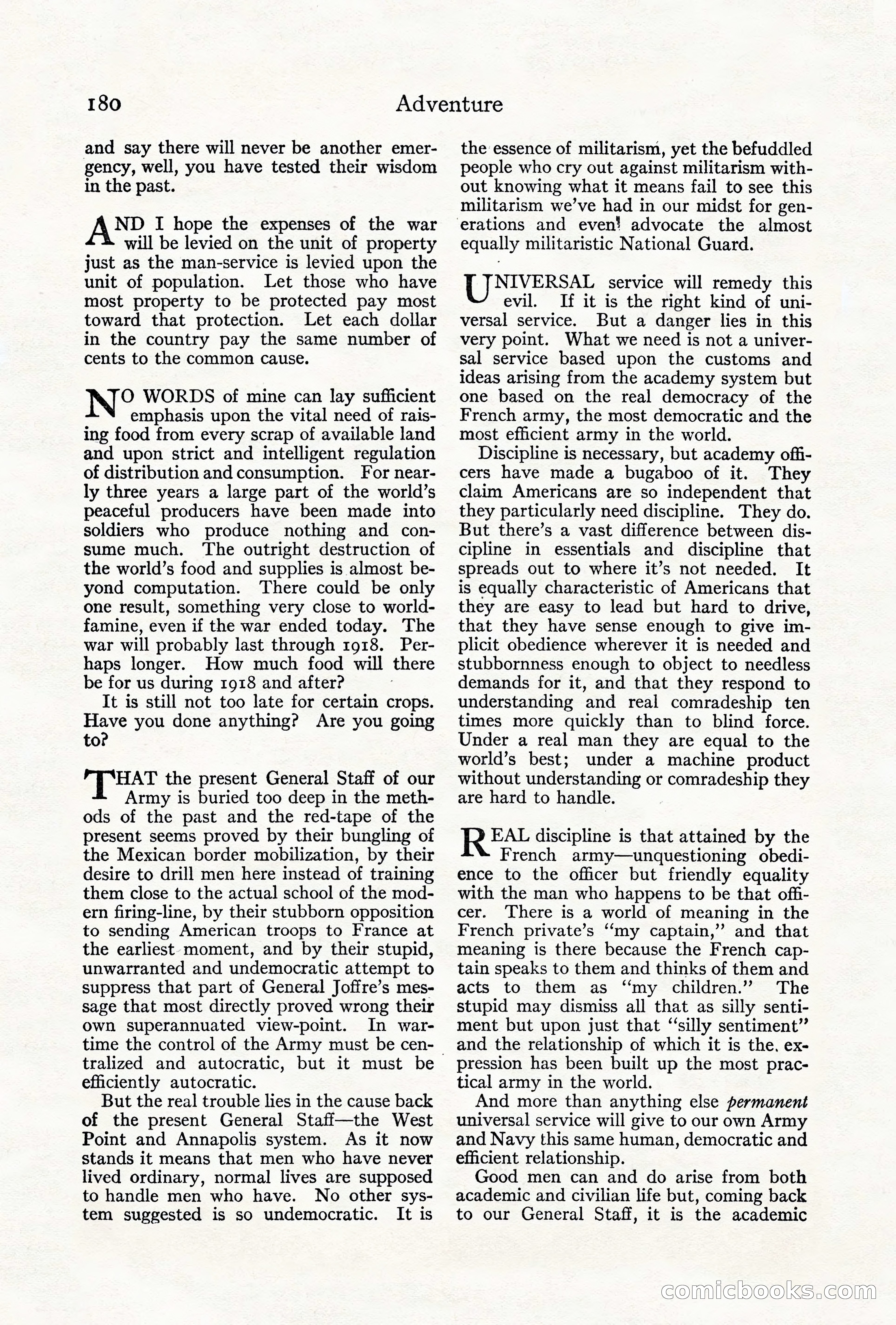
A restored page from Pulp Fiction, 1917. Page through the whole issue in the reader above.
📄 Transcribed text from this page (OCR, searchable)
Machine-transcribed from the original scan — historical spelling and the odd misread are preserved.
180 and say there will never be another emer- gency, well, you have tested their wisdom in the past. AN? I hope the expenses of the war will be levied on the unit of property just as the man-service is levied upon the unit of population. Let those who have most property to be protected pay most toward that protection. Let each dollar in the country pay the same number of cents to the common cause. N°? WORDS of mine can lay sufficient emphasis upon the vital need of rais- ing food from every scrap of available land and upon strict and intelligent regulation of distribution and consumption. For near- ly three years a large part of the world’s peaceful producers have been made into soldiers who produce nothing and con- sume much. The outright destruction of the world’s food and supplies is almost be- yond computation. There could be only one result, something very close to world- famine, even if the war ended today. The war will probably last through 1918. Per- haps longer. How much food will there be for us during 1918 and after? It is still not too late for certain crops. Have you done anything? Are you going to? Tmt the present General Staff of our Army is buried too deep in the meth- ods of the past and the red-tape of the present seems proved by their bungling of the Mexican border mobilization, by their desire to drill men here instead of training them close to the actual school of the mod- ern firing-line, by their stubborn opposition to sending American troops to France at the earliest moment, and by their stupid, unwarranted and undemocratic attempt to suppress that part of General Joffre’s mes- sage that most directly proved wrong their own superannuated view-point. In war- time the control of the Army must be cen- tralized and autocratic, but it must be efficiently autocratic. But the real trouble lies in the cause back of the present General Staff—the West Point and Annapolis system. As it now stands it means that men who have never lived ordinary, normal lives are supposed to handle men who have. No other sys- tem suggested is so undemocratic. It is Adventure the essence of militarism, yet the befuddled people who cry out against militarism with- out knowing what it means fail to see this militarism we’ve had in our midst for gen- erations and even! advocate the almost equally militaristic National Guard. | ERS? service will remedy this evil. If it is the right kind of uni- versal service. But a danger lies in this very point. What we need is not a univer- sal service based upon the customs and ideas arising from the academy system but one based on the real democracy of the French army, the most democratic and the most efficient army in the world. Discipline is necessary, but academy offi- cers have made a bugaboo of it. They claim Americans are so independent that they particularly need discipline. They do. But there’s a vast difference between dis- cipline in essentials and discipline that spreads out to where it’s not needed. It is equally characteristic of Americans that they are easy to lead but hard to drive, that they have sense enough to give im- plicit obedience wherever it is needed and stubbornness enough to object to needless demands for it, and that they respond to understanding and real comradeship ten times more quickly than to blind force. Under a real man they are equal to the world’s best; under a machine product without understanding or comradeship they are hard to handle. | Regal discipline is that attained by the French army—unquestioning obedi- ence to the officer but friendly equality with the man who happens to be that offi- cer. There is a world of meaning in the French private’s ‘‘my captain,” and that meaning is there because the French cap- tain speaks to them and thinks of them and acts to them as “my children.” The stupid may dismiss all that as silly senti- ment but upon just that “silly sentiment” and the relationship of which it is the, ex- pression has been built up the most prac- tical army in the world. And more than anything else permanent universal service will give to our own Army and Navy this same human, democratic and efficient relationship. Good men can and do arise from both academic and civilian life but, coming back to our General Staff, it is the academic COMmiclbook C© 5}