
Pulp Fiction, 1917 · page 181 of 196
Adventure, August 1917 — page 181: what you’re looking at
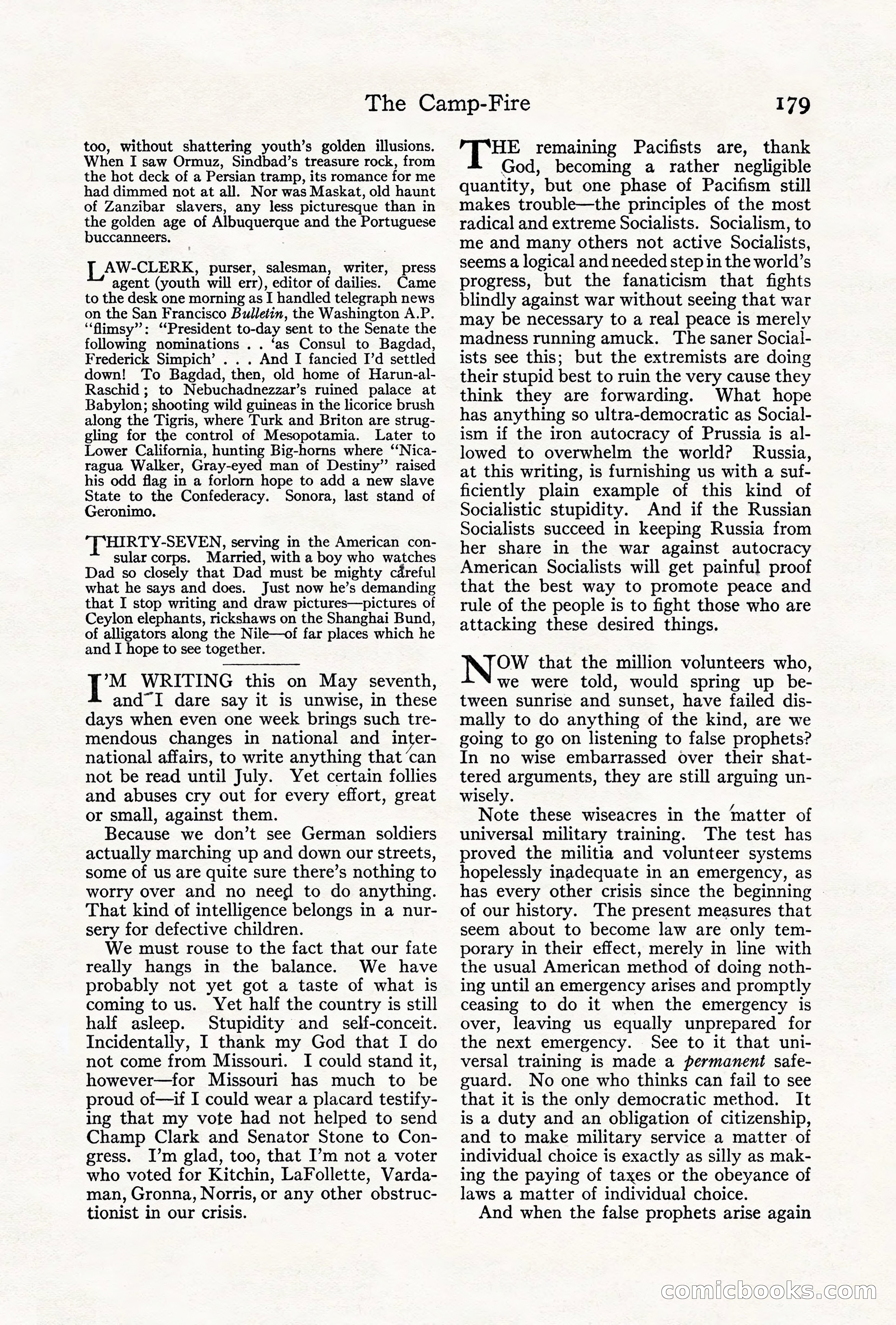
A restored page from Pulp Fiction, 1917. Page through the whole issue in the reader above.
📄 Transcribed text from this page (OCR, searchable)
Machine-transcribed from the original scan — historical spelling and the odd misread are preserved.
The Camp-Fire too, without shattering youth’s golden illusions. When I saw Ormuz, Sindbad’s treasure rock, from the hot deck of a Persian tramp, its romance for me had dimmed not at all. Nor was Maskat, old haunt of Zanzibar slavers, any less picturesque than in the golden age of Albuquerque and the Portuguese buccanneers. [LAW-CLERK, purser, salesman, writer, press agent (youth will err), editor of dailies. Came to the desk one morning as I handled telegraph news on the San Francisco Bulletin, the Washington A.P. ‘‘flimsy”: ‘President to-day sent to the Senate the following nominations . . ‘as Consul to Bagdad, Frederick Simpich’ . . . And I fancied I’d settled down! To Bagdad, then, old home of Harun-al- Raschid ; to Nebuchadnezzar’s ruined palace at Babylon; shooting wild guineas in the licorice brush along the Tigris, where Turk and Briton are strug- gling for the control of Mesopotamia. Later to Lower California, hunting Big-horns where ‘‘Nica- ragua Walker, Gray-eyed man of Destiny” raised his odd flag in a forlorn hope to add a new slave State to the Confederacy. Sonora, last stand of Geronimo. "[HIRTY-SEVEN , serving in the American con- sular corps. Married, with a boy who watches Dad so closely that Dad must be mighty cdreful what he says and does. Just now he’s demanding that I stop writing and draw pictures—pictures of Ceylon elephants, rickshaws on the Shanghai Bund, of alligators along the Nile—of far places which he and I hope to see together. [™ WRITING this on May seventh, and I dare say it is unwise, in these days when even one week brings such tre- mendous changes in national and inter- national affairs, to write anything that ‘can not be read until July. Yet certain follies and abuses cry out for every effort, great or small, against them. Because we don’t see German soldiers actually marching up and down our streets, some of us are quite sure there’s nothing to worry over and no need to do anything. That kind of intelligence belongs in a nur- sery for defective children. We must rouse to the fact that our fate really hangs in the balance. We have probably not yet got a taste of what is coming to us. Yet half the country is still half asleep. Stupidity and _ self-conceit. Incidentally, I thank my God that I do not come from Missouri. I could stand it, however—for Missouri has much to be proud of—if I could wear a placard testify- ing that my vote had not helped to send Champ Clark and Senator Stone to Con- gress. I’m glad, too, that I’m not a voter who voted for Kitchin, LaFollette, Varda- man, Gronna, Norris, or any other obstruc- tionist in our crisis. 179 THE remaining Pacifists are, thank God, becoming a rather negligible quantity, but one phase of Pacifism still makes trouble—the principles of the most radical and extreme Socialists. Socialism, to me and many others not active Socialists, seems a logical and needed step in the world’s progress, but the fanaticism that fights blindly against war without seeing that war may be necessary to a real peace is merely madness running amuck. The saner Social- ists see this; but the extremists are doing their stupid best to ruin the very cause they think they are forwarding. What hope has anything so ultra-democratic as Social- ism if the iron autocracy of Prussia is al- lowed to overwhelm the world? Russia, at this writing, is furnishing us with a suf- ficiently plain example of this kind of Socialistic stupidity. And if the Russian Socialists succeed in keeping Russia from her share in the war against autocracy American Socialists will get painful proof that the best way to promote peace and rule of the people is to fight those who are attacking these desired things. Now that the million volunteers who, we were told, would spring up be- tween sunrise and sunset, have failed dis- mally to do anything of the kind, are we going to go on listening to false prophets? In no wise embarrassed over their shat- tered arguments, they are still arguing un- wisely. Note these wiseacres in the matter of universal military training. The test has proved the militia and volunteer systems hopelessly inadequate in an emergency, as has every other crisis since the beginning » of our history. The present measures that seem about to become law are only tem- porary in their effect, merely in line with the usual American method of doing noth- ing until an emergency arises and promptly ceasing to do it when the emergency is over, leaving us equally unprepared for the next emergency. See to it that uni- versal training is made a permanent safe- guard. No one who thinks can fail to see that it is the only democratic method. It is a duty and an obligation of citizenship, and to make military service a matter of individual choice is exactly as silly as mak- ing the paying of taxes or the obeyance of laws a matter of individual choice. And when the false prophets arise again cCoMmiclsoo =