
Pulp Fiction, 1916 · page 219 of 228
Adventure Magazine Cover, April 1916 — page 219: what you’re looking at
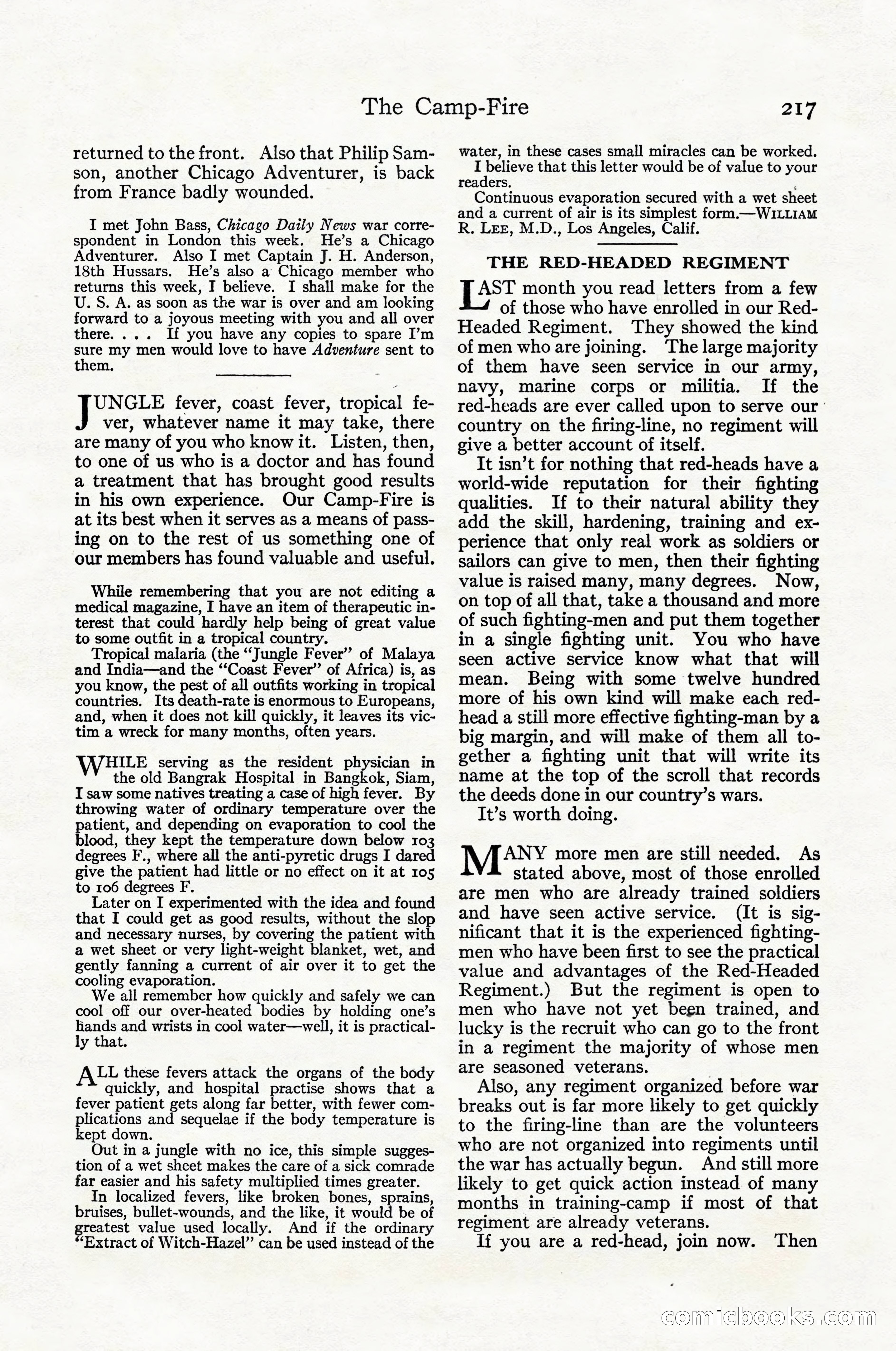
A restored page from Pulp Fiction, 1916. Page through the whole issue in the reader above.
📄 Transcribed text from this page (OCR, searchable)
Machine-transcribed from the original scan — historical spelling and the odd misread are preserved.
The Camp-Fire returned to the front. Also that Philip Sam- son, another Chicago Adventurer, is back from France badly wounded. I met John Bass, Chicago Daily News war corre- spondent in London this week. He’s a Chicago Adventurer. Also I met Captain J. H. Anderson, 18th Hussars. He’s also a Chicago member who returns this week, I believe. I shall make for the U. S. A. as soon as the war is over and am looking forward to a joyous meeting with you and all over there. ... If you have any copies to spare I’m ae my men would love to have Adventure sent to em. UNGLE fever, coast fever, tropical fe- ver, whatever name it may take, there are many of you who know it. Listen, then, to one of us who is a doctor and has found a treatment that has brought good results in his own experience. Our Camp-Fire is at its best when it serves as a means of pass- ing on to the rest of us something one of our members has found valuable and useful. While remembering that you are not editing a medical magazine, I have an item of therapeutic in- terest that could hardly help being of great value to some outfit in a tropical country. Tropical malaria (the “Jungle Fever” of Malaya and India—and the “Coast Fever” of Africa) is, as you know, the pest of all outfits working in tropical countries. Its death-rate is enormous to Europeans, and, when it does not kill quickly, it leaves its vic- tim a wreck for many months, often years. WHILE serving as the resident physician in the old Bangrak Hospital in Bangkok, Siam, I saw some natives treating a case of high fever. By throwing water of ordinary temperature over the patient, and depending on evaporation to cool the blood, they kept the temperature down below 103 degrees F., where all the anti-pyretic drugs I dared give the patient had little or no effect on it at 105 to 106 degrees F. Later on I experimented with the idea and found that I could get as good results, without the slop and necessary nurses, by covering the patient with a wet sheet or very light-weight blanket, wet, and gently fanning a current of air over it to get the cooling evaporation. We all remember how quickly and safely we can cool off our over-heated bodies by holding one’s hands and wrists in cool water—well, it is practical- ly that. LL these fevers attack the organs of the body quickly, and hospital practise shows that a fever patient gets along far better, with fewer com- plications and sequelae if the body temperature is kept down. Out in a jungle with no ice, this simple sugges- tion of a wet sheet makes the care of a sick comrade far easier and his safety multiplied times greater. In localized fevers, like broken bones, sprains, bruises, bullet- wounds, and the like, it would be of greatest value used locally. And if the ordinary “Extract of Witch-Hazel” can be used instead of the 217 water, in these cases small miracles can be worked. I believe that this letter would be of value to your readers. Continuous evaporation secured with a wet sheet and a current of air is its simplest form.— WILLIAM R. LEE, M.D., Los Angeles, Calif. THE RED-HEADED REGIMENT i month you read letters from a few of those who have enrolled in our Red- Headed Regiment. They showed the kind of men who are joining. ‘The large majority of them have seen service in our army, navy, marine corps or militia. If the red-heads are ever called upon to serve our ' country on the firing-line, no regiment will give a better account of itself. It isn’t for nothing that red-heads have a world-wide reputation for their fighting qualities. If to their natural ability they add the skill, hardening, training and ex- perience that only real work as soldiers or sailors can give to men, then their fighting value is raised many, many degrees. Now, on top of all that, take a thousand and more of such fighting-men and put them together in a single fighting unit. You who have seen active service know what that will mean. Being with some twelve hundred more of his own kind will make each red- head a still more effective fighting-man by a big margin, and will make of them all to- gether a fighting unit that will write its name at the top of the scroll that records the deeds done in our country’s wars. It’s worth doing. ANY more men are still needed. As stated above, most of those enrolled are men who are already trained soldiers and have seen active service. (It is sig- nificant that it is the experienced fighting- men who have been first to see the practical value and advantages of the Red-Headed Regiment.) But the regiment is open to men who have not yet been trained, and lucky is the recruit who can go to the front in a regiment the majority of whose men are seasoned veterans. Also, any regiment organized before war breaks out is far more likely to get quickly to the firing-line than are the volunteers who are not organized into regiments until the war has actually begun. And still more likely to get quick action instead of many months in training-camp if most of that regiment are already veterans. If you are a red-head, join now. Then CoMmicboooks CO