
Pulp Fiction, 1916 · page 218 of 228
Adventure Magazine Cover, April 1916 — page 218: what you’re looking at
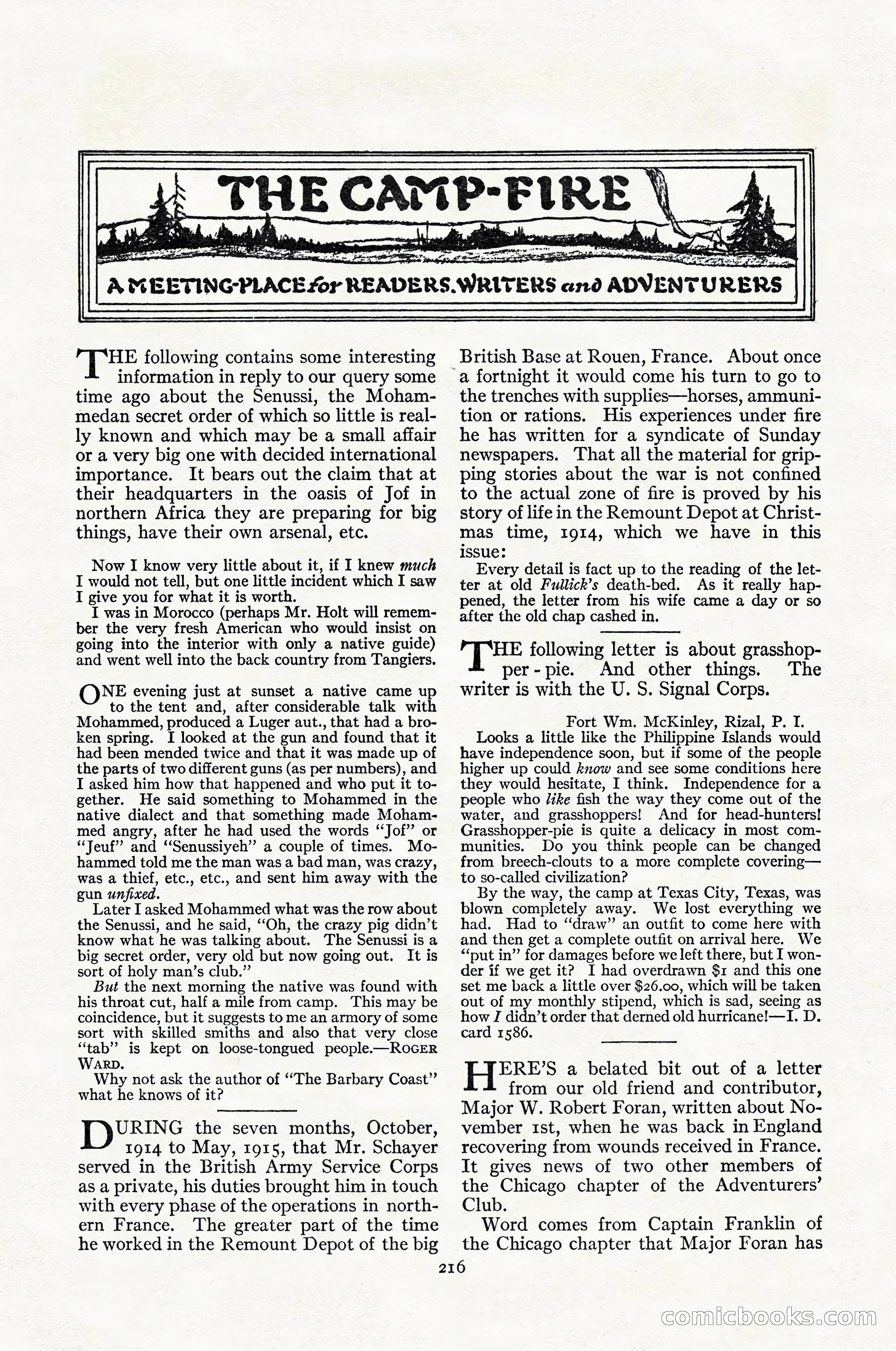
A restored page from Pulp Fiction, 1916. Page through the whole issue in the reader above.
📄 Transcribed text from this page (OCR, searchable)
Machine-transcribed from the original scan — historical spelling and the odd misread are preserved.
A MEETING PLACE Zr READERS. nice ad ano eed RERS | pats following contains some interesting information in reply to our query some time ago about the Senussi, the Moham- medan secret order of which so little is real- ly known and which may be a small affair or a very big one with decided international importance. It bears out the claim that at their headquarters in the oasis of Jof in northern Africa they are preparing for big things, have their own arsenal, etc. Now I know very little about it, if I knew much I would not tell, but one little incident which I saw I give you for what it is worth. I was in Morocco (perhaps Mr. Holt will remem- ber the very fresh American who would insist on going into the interior with only a native guide) and went well into the back country from Tangiers. ONE evening just at sunset a native came u to the tent and, after considerable talk wit Mohammed, produced a Luger aut., that had a bro- ken spring. I looked at the gun and found that it had been mended twice and that it was made up of the parts of two different guns (as per numbers), and I asked him how that happened and who put it to- gether. He said something to Mohammed in the native dialect and that something made Moham- med angry, after he had used the words ‘‘Jof”’ or “Jeuf” and ‘‘Senussiyeh”’ a couple of times. Mo- hammed told me the man was a bad man, was crazy, was a thief, etc., etc., and sent him away with the gun unfixed. Later I asked Mohammed what was the row about the Senussi, and he said, ‘‘Oh, the crazy pig didn’t know what he was talking about. The Senussi is a big secret order, very old but now going out. It is sort of holy man’s club.” But the next morning the native was found with his throat cut, half a mile from camp. This may be coincidence, but it suggests to me an armory of some sort with skilled smiths and also that very close “tab” is kept on loose-tongued people.—ROGER WARD. Why not ask the author of ‘‘The Barbary Coast’”’ what he knows of it? URING the seven months, October, 1914 to May, tots, that Mr. Schayer served in the British Army Service Corps as a private, his duties brought him in touch with every phase of the operations in north- ern France. The greater part of the time he worked in the Remount Depot of the big ron Yh ‘“ Pree > * ple Bia ee ome = - wes webs Pate 2, British Base at Rouen, France. About once a fortnight it would come his turn to go to the trenches with supplies—horses, ammuni- tion or rations. His experiences under fire he has written for a syndicate of Sunday newspapers. That all the material for grip- ping stories about the war is not confined to the actual zone of fire is proved by his story of life in the Remount Depot at Christ- mas time, 1914, which we have in this issue: Every detail is fact up to the reading of the let- ter at old Fullick’s death-bed. As it really hap- pened, the letter from his wife came a day or so after the old chap cashed in. TS following letter is about grasshop- per-pie. And other things. The writer is with the U. S. Signal Corps. Fort Wm. McKinley, Rizal, P. I. Looks a little like the Philippine Islands would have independence soon, but if some of the people higher up could know and see some conditions here they would hesitate, I think. Independence for a people who /ike fish the way they come out of the water, and grasshoppers! And for head-hunters! Grasshopper-pie is quite a delicacy in most com- munities. Do you think people can be changed from breech-clouts to a more complete covering— to so-called civilization? By the way, the camp at Texas City, Texas, was blown completely away. We lost everything we had. Had to “draw” an outfit to come here with and then get a complete outfit on arrival here. We “put in” for damages before we left there, but I won- der if we get it? I had overdrawn $1 and this one set me back a little over $26.00, which will be taken out of my monthly stipend, which is sad, seeing as how I didn’t order that derned old hurricane!—I. D. card 1586. ERE’S a belated bit out of a letter from our old friend and contributor, Major W. Robert Foran, written about No- vember 1st, when he was back in England recovering from wounds received in France. It gives news of two other members of the Chicago chapter of the Adventurers’ Club. Word comes from Captain Franklin of the Chicago chapter that Major Foran has 216 CoOMmMichoooks (CO