
Pulp Fiction, 1914 · page 46 of 228
Adventure, December 1914 — page 46: what you’re looking at
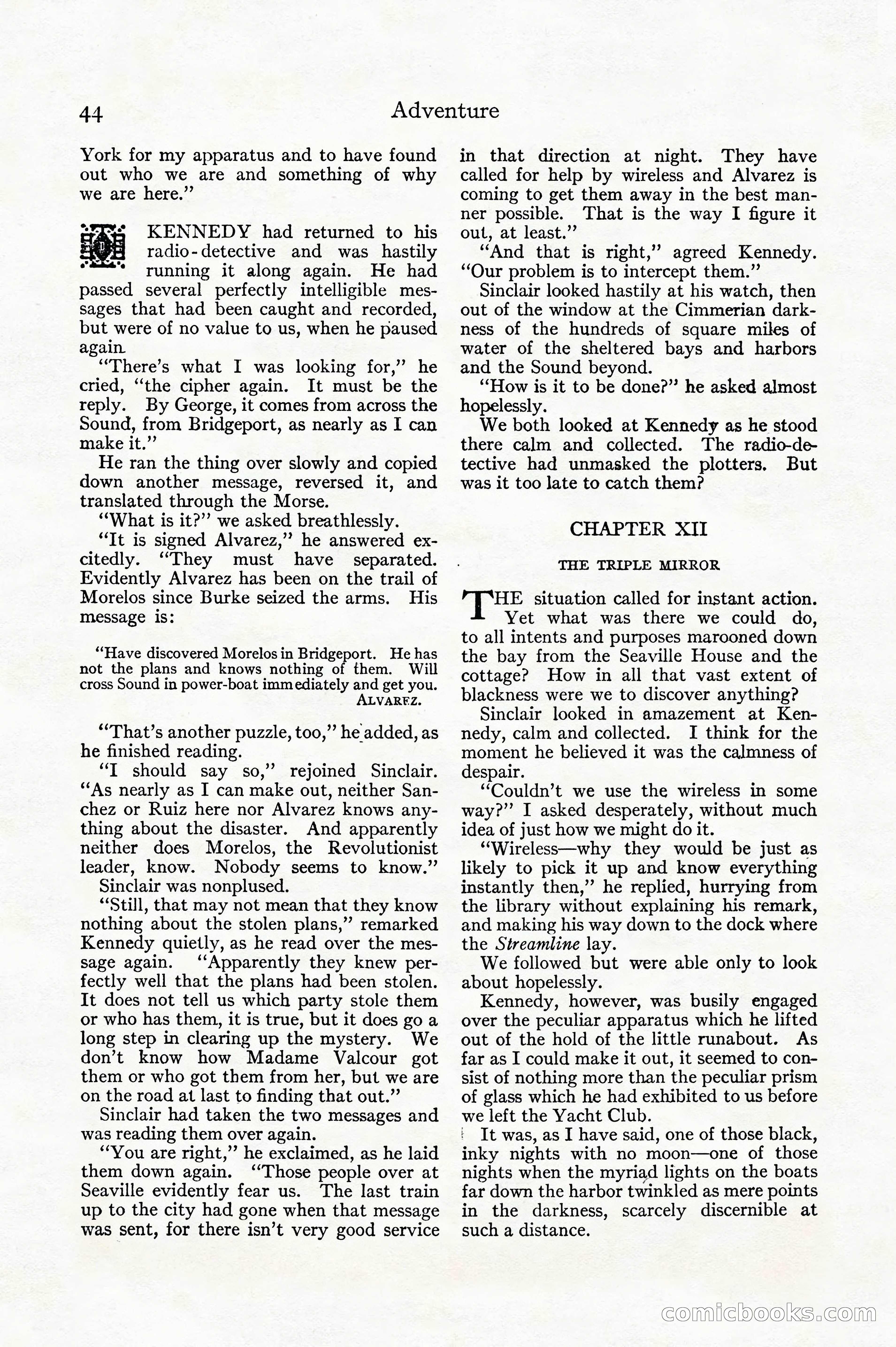
A restored page from Pulp Fiction, 1914. Page through the whole issue in the reader above.
📄 Transcribed text from this page (OCR, searchable)
Machine-transcribed from the original scan — historical spelling and the odd misread are preserved.
44 York for my apparatus and to have found out who we are and something of why we are here.”’ KENNEDY had returned to his radio-detective and was hastily running it along again. He had passed several perfectly intelligible mes- sages that had been caught and recorded, but were of no value to us, when he paused again “‘There’s what I was looking for,’ he cried, “‘the cipher again. It must be the reply. By George, it comes from across the Sound, from Bridgeport, as nearly as I can make it.” He ran the thing over slowly and copied down another message, reversed it, and translated through the Morse. ‘“‘What is it?’’ we asked breathlessly. “It is signed Alvarez,” he answered ex- citedly. “They must have separated. Evidently Alvarez has been on the trail of Morelos since Burke seized the arms. His message is: “Have discovered Morelos in Bridgeport. He has not the plans and knows nothing of them. Will cross Sound in power-boat immediately and get you. ALVAREZ. “‘That’s another puzzle, too,” he added, as he finished reading. “IT should say so,” rejoined Sinclair. ‘As nearly as I can make out, neither San- chez or Ruiz here nor Alvarez knows any- thing about the disaster. And apparently neither does Morelos, the Revolutionist leader, know. Nobody seems to know.”’ Sinclair was nonplused. “Still, that may not mean that they know nothing about the stolen plans,” remarked Kennedy quietly, as he read over the mes- sage again. “Apparently they knew per- fectly well that the plans had been stolen. It does not tell us which party stole them or who has them, it is true, but it does go a long step in clearing up the mystery. We don’t know how Madame Valcour got them or who got them from her, but we are on the road at last to finding that out.” Sinclair had taken the two messages and was reading them over again. “You are right,”’ he exclaimed, as he laid them down again. “Those people over at Seaville evidently fear us. The last train up to the city had gone when that message was sent, for there isn’t very good service Adventure in that direction at night. They have called for help by wireless and Alvarez is coming to get them away in the best man- ner possible. That is the way I figure it out, at least.” ‘And that is right,’ agreed Kennedy. “Our problem is to intercept them.” Sinclair looked hastily at his watch, then out of the window at the Cimmerian dark- ness of the hundreds of square miles of water of the sheltered bays and harbors and the Sound beyond. ‘“‘How is it to be done?” he asked almost hopelessly. We both looked at Kennedy as he stood there calm and collected. The radio-de- tective had unmasked the plotters. But was it too late to catch them? CHAPTER XII THE TRIPLE MIRROR HE situation called for instant action. Yet what was there we could do, to all intents and purposes marooned down the bay from the Seaville House and the cottage? How in all that vast extent of blackness were we to discover anything? Sinclair looked in amazement at Ken- nedy, calm and collected. I think for the moment he believed it was the calmness of despair. “‘Couldn’t we use the wireless in some way?’’ I asked desperately, without much idea of just how we might do it. ‘‘Wireless—why they would be just as likely to pick it up and know everything instantly then,” he replied, hurrying from the library without explaining his remark, and making his way down to the dock where the Streamline lay. We followed but were able only to look about hopelessly. Kennedy, however, was busily engaged over the peculiar apparatus which he lifted out of the hold of the little runabout. As far as I could make it out, it seemed to con- sist of nothing more than the peculiar prism of glass which he had exhibited to us before we left the Yacht Club. ' It was, as I have said, one of those black, inky nights with no moon—one of those nights when the myriad lights on the boats far down the harbor twinkled as mere points in the darkness, scarcely discernible at such a distance. MICLOOOK C©